Chasing Bunnies in Don’t Starve Together
You must already know the path to walk it.

When I was courting (and being courted by) my now-wife, we spent nine months long distance. Being on opposite coasts couldn't stop us from connecting through the world of Don't Starve Together. Through wolf attacks and bitter winters, our encampment grew in fits and starts as we became accustomed to the rhythm of the game. It has become “our game,” and once a year, most years, we return and start anew. In San Francisco, it was rainy November or gloomy June. Now in Denver, it's a trusty winter activity as snow shuts down the city and our social lives. Don't Starve Together is the game that has stood the test of time in my relationship with my wife, whose common refrain whenever I broach the topic of playing a new game is, “Why, when we could play Don't Starve?”
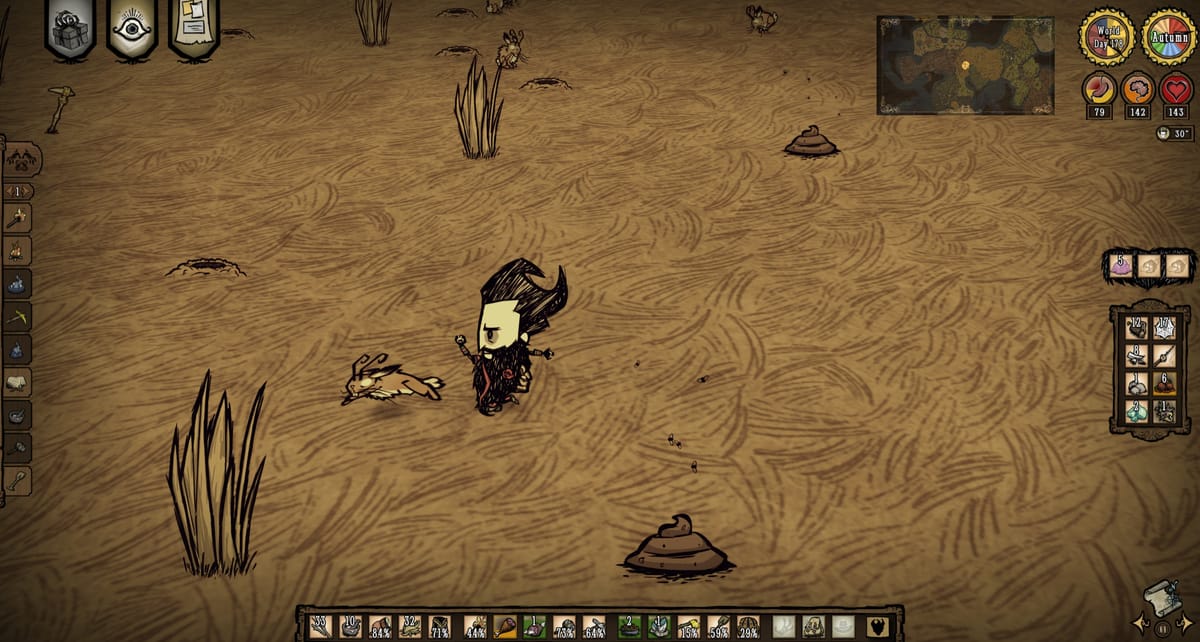
Klei Games’ Don’t Starve Together is the multiplayer-only version of Don’t Starve, a survival horror game where even the nightmares trying to murder you from inside your addled mind are kind of cuddly. Like many survival games, you are dropped into a terra nullius in which you must harness the elements to establish a home. The sinister nature of this cartoonish world is belied by the three gauges in the upper right corner: your heart, your stomach, and your mind. Your stomach gauge drains readily, signifying the march toward starvation. If it reaches zero, you lose health until you find food or die. To avoid this fate, do as the title of the game suggests: Don’t Starve.
Gathering food to refill your always-emptying tummy is just one of many competing priorities — neglect any of them, and be rewarded with an exciting new way to perish. Don’t Starve’s world, called the Constant, is not a value-neutral receptacle for resources, waiting to be exploited. Rather, it is explicitly arrayed against you. Simply existing in it inflicts a steady drain on your sanity, and as your grip on reality withers, the shadow creatures which nibble at your peripheral vision gain substance and the very real ability to hurt you. Nighttime is rapidly lethal. The seasons themselves each pose a mortal danger that requires preparation to withstand, ranging from frostbite to sun stroke to apocalyptic swarms of killer frogs raining from the sky. All of this suffering is filtered through an adorable art style, and even the pain of your character is heartbreakingly cute-ified by the musical tonality of their not-quite speech.
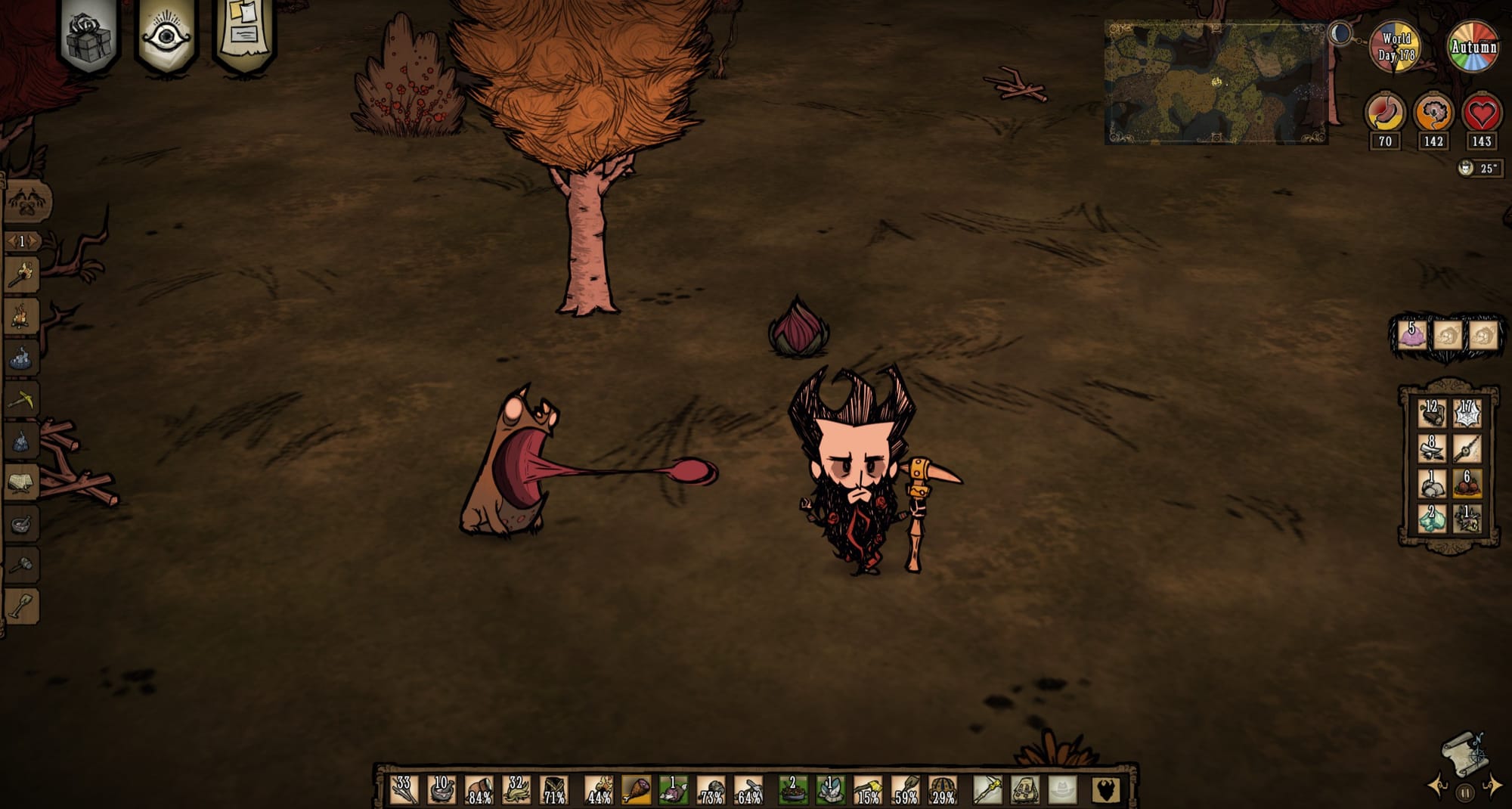
The point is not just to survive the Constant, but to bend it to your will, and this requires ingenuity. There is a surface-level gameplay loop, which consists of personally gathering the resources you need to Not Starve. This involves a lot of picking berries and chasing rabbits around, which I find perpetually enjoyable. But if you want to explore more of the game, you have to make your days more efficient. Rather than hunting individual bunnies, start a colony of bunnymen, fence them in, and farm them for meat as needed. Instead of cutting down trees yourself, anger a giant badger and use its scything swings to fell a forest all at once. Freed from toil, your days will open up, and this is when the real game begins.
This next part of the game is so deep as to be fathomless. Moreover, it is as wide as it is deep. My wife and I have spent many hours just pursuing a single track of content as far as we can, while leaving entire swaths of the game untouched. Collectively we have over a thousand hours logged, yet we have never reached true endgame content. Partly, this is because there is a joy in starting from scratch each winter. If we were to boot up last year's game, chances are we couldn't remember what we were working toward. It feels like walking into your home after a long period away — familiar yet alien. Someone has rearranged the furniture, and that someone is you.
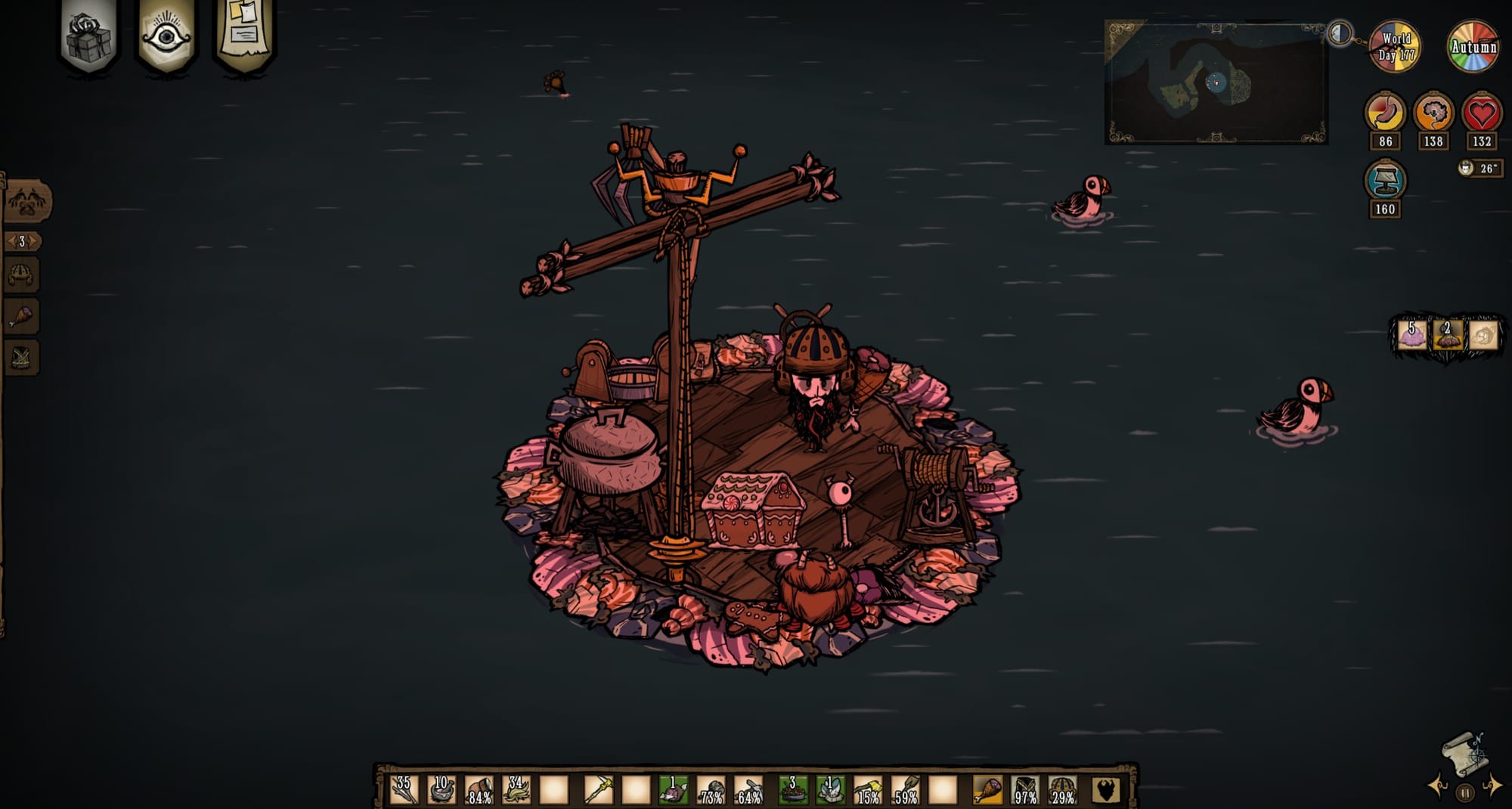
But the main reason we've never gotten far into the endgame is because that content is nigh-undiscoverable on its own. You must already know the path to walk it. Don't Starve Together’s endgame is not like the average live service game, a perpetual escalation of doing the same thing at harder difficulties to get the same weapons with better stats. Rather, there is an agglomeration of increasingly complex and interdependent objectives that require different tactics and resources. The game's texture changes as you go deeper. It is not unlike the experience of playing fellow survival crafting games like Terraria and Minecraft, but turned up to 11.
An example: there is a charming island with a cranky hermit crab living on it. To get there you have to research, build, and then sail a boat to the island — something that took us a couple playthroughs to get the hang of. Once there, you can earn the crab’s trust by bringing her specific items, which you need to source on the mainland and then sail over to her. The whole goal of this island is to get the crab’s pearl by becoming her friend, which is used to buff a boss, the Crab King. Why would you want to make the boss stronger? So he’ll drop the Inactive Celestial Tribute, which is used along with the Celestial Sanctum and Celestial Altar on the Lunar Island to generate Mysterious Energy. That is necessary for the Lunar Siphonator, which summons the Celestial Champion. Defeat it to obtain the Enlightened Crown, which is a very nice piece of headgear.
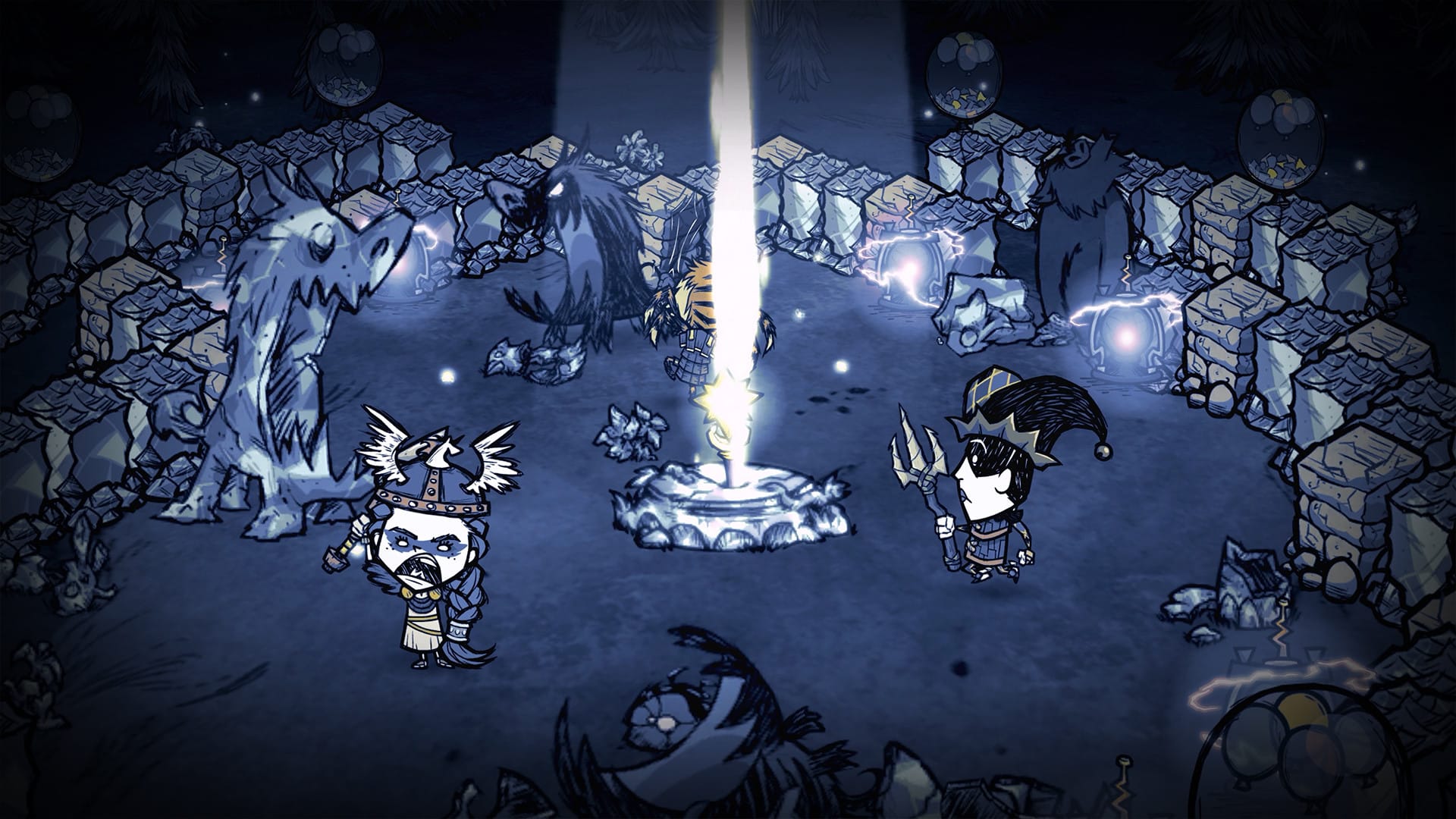
Does that sound like a lot? It is. How would anyone ever figure this out? I imagine discovering these secrets takes untold hours of experimentation. For the rest of us, there's a wiki. I had to open eight tabs from that wiki just to describe this chain of dependencies, which doesn’t even touch the steps to get the Sanctum and the Altar. Our collection of browser tabs expands exponentially through our annual foray, like cell growth propelled by the mitosis of ambition, as surely as our knowledge will be forgotten by the following winter, when we will have to open the same tabs to refresh our memories. We are admittedly not very skilled at our favorite game.
I’ve taken to calling games like this “wiki games.” It means any game where I wind up with a wiki open in the background so I know what the heck to do next. What is or isn’t a wiki game is a personal thing — what requires a wiki for me to get through might not be the same for you. A wiki game tends to have: 1) information density or obscurity which requires a lot of 2) time I don’t have, plus 3) choices which can be optimized for time efficiency. For all its efforts to make failure fun, I often consulted the wiki for Disco Elysium to plan my Thought Cabinet choices, since some of them fundamentally change the way the game is played while others are a waste of resources and — again — time. I am an avowed optimizer. I admit to being a bit defensive about this. This is the reality of loving and playing games in this season of my life, when the time I can give a game my undivided attention is truncated by the responsibilities I have taken on. I have a job, a child, and sometimes I like to go outside. In college I would skip classes to keep practicing trick shots with the missile launchers in Battlefield: Bad Company 2. I am more responsible in my middle-age, but I still want to experience games — for me they are the prime cultural touchstone that movies or music or books are for other people. I can no longer afford to give a game an unlimited amount of my time. This has shifted my taste in games toward shorter runtimes, or ease of putting them down. Don’t Starve Together is neither of these, but it is a damn good game, and it does have a good wiki, which I can consult to make my play more efficient.
Why then do we start a new world when we return to Don’t Starve Together after a hiatus, erasing our prior progress? It would be more efficient to pick up where we left off, with a well-established encampment and advanced tools. It would save us time we could spend getting closer to that endgame content. One reason is that it's difficult to drop back into the game after a time away and remember what we were working toward. Piecing together the story of a jumbled chest of random resources is its own toil — was this important, or junk? The other reason is that starting again is part of the fun of playing. The point of helping that cranky hermit crab isn't to get the Enlightened Crown 20 hours later, but just because there is joy to be found in assisting her, and learning her name is Pearl. She warms up to your character and begins giving you gifts, and that is the kind of cozy, simple reward that pairs well with a lazy snow day of play.
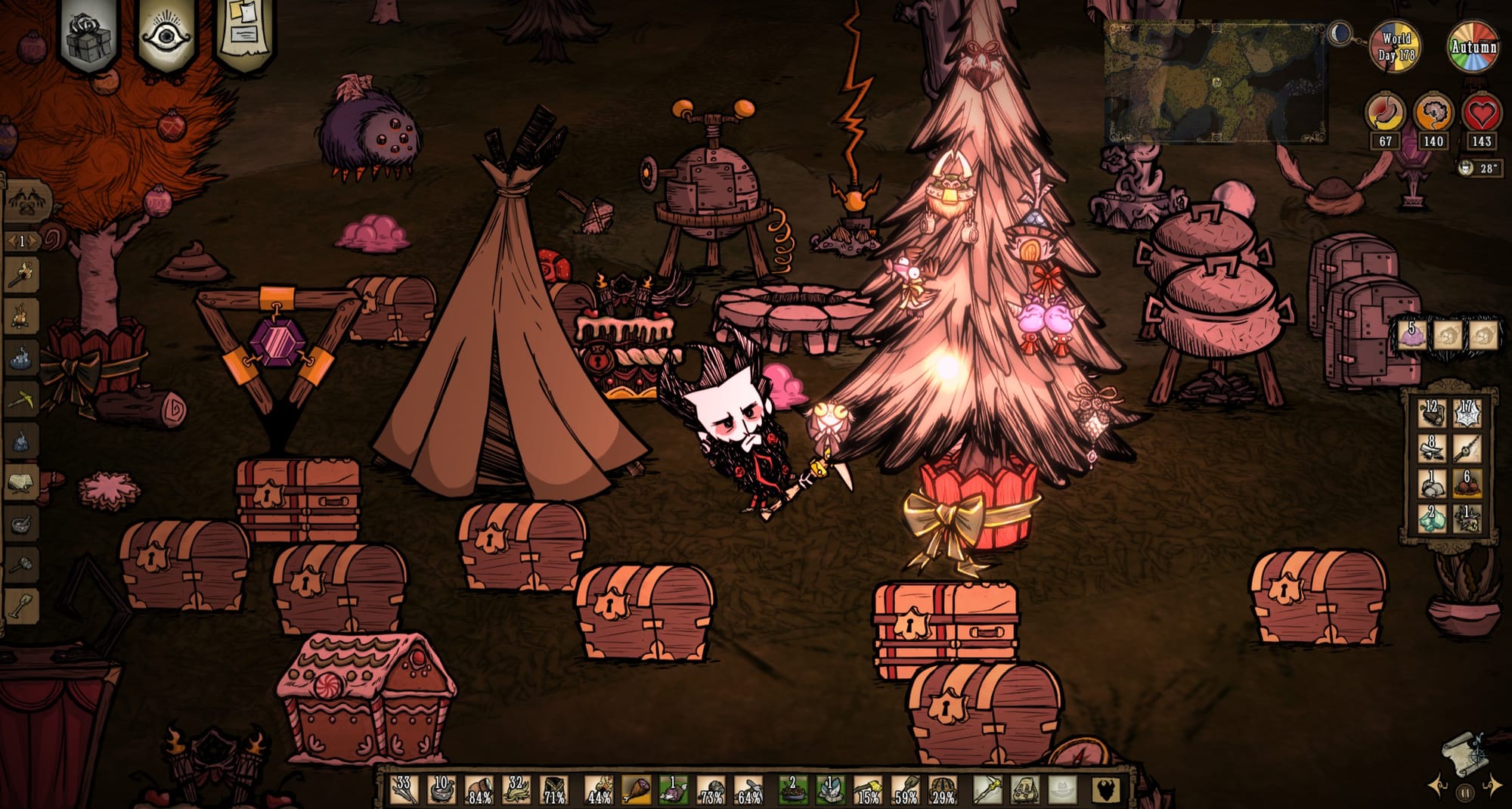
When you get close to a bunny in Don’t Starve Together, it shrieks and runs toward its burrow. If you have placed a trap in its path, it will be caught. It requires a bit of skill, and I'm pretty good at it now. It's a reliable source of meat to keep your character alive at the beginning of the game. It's immediately available. I consult no wiki pages on how to chase rabbits. It’s also not a very efficient way to harvest meat, compared to methods that become available later. Yet for me it’s one of the most evocative parts of Don't Starve Together, such that I’ll spend time chasing rabbits well past the point it “makes sense” for where we are in the game. It is ritual, and ritual need not be efficient, because life is not efficient, though the masters of shareholder capitalism might wish otherwise. I make pour-over coffee every morning; if I only valued time I would use a Keurig, or Nespresso, or instant. Instead, I stand at the counter in the dawn light, Kalita at the ready, while my child helps grind the beans — and there is no greater exercise in “inefficiency” than letting a child do something. But it’s about the ritual, and our relationship. One day I hope she’ll join me in making her own coffee, the same way I hope she’ll play Don't Starve Together with us in the wintertime. I’ll let her chase the rabbits, then. Or, I’ll join her in doing so.
The act of hitting “New Game” is a salve for how locked in the world can feel. We have always restarted our worlds, because it is ritual. Our lives are loops of ritualism, cycles ever repeating but shifting and evolving as our lives do. We do the same things, a little differently each time, and it is by these inches that the world turns and changes.
Elsewhere in this inaugural issue of Deleted Saves, Wallace Truesdale talks about a short game from his childhood he revisits regularly, and contrasts it with games which demand endless attention, such as World of Warcraft and Fortnite. Don't Starve Together will probably command some part of my attention forever, but it also commands attention differently than these games. Though Klei does add new characters and events to Don't Starve Together, it is not in a way that makes us feel like we have to play, unlike the breakneck pace that live service games use to invoke FOMO. We give it our time freely, instead of having it extracted from us by incentives. The wiki does not cost anything to use, except perhaps some small fragment of my sense of wonder. It is the free product of passionate individuals cataloguing everything about the game. “The Don't Starve Wiki is written and maintained by the players,” it proudly declares. I’m grateful for those players, because without their diligence I wouldn’t have been able to experience nearly as much of Don't Starve Together’s vast content. However, embracing the enjoyable inefficiencies of a game is the way I've found to rescue myself from the urge to optimize away its heart. Life’s inefficiencies, after all, are often its most enjoyable parts. In an age where optimization has been commodified into purchasable battle passes and XP boosters, it feels like reclamation to do something in a game just because it’s fun to do.