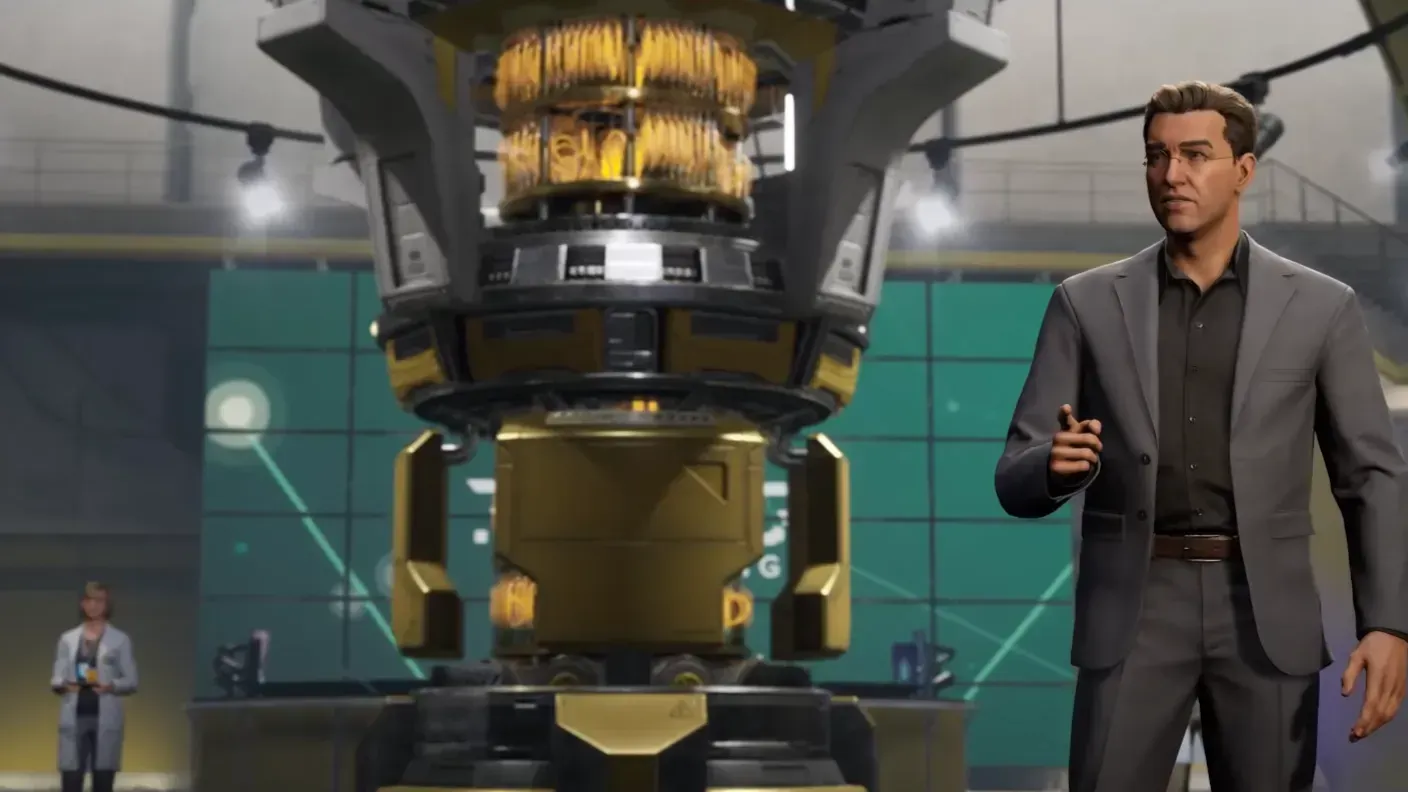
For a game about stories, the plot of Split Fiction isn’t really the point. The nature of the machine in which heroines Zoe and Mio wind up living out their creative ideas is less important than that it is the framing device for the variety of challenges and puzzles they must overcome. The cartoonish villainy of Rader is not meaningful beyond providing Zoe and Mio an antagonist. Yet, it is easy to look at the constituent parts–evil corporation, a machine that steals ideas from creatives–and conclude the game has a bone to pick with generative AI. It’s not surprising, then, that many onlookers have interpreted Split Fiction’s framing as a commentary on AI’s fraught relationship with creative industries like writing. To do the high school critical analysis thing, the villain is named Rader and he is quite literally raiding creatives for their ideas, just as large language models do. However, a key difference between contemporary AI and Rader’s machine is that while AI is given to hallucinate incorrect or entirely fabricated information, the machine (it’s never given a name beyond “my machine!” as said frequently by Rader) is able to render in life-like, experiential detail the creative thoughts of its subjects. It can even recreate old or partial ideas and bring them accurately to life. Given this, why bother stealing people’s ideas with this invention? Sell this experience and make a trillion dollars! One in every home! If you are committed to stealing people’s ideas for vague reasons of owning creativity, why bother with the ideas of unpublished freshman authors and not immediately cram the living canon into those floaty bubbles?
It is this unabashedly goofy framing, along with Rader’s comically one-dimensional villainy, his chronically understaffed hench-scientists that catch a conscience way past the point of being accessories to kidnapping, the stereotypically greedy board of directors that are super okay with this idea-piracy until it goes sideways, and so on, which makes Split Fiction’s style of storytelling a deeply unserious, campy one. It exists to justify an acid trip through a sci-fi and fantasy mashup that provides the backdrop for the teamwork-based puzzle solving on which Joseph Fares has staked a unique claim, following on the heels of previous hit It Takes Two. Given this unseriousness, it seems silly to conclude the story has something meaningful to say about the generative AI tools which are actively rewriting our access to information. For his part, Fares’ quotes on the subject leave much room for interpretation. In February, he told Video Games Chronicle that developers should “work with and not against” technologies like AI. In March, Inverse claimed he confirmed that the pods Zoe and Mio are forced into are a direct symbol for generative AI. However, the cited interview does not contain this quote directly, just that no generative AI was used in the creation of Split Fiction. Regardless, there are symbolic commonalities in what Rader’s machine signifies, and what conclusions AI skeptics are beginning to draw about how AI is changing our relationship with ourselves.
The idea of the “attention economy” is that the technological platforms which came to prominence in the past twenty-five years are designed to profit off of capturing people’s attention, and subsequently selling that attention to advertisers. In exchange, the platforms provide services such as navigation (Google Maps), entertainment (Netflix, TikTok), music (Spotify), and shopping (Amazon). These platforms have evolved into simulacra of marketplaces which charge rent for access to buyers, as Yanis Varoufakis writes in Technofeudalism. They can do this because they have achieved such control over access that it is difficult to operate a business without them. Similarly, users have become so dependent on the services provided that we are similarly compelled to use them. This is because we offload our cognitive functions onto the platforms, which atrophies our ability to independently exercise them. We have already seen how Google Maps has made people (myself included) worse at navigating. Economics commentator Kyla Scanlon has recently suggested this “attention economy” is shifting toward a “simulation economy”, where the next tranche of cognitive functions to be offloaded to for-profit platforms is to the ability to research, critically think, and create. This, she writes, is being driven by AI: “AI is the newest terrain in a decades-long race to eliminate all forms of cognitive resistance — to build the most complete, most seamless, most profitable mind-melder that follows you across platforms, logs your preferences, and gently nudges you toward products, perspectives, or more recently, policies.”
Rader’s machine is this frictionlessness applied to the creative process. No more slaving over the right words, the ideas are just transmuted out of your head into a personal virtual reality. I came to see Rader’s machine as a representation of that “venture capital funded frictionless cognitive offloading” of creativity to a magical machine which can virtually create whatever we can imagine, without the hard work and the friction of making something real out of an idea. As we have outsourced our cognitive functions to algorithms and platforms, so too are we offloading our creativity to the black box of AI, which promises to eliminate yet another source of friction in our lives. Rader’s machine and AI both promise the same easy path.
In the real world, there is friction between us and accessing our creative ideas. Now, the friction of meaningful work is competing with more frictionless distractions for our time. Exhausted from the friction of existing in the real world, we tell ourselves we deserve these breaks from the drain of modern existence. We take some time to scroll on social media and make tongue in cheek jokes about “revenge time,” staying up too late in order to reclaim ownership over our time. Our entertainment platforms do not just provide access, but recommendations that meet our tastes: the right song, the right video, the right game. Games are a large competitor in the attention economy, and platforms like Steam provide more than access. They take the brainpower out of finding the right game, anticipating our desires before we are even aware of them. When I log onto Steam, the first thing I see is not the games I already own, but the store page, with a list of games for sale specially curated for me. Often, it is spot on. Our desires are not only anticipated, but come pre-influenced. Eventually they merge, and our desires and the influences upon them become indistinguishable. During his tenure as Valve’s chief economist, this is a relationship that Varoufakis helped lay the foundation for, though he now expresses regret at the commoditization of it.
We find our time squeezed by the friction of the world. Crumbling infrastructure and supercommutes sap our time. Stagnating wages require us to work more to afford the increasing cost of food, a car, and a place to live. This squeeze produces a market demand for an easier path, a way to offload the hard parts and recognize the goal sooner. The same companies which have productized our attention and stolen our time have already sold us back time-savings in the form of recommendations for music, games, and movies we will like. Now they promise to save even more of our time with AI. Make art faster, research topics faster, write faster. Have the ideas teleported out of your head, rendered in full detail on the screen in front of you, like Rader’s machine does. In the competitive market for our attention, a machine which promises frictionless access to our creativity stands a better chance against similarly frictionless diversions. Rader’s machine would do well in this marketplace. We outsource the skill to the machine, so we can forget it. It is this forgetting that is the invisible cost of the machine, for we risk forgetting that we don’t own the machine. By inches, the machine comes to own us. AI promises to remove the hard work of being creative, neglecting to recognize that the friction of hard work is what makes something satisfying to do.
It’s interesting that Scanlon frames this shift in terms of “friction”, for games essayist Tim Rogers also obsessed over friction in his writing about games. For him, friction was what made games feel good to play, an essential component. So, for us to be talking about removing friction in a different context makes me think about how frictionless games are also becoming. The latest release of Call of Duty, Black Ops 6 revealed its “omnimovement” system, making it possible to sprint, slide, and dive in any direction with no conservation of momentum. Complete nonsense movement, but also completely frictionless. This was lauded as an improvement to the popular game. Friction to payment is constantly being eliminated in microtransaction-funded models, as it becomes ever more seamless to buy a new weapon, or a limited edition cosmetic skin. Scanlon and Roger’s understanding of friction comes from different places, but here it begins to coincide, as the coefficient of friction increases in the real world–the work required to buy a house or pay off student debt–rises, the attractiveness of frictionless digital entertainment as a substitute for effort also increases.
In a counterpoint to the frictionlessness of modern gaming, and that of Rader’s machine, the actual play of Split Fiction is loaded with satisfying friction. This mostly comes through the collision of movement and level design that defines Split Fiction’s best moments. Driving a cyberpunk motorcycle up a ramp to shoot downwards into a boss’ weakpoint. Spelunking hundreds of feet down into a nightclub thudding with Gustaf Grefberg’s house beats. Plunging through the air in wingsuits as walls of water tower over a hovertrain zipping underneath. It’s no coincidence that these peak moments live within Mio’s sci-fi stories, which are more kinetic and combat heavier, while Zoe’s levels have a slower burn. Zoe’s best level, aside from the pig level obviously, is one where she embodies the geometry of the level and must manipulate it so Mio can navigate through, flipping the idea of the “level” in a puzzle platformer from the obstacle that must be overcome, to the tool that enables the overcoming.
Split Fiction relentlessly changes up the perspective, movement, and actions available for solving its levels. It frequently does the puzzle-game thing where a mechanic is introduced at the beginning of the level and then expanded upon with increasing complexity. However, just as often whole mechanics will be introduced for a short segment and then discarded. It feels like a game meant to maximize the variety of ways to interact with its world, regardless of staying power. The exception is that there is always a grappling hook, as grappling hooks objectively make any game more fun. Interspersed throughout are references to other games: the ironic rooster caw replacing the iconic Assassin’s Creed hawk cry when diving from a great height into a pile of hay. Hiding in a box, like Solid Snake. The best moments go beyond video game reference humor and explore the absurdity of co-op games, the inherent friction built into relying on another player for your success. The best of these is when Mio is racing a cyberpunk motorcycle that is about to explode through the towering city of her imagination, dodging enemy fire while Zoe clutches to her back and has to disarm the bike’s self-destruct through an impossible series of captchas and terms and conditions. Ultimately the inevitable happens, and while our heroes survive, there is no way to get through all the authentication screens in time before the bike explodes. But in this moment, winning isn’t the point, rather it’s dying of laughter with the person physically next to you at the absurdity of the moment. This moment is peak friction; the digital world provides an insurmountable task that brings you closer to those you share the real world with. In this moment, there is no frictionless digital alternative that proposes an easier path. In a time where video games have ever streamlined the player’s path to the dopamine hit that keeps them playing, removing their reliance on other players or even removing the very obstacles of the game, this is how Split Fiction taps into the joy of doing something difficult. This is the kind of thing that gets us playing with, and talking to, each other again.