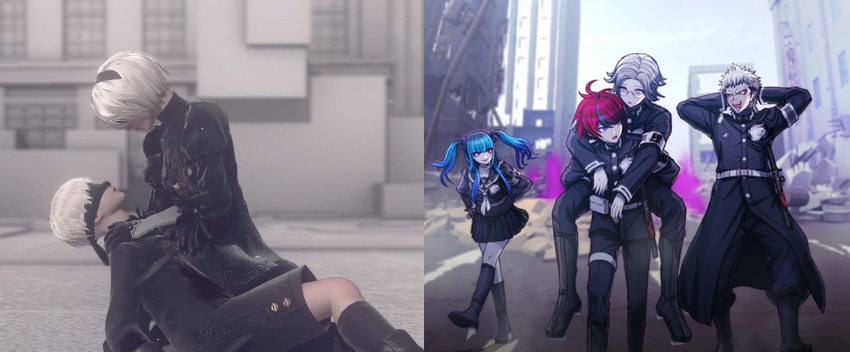
This text contains full spoilers for The Hundred Line: Last Defense Academy and Nier: Automata. Reader discretion is advised.
For those in the know, The Hundred Line: Last Defense Academy was the talk of the town in 2025. The brainchild of adored murder mystery game writers Kazutaka Kodaka (Danganronpa) and Kotaro Uchikoshi (Zero Escape), this visual novel/tactical RPG hybrid boasts a 30-hour prologue and, from it, delves ever deeper into a grand homage of the visual novel genre, dividing itself in 100 unique endings (with minimal fluff) across 22 routes, each with its own tone and focus. The main thing, though, is that no matter what story’s being told, the background is always the same: you’re a conscripted teenage soldier forced to fight for “the future,” which can mean a lot of different things depending on the route.
Nier: Automata is no slouch, either. The culmination of Yoko Taro’s work doesn’t take quite as long to truly get going, but it’s similarly marked by a slow start of some 10 to 15 hours before things really begin to go off the rails (it doesn’t help that “Ending A” isn’t really the end, which the game does warn you about, but I’ve seen several people drop it forever right then out of boredom). While this game is also known for a large volume of different conclusions, the “full experience” can be encapsulated by three playthroughs: one that's heavily battle-focused and relatively low on narrative content; a recapitulation of the story with added context; and, all that established, the definitive, land-razing conclusion. There's also an alternate outcome for the main plot, a certain sidequest game-over geared toward existing fans, and 20 joke endings. Its other claim to fame among non-Nier series buffs — myself included — lies in the pessimistic existentialism it uses to speak of its truly doomed world, one that lives in the shadow of Man and as such is bound to make the exact same mistakes.
The two games are in open conversation at every moment. Kodaka’s famous “hope vs. despair” duality, which serves as the crux of Danganronpa and is also seen throughout The Hundred Line, is but an alternate description for Automata’s predominant theme: how to derive meaning from that which is meaningless. During the centerpiece moments of both games, our protagonists come to face with crushing truth after crushing truth at a brutal pace, constantly having to steady themselves in the face of their carefully crafted realities crumbling beneath them.
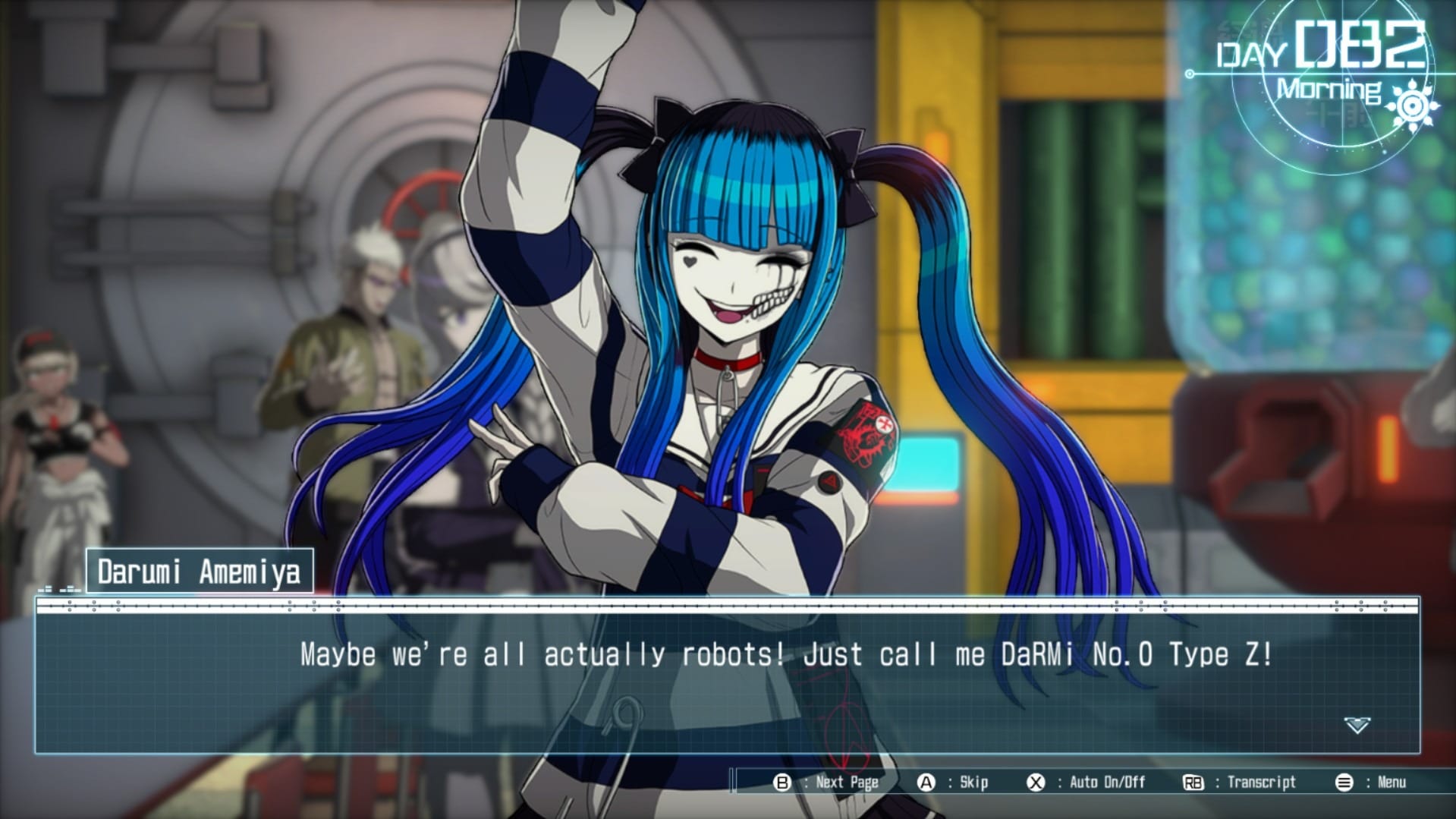
The setup is identical: in both games you play as a fixed number of battalion soldiers who fight one of several proxy wars of conquest for Planet Earth (the number of wars is even similar: 14 in Automata, 15 in The Hundred Line). The Hundred Line draws its combatants from a “high school” (it’s complicated), seeing the Special Defense Unit fend off creatures known simply as “school invaders”, while Automata’s fighters are based on an off-planet bunker, from which the YoRHa squadron of androids is pitted against a variety of automata named “machine lifeforms.”
Each game’s sets of enemies are presented as alien in nature, though they take on more and more humanlike qualities as the story progresses. Eventually, you’ll have to cross blades with specimens that look just like the “real thing” — even when they don’t, they’ll plead for mercy and avenge their fallen and call you a monster in a tongue you can fully understand — to the continued insistence of your higher-ups that it doesn’t matter. “There’s no actual meaning behind what machines do,” YoRHa No.9 Type S “9S,” the plucky Scanner boy whose degree of curiosity about the machines doesn’t extend to actually thinking of them as individuals, says like a mantra throughout the first act of Automata. Being a racist is quite literally programmed into his android brain, as it is for those of most anyone serving under the esoteric nihilists of YoRHa.
9S will later harshly criticize machinekind for being unable to develop past the legacy of the Earth they took, just blindly worshipping the remnants of Man, as though the androids — in their hunger for war and big heads about technological superiority — aren’t one and the same. Incurious workaholic YoRHa No.2 Type B “2B,” 9S’ field partner, opens the game by scornfully mentioning a “never-ending spiral of life and death.” The entire machinery that has made her existence possible endorses this spiral, a machinery she never once considers questioning. It’s just not in her nature.
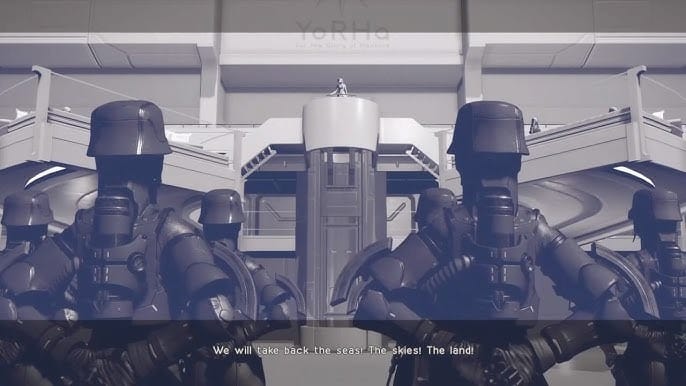
A military-sponsored unwillingness to learn is the driving force of war on both sides of the Automata conflict. The machines and androids alike serve extinct masters — aliens and humans, respectively — enacting a proxy war on behalf of the dead. The Red Girls, the face of the network that binds all machine lifeforms together, can only derive a reason for existence from war, following the last order given by the alien masters they’ve slain: “Defeat the enemy.” They act to prolong the conflict between the machines and androids for centuries on end, using it as a means to “evolve” just for the sake of wreaking even more effective destruction. While the machines at large are fascinated by humans, androids aren’t objects of interest to them — they’re “Scary. So… Kill,” as one machine encountered in the desert puts it. On its front, YoRHa, the machines’ necessary opponent, has fashioned recon units so effective they frequently find themselves before the truth of how staged it all is; it’s led to the development of an android line, the “B-types” (actually E, for Executioner) that exists solely to murder them and wipe their memories when it’s all laid bare.
This, we learn, is the exact kind of relationship 2B has to 9S. He searches and she destroys, an eternal cat-and-mouse game that has more than taken its toll on her psyche; the duo is a microcosm for the entire soullessness of the thing, violence for violence as the rule of beasts. The worst part is that, it turns out, 2B’s initial insistence on the “emotions are forbidden” YoRHa credo is nothing short of self-preservation. She’s tired of being charmed over and over again by 9S’ curiosity, just to have to punish him for it every time. Who was it that cursed a blade with the capability to feel?
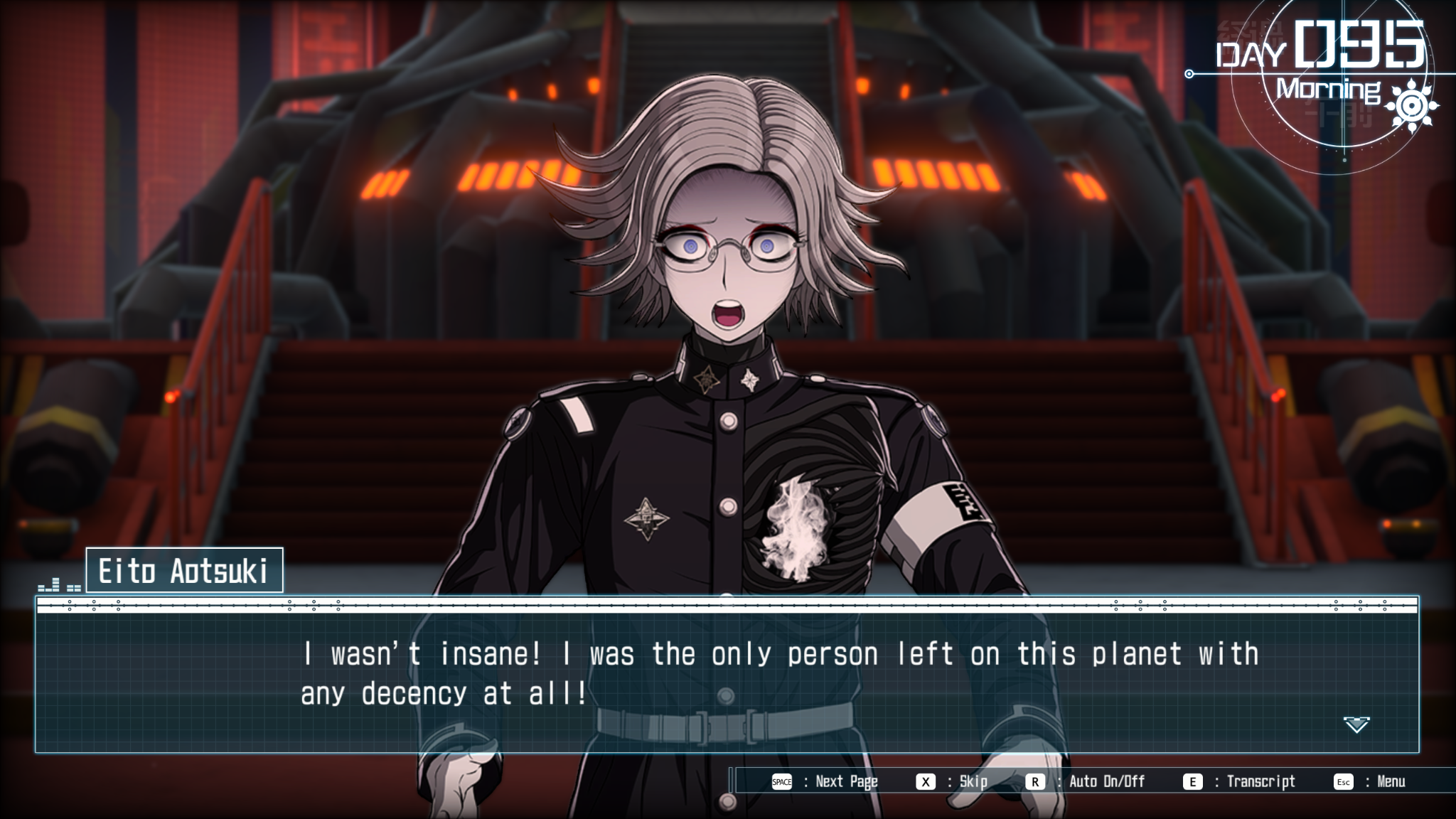
The Hundred Line sees much the same come to pass across its Second Scenario, the main artery from which most of the game’s alternate conclusions branch off, also referred to as the “Truth” — not “True” — Route by its author Kodaka. It all starts with a betrayal by one Eito Aotsuki, a young boy who backstabs his fellow child soldiers of the Special Defense Unit by committing several murders while proclaiming to have figured everything out.
After looping back to the past, teenage protagonist Takumi Sumino stops Eito from throwing his first spanner in the works of the war effort by preventing the execution of the SDU’s robo-commander Sirei. He chooses to spare the would-be saboteur, and ends up tipping off the now-caged Eito to the truth he supposedly discovered in the first 100 days (a.k.a. the First Scenario), but never revealed. In an impressive feat of determinism and/or stupidity, Takumi motivates Eito to break free from his command-issued cage and, instead of skulking about and performing little feats of treason like before, properly become an ally of the school invaders.
Over the course of the Second Scenario, the truth behind the war between the humans and school invaders is revealed: the identity of the “invaders” is the Futurans, who make up the native population of Futurum, the planet the SDU has been told is Earth. Futurum’s original sin was looking and behaving just like Earth, a prospective new home after mankind brought about the end of its own (“World Death”) and started temporarily living in the Artificial Satellite, a Moon-shaped space station not unlike a certain star of death.
Eito is what YoRHa never allowed 9S to be — the one who escaped the allegorical cave. Perhaps the biggest truth bomb in Second Scenario is that the entire SDU are homunculi made from stolen DNA of the Futurans, equipped with false memories and groomed to believe they belong to Earth. The humans’ best weapon to harness this supposed “land without a people” is one that shares the purportedly undeserving people’s super-powered blood (due to which no ordinary weapons work on their squad commanders).
However, it’s quietly implied Eito was planted as sabotage conducted by the Anti-Exodus Faction, a rebel human group seeking to stop the ongoing genocide of Futurans. His lab-grown backstory includes false memories of committing mass murder, and also has him grapple with an implanted cognitive disorder that makes him see all humans as monsters (which extends to his peers, despite their Futuran genes, but not the planet’s natives).
He may walk around with the Sovereign Army, the proper name for the Futurans’ war effort, and put on the evil advisor mask when speaking of Supreme Commander V’ehxness, touting her dictatorially self-absorbed rule of Futurum as the one true path, but his feelings radically change when all the hatred of Man in his heart is exposed as predetermined. It’s what makes him decide he can roll with the SDU after all, and all it takes is gouging his eyes out so he’s not haunted by how ugly his companions are to him. Eito wants belonging, no matter the group, and belonging he obtains — he is so caught up in his hate, his inner compass only points in a direction in which he stands as the savior of all. Implanted or not, his colonist upbringing may be to blame.
And so we have to ask: in the eyes of these games, is it impossible, after all, to build any sort of meaningful resistance to being placed as a pawn in a war of conquest? Is the establishment always poised to crush our meek efforts? Is bowing one’s head to doom — or ending yourself in disbelief, as an NPC machine does in Automata after coming to terms with its one-track existence — all there is to be done when you have the drive but lack the means?
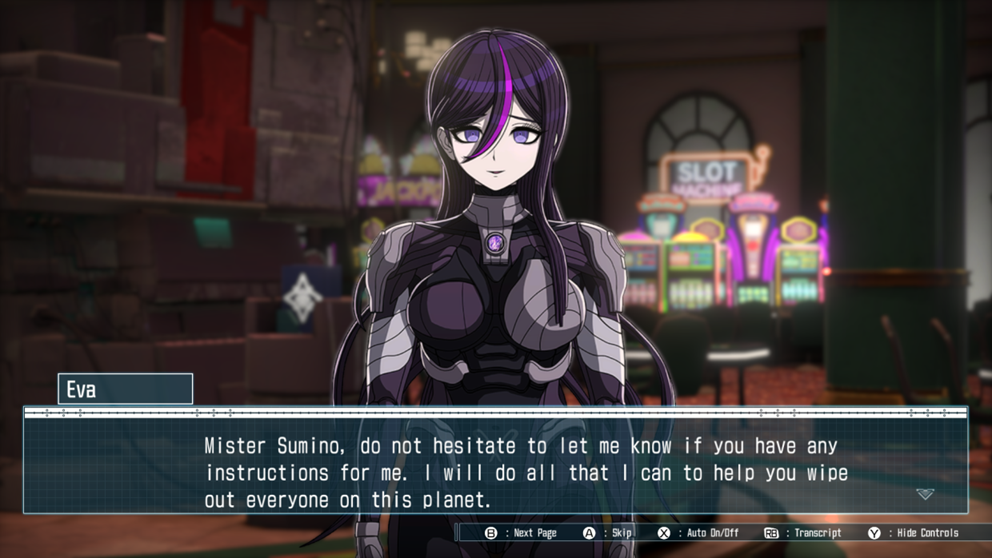
In several routes of The Hundred Line, your team may capture an enemy commander, who removes her custom-made war mask as a sign of respect and surrender to reveal unignorably humanoid features. The first time you do it, you don’t speak the same language, which naturally renders any sort of bond impossible; when you next loop, however, you are blessed with the ability to understand her tongue. It becomes clear that the prisoner, whose name is Eva, will accept any sort of humiliation — up to and including being brainwashed, abused, enslaved, sexually harassed, and wielded as a weapon against her own people — if it means she gets to stay alive, so that she may eventually reunite with her adopted daughter Kamyuhn.
The only story conclusion where the latter scenario comes to pass is one where Takumi enters a romantic relationship with Eva, an arrangement plagued by so many power imbalances on both sides, it can hardly be considered the perfect ending — in fact, no fates she can encounter are. All that her complete willingness to trade off her control of her own body for her continued existence nets for her is repeated abuse, almost never to reap the outcome she wishes for. For the ending Takumi canonically considers to be the “best” to come to be, brainwashing her thoroughly is considered absolutely necessary, even though most of us playing that route already know Eva to be an amiable, understanding person, who is capable of choosing to switch sides out of a hatred for the genocidal tendencies of V’ehxness, her older sister.
The closest Automata inches to a character like Eva is Pascal, leader of a village of machines who have untethered themselves from the network (as have a handful of other groups, but this is the only one to cherish peace as a clear value). Pascal has a working relationship with the Resistance Camp, an android community that predates YoRHa, but supports it. He does his best to peacefully coexist with androids, to assist defection efforts by fellow machines, and to pass on any human values of old, which he is fascinated by, to the never-growing children of his home.
Unfortunately, his obsession with humanity’s knowledge traps him in the same cycle of humanity’s folly — as happens, we learn, to several other machines. When, in his pursuit of wisdom, Pascal teaches fear to the village kids, it drives them to mass suicide the minute hostility knocks on the door; you can perform the mercy kill he comes to yearn for afterward, but you can also delete his memory (always synonymous with death in this universe) and have him sell you his people’s body parts, if you so wish.
Pascal diverges from Eva in a key factor: agency. His rebellion, unbeknownst to him, is a controlled experiment run by the Red Girls, who ensure that it’s doomed to fail. Despite his running of a community of like-minded beings, which in turn grants him the unity Eva’s lonely uprising lacks, it gets cannibalized in the end by a logic virus the Girls unleash upon the village after deciding they’d gotten all the information they could wring out of it. Peace is a cruelly tempting possibility dangled in front of our faces by the establishment, crushed before it can take root because the Enemy makes it so difficult.
Eva, on the other hand, goes AWOL on V’ehxness in every single story path out of her own free will. Yet she sees that agency she cherished violated by the SDU time and time again, since war propaganda has thoroughly convinced them she’s a dangerous monster not to be trusted; it’s all suffering with no reward. Even those who object to breaking her mind, such as self-hating pacifist Shouma Ginzaki, never do much of anything to stop it, just letting it wash over them as though it’s a reasonable thing to do. All’s fair in love and war, or so the adage goes.
You see, in both of these wars, pure nonviolence won’t cut it (even Pascal, the sweetest of machines, has to face this fact as he finally takes up arms before his village’s doom). Individualism, thinking yourself the only one who can break down the walls of war and nobody will ever grasp the truth like you, won’t cut it. Trying to retool a Goliath made only for destruction “from the inside” won’t cut it. Despair sure as hell won’t cut it either.
Do you know what will?
In the endings that see the complete end of the war in both Automata and The Hundred Line, there is only one solution. In the former, YoRHa and the Red Girls implode after respective machine and android meddling, the figurative and literal networks enforcing their forever struggle coming completely undone. In the latter, it’s not just about stopping V’ehxness’s militant, war–crimes–filled pursuit of godhood (and the routes that do content themselves with just that are not feel-good ones): the warmongers on the Artificial Satellite must have their plans foiled, be it by their soldiers turning on their planet-leveling strategy or, sometimes, the people they’ve tried to extinguish turning said plans right back on them. In a move dripping with metanarrative sarcasm, V’ehxness calls her Second Scenario missile strike on the fake Moon the “Bad Ending.”
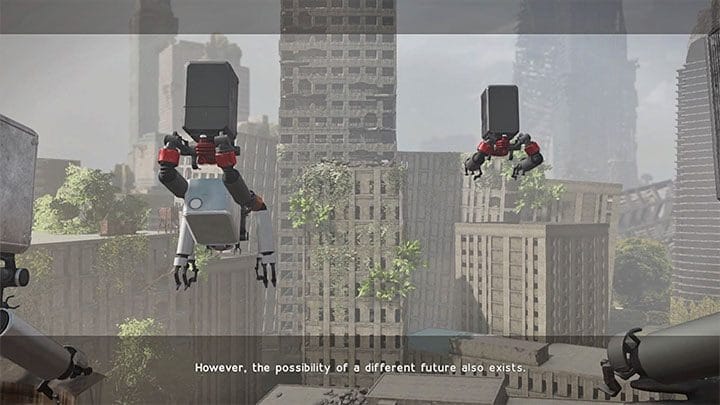
If you yearn for the end of strife, you must slash the evil that sustains it at the root. It’s true for the androids and machines, who can only reconstruct and be truly amiable with each other after nobody is left to drill war into their logic circuits (which are, turns out, made of the same stuff after all). It’s true for the SDU and Futurans; remarkably, the ending Takumi swears by being the “best outcome,” i.e. the one where all characters live (for his morality is pliable and he cares not for others as people, but as objects to protect), comes with a steep price. He and his squadron may have escaped an unrelenting time loop of senseless violence, but did so on the back of several atrocities — up to and including brainwashing Eva and Eito into complete obedience. Additionally, what remains unspoken is the knowledge that the Powers That Be will eat them all alive when they return to the Satellite with no genocide wrought.
There are some shades of “both sides” arguments, one may notice, that could be painted onto these conclusions. Everything must be leveled because V’ehxness is a genocidal maniac too, isn’t she? The Girls need YoRHa to do war, don’t they? Well, it’s true that the damage runs too deep for the slate not to necessitate a full wiping, but it would do well not to confuse cause and effect.
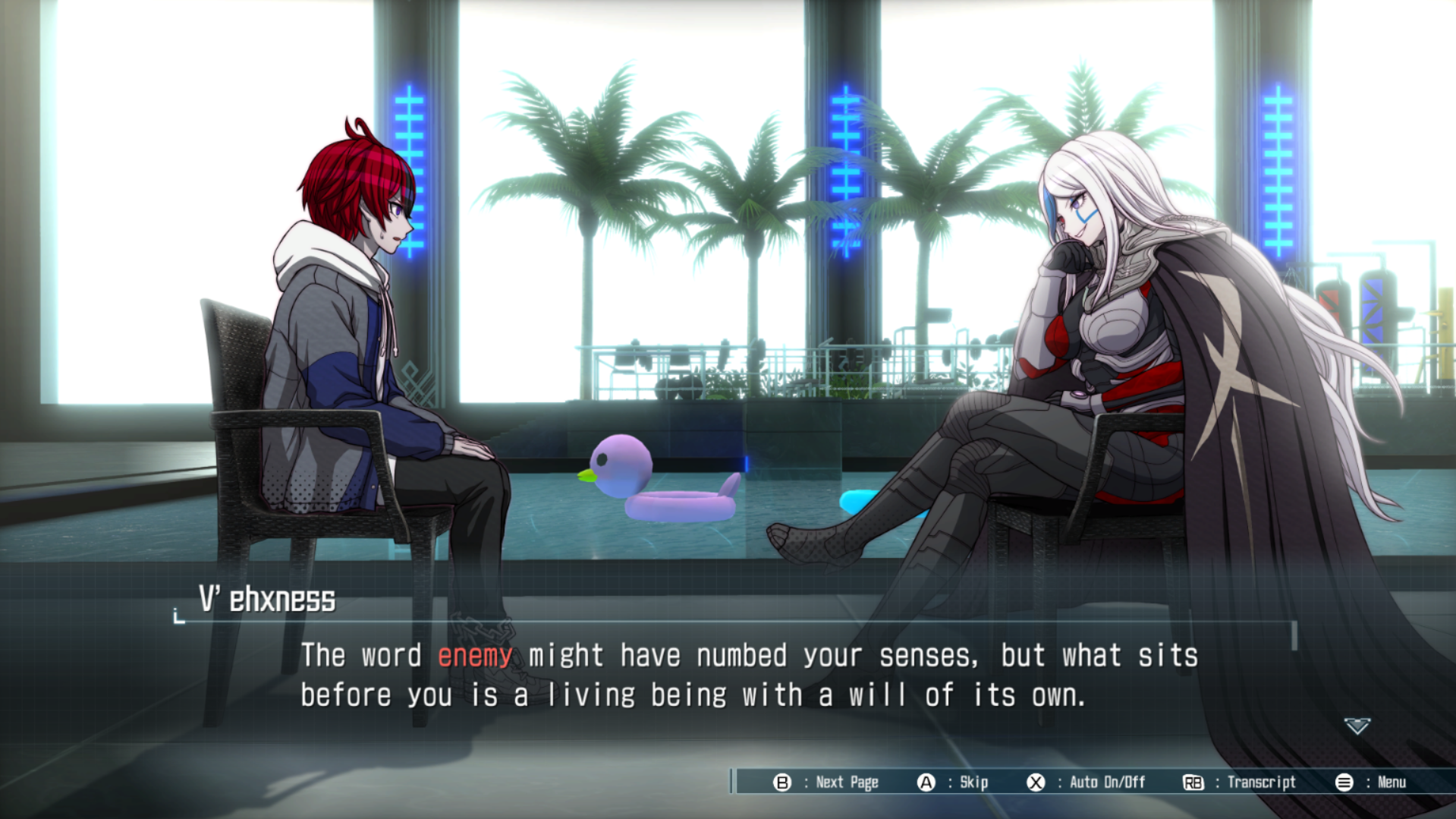
The Hundred Line is crystal clear at every turn: Takumi and co. are the direct fruit of a genocidal effort. The SDU’s existence in Futurum is a living reminder of humanity’s selfish cruelty, a group that not once considered a peaceful coexistence with the sentient species that, through the sinuous path of evolution, came to be almost exactly like them in form, culture, and physiology. When their bioweapons finally start longing for peace, there’s already an immovable army at their door, spearheaded by a woman who, by humanity’s own design, knows only war. Can anyone truly blame V’ehxness for growing obsessed with overpowering all that would dare claim her continued drawing of breath is blasphemous? All that she is — in her missile strike on innocents, in her grooming of 17-year-old Takumi at a certain juncture, in her repeated cannibalization of her own squad commanders — is the embodiment of the fascist rhetoric of “us vs. them” willed into being.
Automata, on its side, imbues that rhetoric into soldiers that have no idea they’re not helping anyone return to Earth, and are themselves made from repurposed machine lifeform cores, built using parts of their so-called enemies. Hatred is an artificial thing, here employed to give the Red Girls and YoRHa alike any semblance of meaning, self-destructive and lonely though it may be. It’s a senseless separation that serves only to keep their respective masses down, sustained by a web of lies which convince the androids that the machines are stupid, unreachable, fundamentally different creatures that could never hope to be like them.
Of the forced nature of racism, cartoonist Marjane Satrapi once said:
The world is not divided between East and West. You are American, I am Iranian, we don’t know each other, but we talk together and we understand each other perfectly. The difference between you and your government is much bigger than the difference between you and me. And the difference between me and my government is much bigger than the difference between me and you. And our governments are very much the same.
The two games share a single, radical argument: it’s not just that war is bad, it’s that war is a construction to maintain an unjust status quo. The structures that uphold colonialist thinking, be they racial superiority or national identity, are all fabrications, serving to defend some imagined utopian ideal, one reserved for only a certain group which “deserves” it. The greatest threat to this line of thinking is that we break down our walls, join hands, and claim that utopia for everyone. War is meant to divide, to prevent people from realizing their commonalities and common enemies. Though even the most hopeful endings of The Hundred Line and Automata come with steep costs, both games give players agency so that we can begin to let go of these lies and see that we are not so different from each other after all.