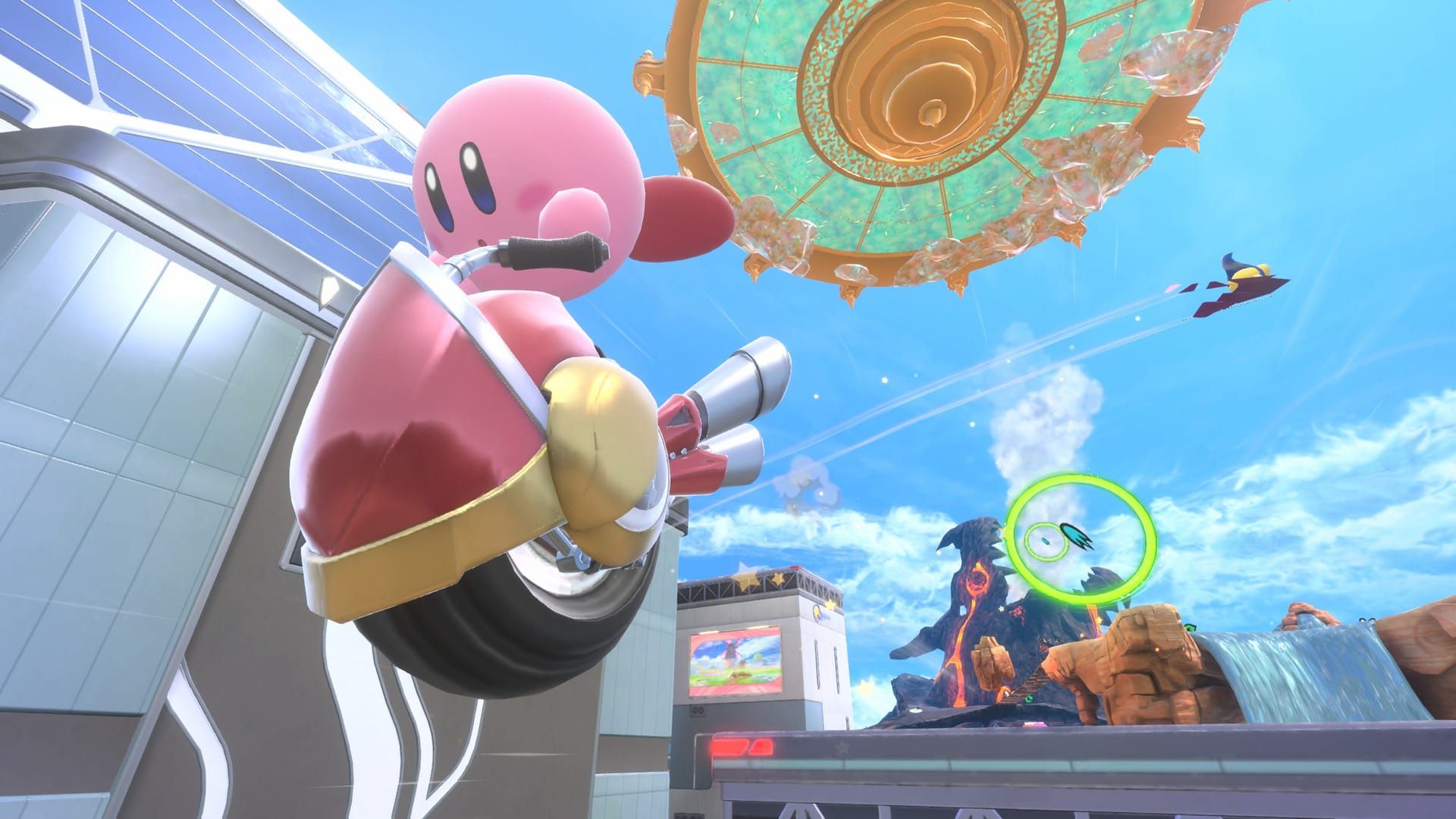
Editor's Note: Welcome to the first Checkpoints article! The Checkpoints concept is designed to highlight exceptional writing from contributors outside the cadence of Deleted Saves' quarterly issues. Below, Drew Byrd breaks down the physics of Kirby Air Riders and how it influences the revamped City Trial mode.
“Bigger is better” looms over video games like a specter. The medium’s publicity machine has long employed it as its guiding principle; with every new technological advancement comes a battery of advertisements promising the most sophisticated gaming experiences yet. Nintendo, despite its veneer of family-friendly simplicity, has danced with this specter more closely than ever in the last decade. Several of its venerable franchises — like Zelda, Metroid and Mario Kart — have crept toward the open-world model, terraformed into sprawling plateaus rife with hyperinflated currencies and inventories, and the infinite multiversal orgy that is Super Smash Bros. continues to enjoy a robust playerbase in both its casual and competitive scenes.
Masahiro Sakurai, director of the Super Smash Bros. games, Kirby’s debut in Kirby’s Dream Land, and five subsequent Kirby installments, has extensive hands-on experience iterating on franchises under Nintendo’s corporate demands. It is perhaps unsurprising that he used those skills to great effect when he returned to direct Kirby Air Riders, long-gestated sequel to the sleeper hit GameCube racing game Kirby Air Ride. Air Riders’ scope has, as one might expect, vastly increased — it features more maps, more characters, more customization options, and more modes of play. The most notable beneficiary of this boost in scope, however, is fan-favorite mode City Trial. In the original Air Ride, City Trial is a local competitive mode in which two to four players are placed in a large arena and given five minutes to find as many stat-increasing power-ups as possible, modifying their machines in preparation for a randomly-selected minigame that decides the victor. In Air Riders, City Trial has been expanded to include online play for up to sixteen participants, each blazing through a far larger arena in preparation for over 25 new events and 25 new minigames. What Air Riders gets little credit for, however, is the changes it makes to the underlying physics of City Trial, changes that convey an understanding of the ways gaming technology has progressed in the 23 years since the mode’s first appearance, and how that progression can be used to support racing game fundamentals.
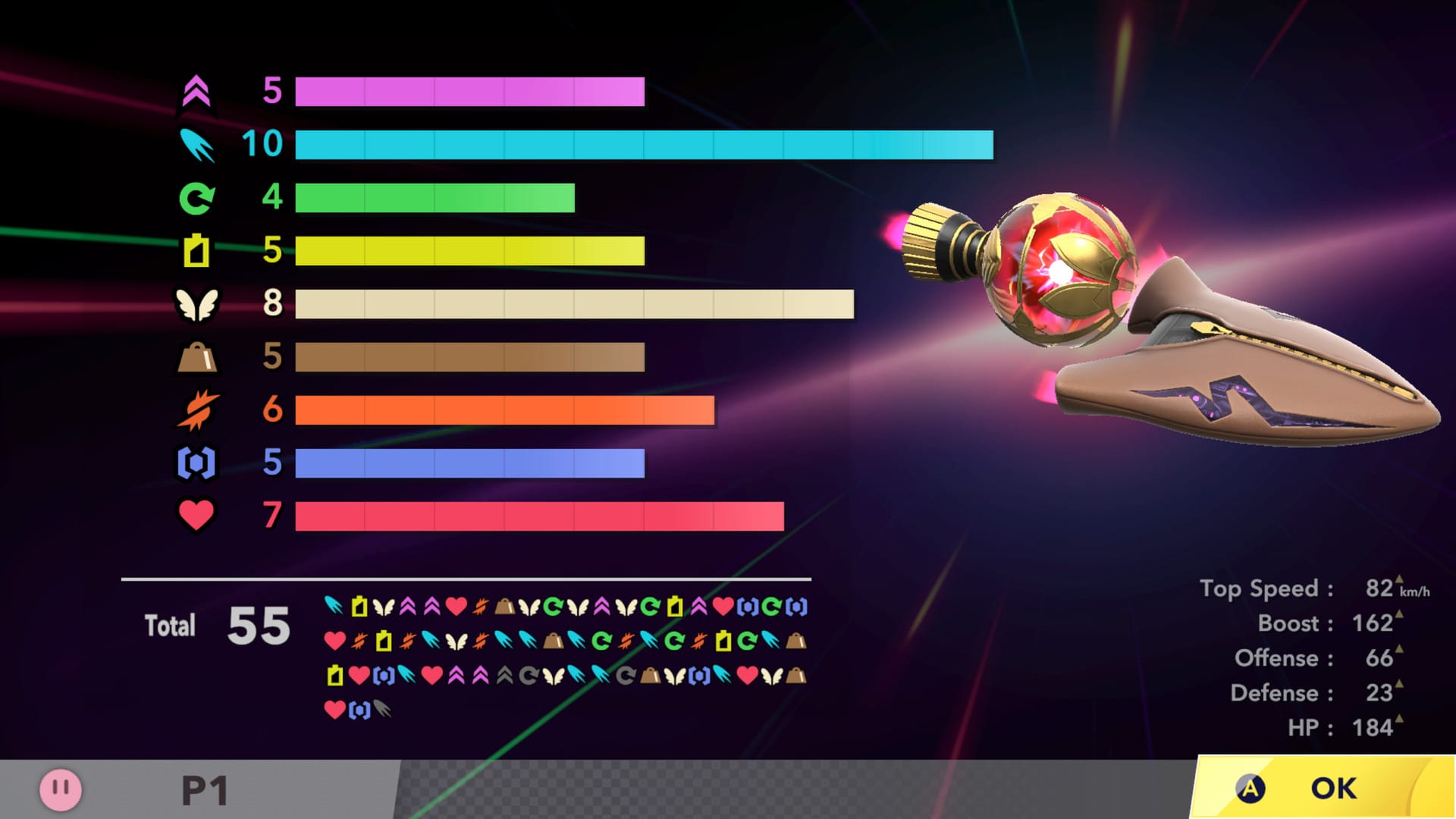
To change the physics of City Trial is to change City Trial itself, because the mode is so thoroughly dictated by the player’s constantly-evolving relationship with physics: it shapes your traversal through and presence within the arena, the interactions you have with other players, and the ultimate result of each session. All racing games have converged on similar methods to simulate physical principles, but few of them encourage persistent granular engagement with every single facet of those principles to the extent that the Air Ride series does in this mode. City Trial explicitly breaks down each physical property of your vehicle into scaling stat blocks — such as Top Speed, Weight, and Turn — and the power-ups you grab during a session enhance these properties. Once the session timer runs out, players choose one of four minigames with such objectives as defeating as many mobs as possible, gliding into a giant array of panels displaying scores, or straight-up drag racing. Rather than the first-to-the-finish white-knuckling of most racing games, the Air Ride games take every aspect of vehicular action into consideration as sites of competition.
If this all sounds a bit abstract, let’s consider a concrete example of how this stat-driven competition plays out through the physics of the game in the context of a head-on collision between two characters. In one corner of this clash, we have our hero himself, good old pink puffball Kirby. In the other, we have Kirby’s large hamster friend, Rick, straight from Kirby’s Dream Land 2.

Statistically, the two characters are quite different in multiple fields, but our primary focus for this example will be the discrepancy in their Weights. In classical mechanics, weight (or more specifically, mass) is the m part of the formula Ek=½mv2, which determines the kinetic energy (Ek) of an object in motion; the v represents speed, which is the magnitude of a moving object’s velocity. Kinetic energy is important to us in this example because when two objects collide, the result of the collision is dictated by each object’s kinetic energy. What happens when Kirby and Rick, two characters with different Weights using the same vehicle and traveling at the same speed, each with zero power-ups, collide into one another during a City Trial session?
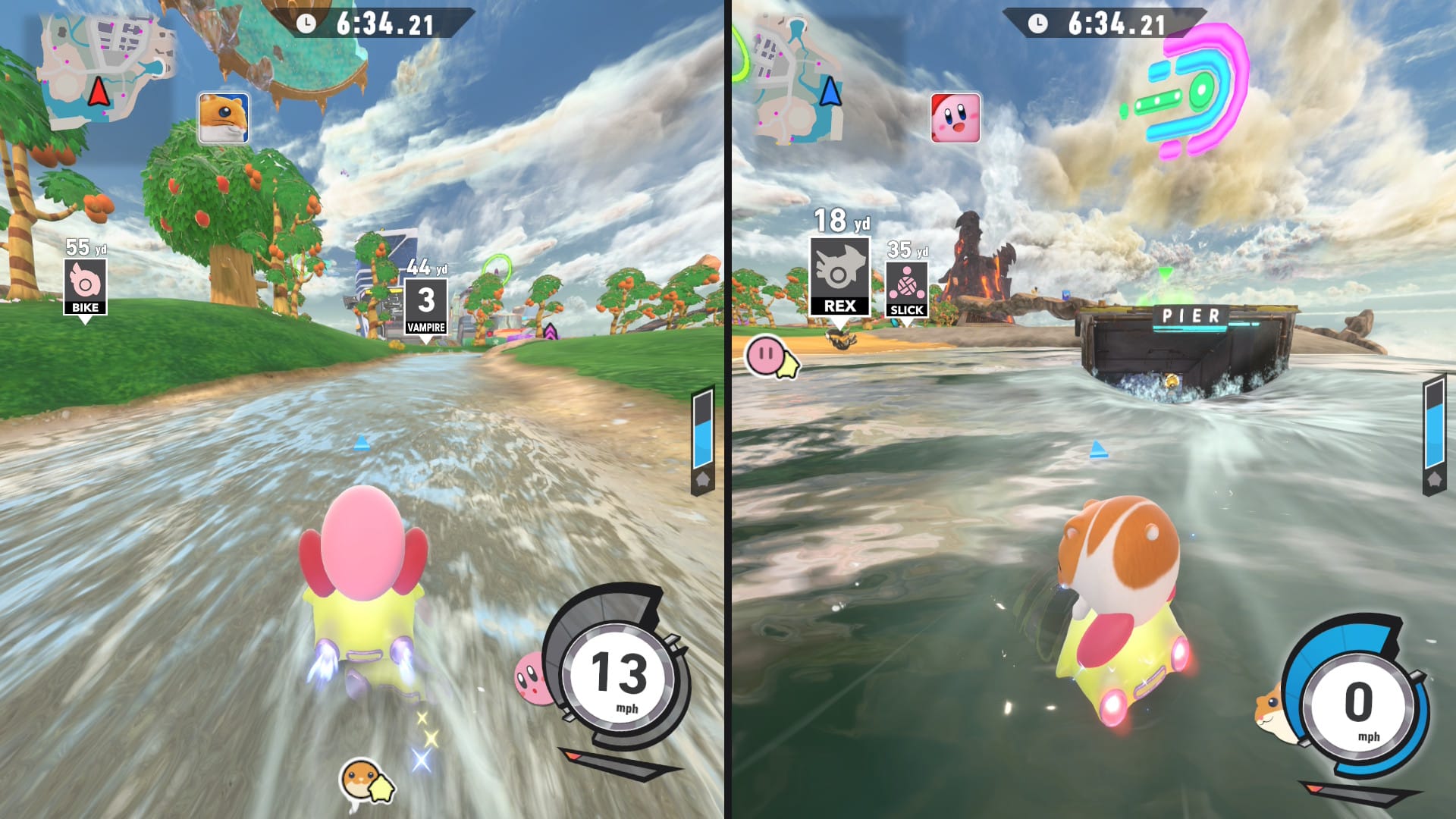
Presumably to preserve the game’s pace, player-to-player collisions in this game have a minimal impact on speed — in fact, landing a hit on an opponent causes you to briefly speed up. Weight’s role in these collisions is instead evaluated in total damage to each vehicle. As measured by the life bar on the right of each character’s UI, this is decidedly a defeat for Kirby. He loses about 40% of his HP in the clash, while Rick loses less than 30%. But what are the results when this same clash occurs after Kirby has accumulated three Weight power-ups?
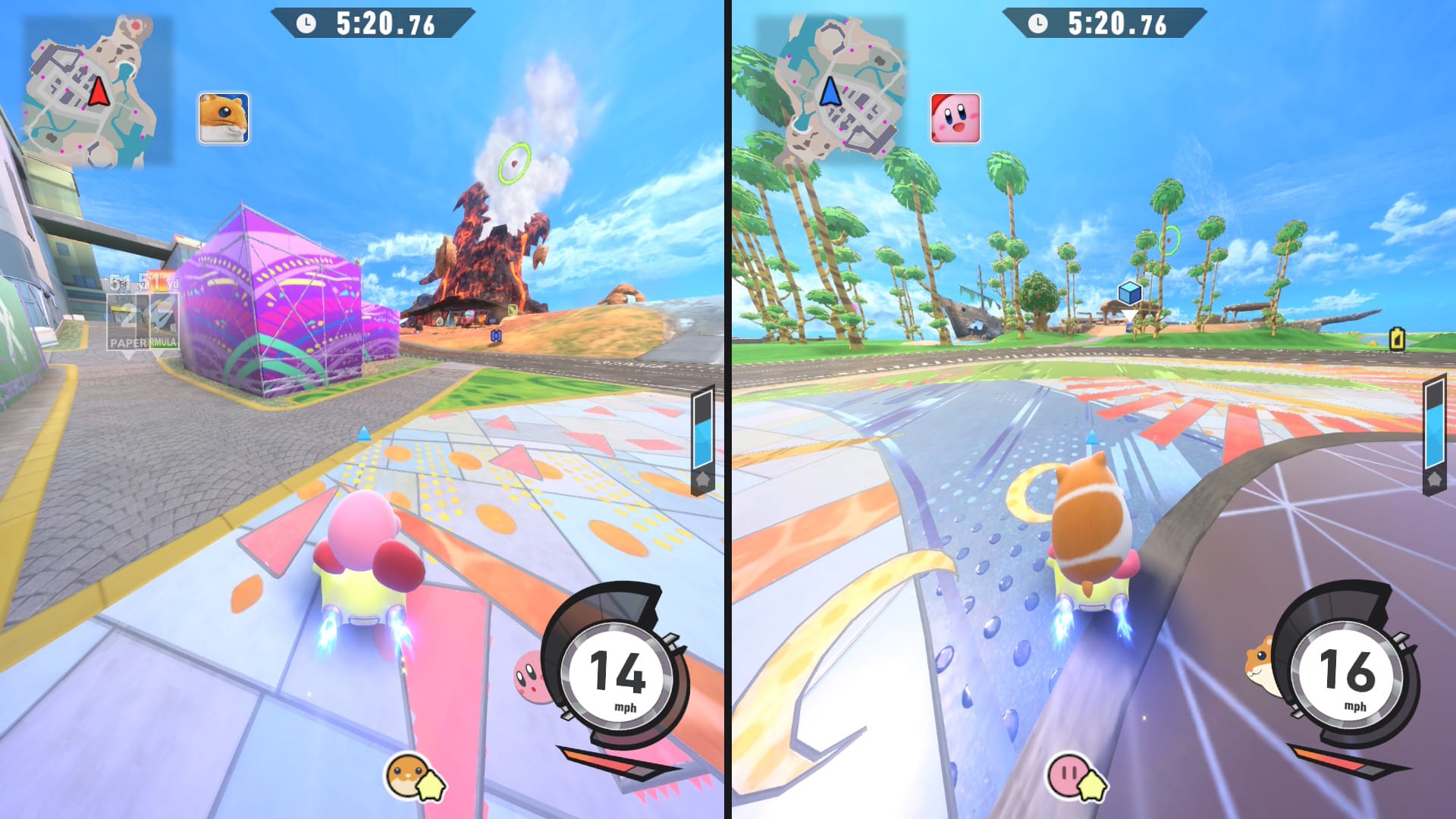
…or seven?
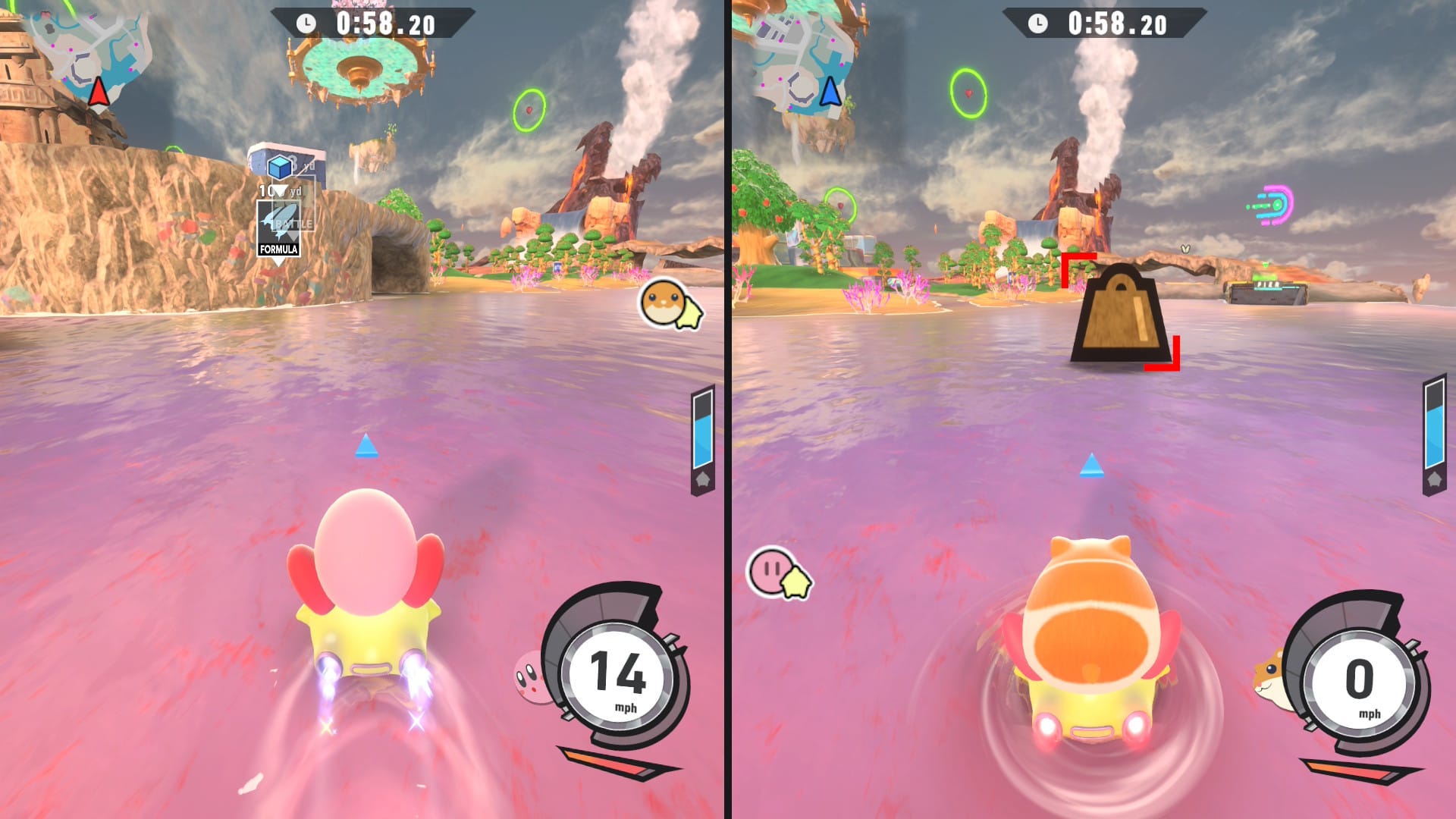
The differences are hard to see in the original screenshots, but become more visible when placed alongside one another:
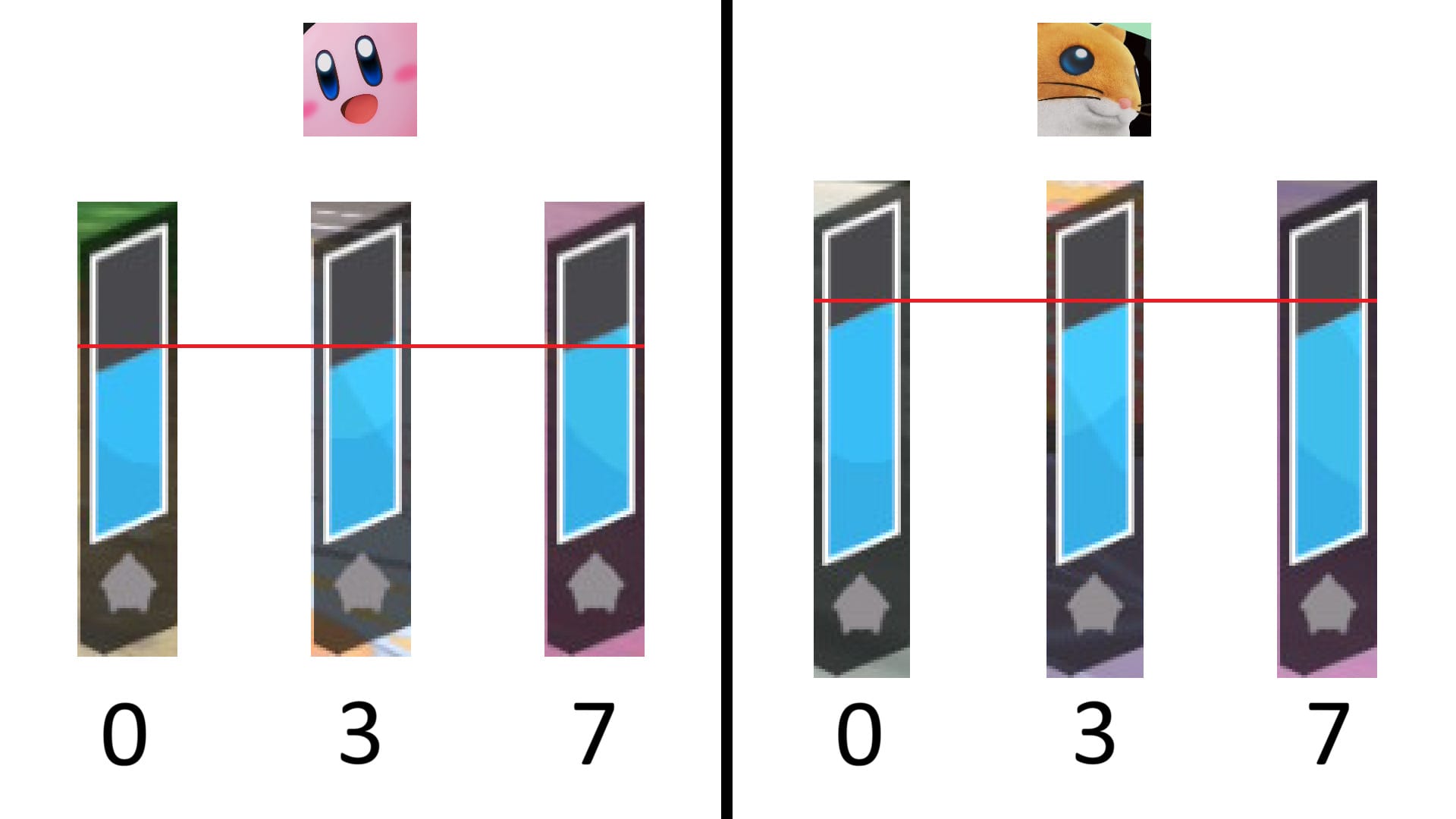
Although these may seem like fairly subtle increments, they represent the way that Air Riders’ adherence to the principles of kinetic energy affects the damage Kirby takes and receives. Furthermore, it’s important to remember that stats influence your performance, as well as each other, in unexpected ways. Beyond its role in determining damage, Weight applies additional physical principles that influence several other stats such as Top Speed and Turn, and is itself influenced by Glide, so most power-ups serve less as flat increases to certain parameters and more as dynamic modifications to each vehicle’s overall performance. One notable exception might emerge if Kirby pays no mind to any of these considerations and, desperate for hamster blood, picks up 10 Offense power-ups, which do nothing but increase the holder’s raw damage:
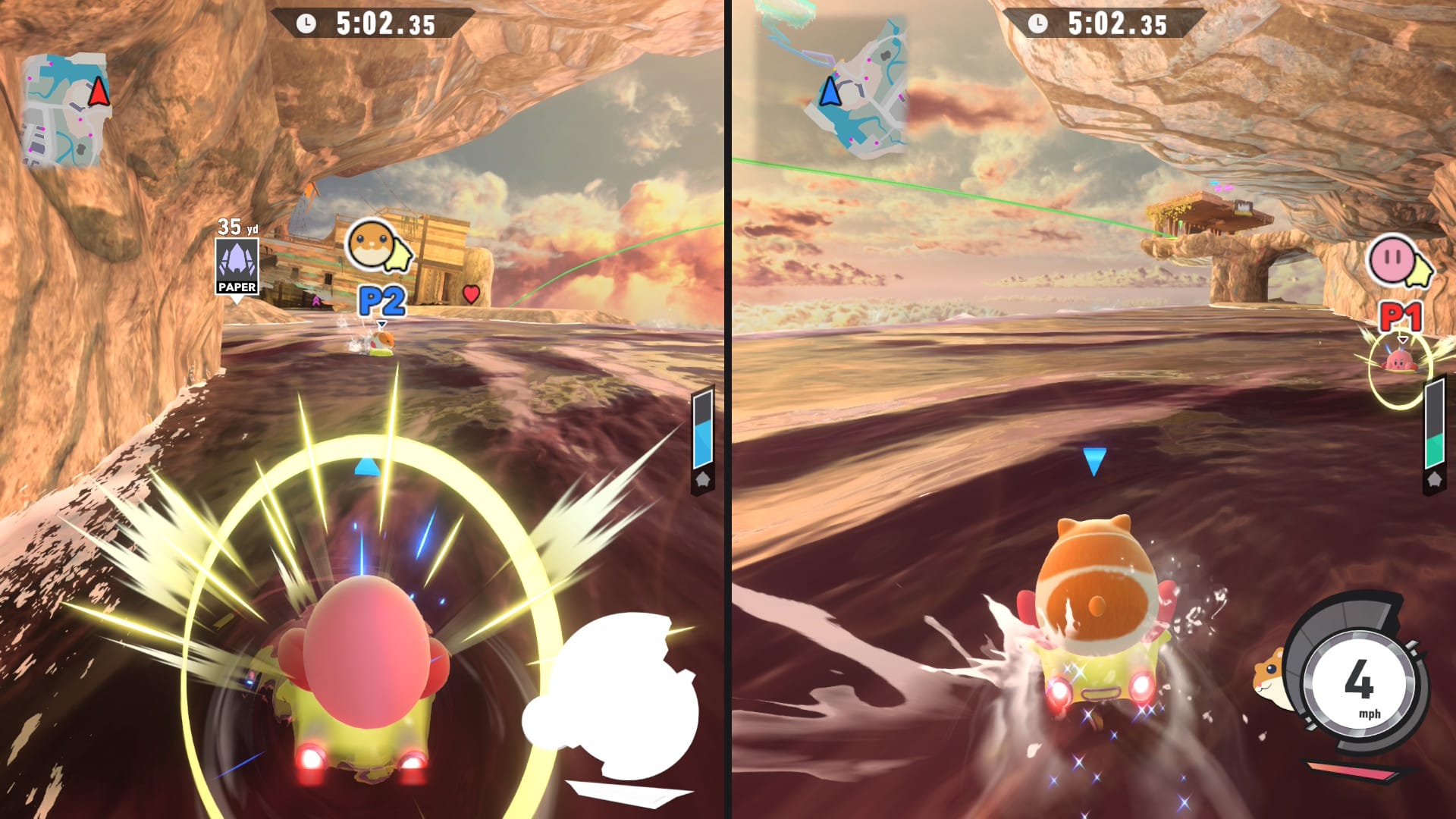
Kirby still loses a chunk of HP to Rick, but in return he knocks his opponent’s health down by two thirds.
Setting aside the joy of head-to-head carnage, Kirby isn’t limited to preparing himself for direct confrontation with Rick. If he’s been building up his Turn, he can maneuver around him, taking advantage of Rick’s comparatively poor handling. He can accumulate Top Speed to turn tail and run, but Rick is fast, so he’d need quite a bit of velocity to make his escape. If his stats are letting him down, he can also hop onto a sturdier or nimbler vehicle and change the terms of the clash that way.
There is an incredible diversity of physical interactions between players to be observed in Air Riders’ City Trial, all of them ultimately meant to highlight the mode’s magnified commitment to competitive rigor. Air Ride’s local co-op City Trial was exploratory, staged in a map more than big enough for four players, not quite solitary but not explicitly geared toward aggressive play. In contrast, Air Riders’ City Trial, especially online, is gladiatorial. You’ll rarely go more than a few seconds without seeing another rider; striking and vanquishing other riders causes them to drop more power-ups than the previous game; and weapons of considerable strength and range are plentiful. The mode’s increase in inter-player friction calls to mind another evolution of one Sakurai title into another: Super Smash Bros. for Nintendo 64 and Super Smash Bros. Melee for GameCube. Although Sakurai has stated repeatedly that these games were never meant to be competitive fighters, the substantial jump in mechanical complexity between the N64 installment and Melee led players to position Melee as exactly that.
In service of embracing a more competitive spirit, one of Air Riders’ chief design concerns as a sequel is increasing the number of ways for players to observe and engage with the enhanced sophistication of the game’s physical systems. Sakurai’s team achieves this by providing a higher volume of points at which these systems can be expressed. Some are obvious changes to the parameters of the possibility space: numerous events from the original City Trial appear in pluralized forms to accommodate the newly expanded player count, such as “a mysterious pillar” becoming “mysterious pillars” and “Tac” becoming “Tacs.” Events like these dispense power-ups in greater volume than their Air Ride counterparts, and reflect Air Riders’ new overall generosity with loot; it’s far more common to see one or more stats creep toward the cap of 19 here than it ever was in Air Ride. The abundance of power-ups signals a more accessible range of potential skill expression for players, and thus a widened breadth of what is physically possible within the game. Other changes are more subtle and skill-based, and require that returning players adjust their intuitive approach to City Trial. Many loot items, for instance, now disperse from the crates that contain them at a distance, angle, and speed relative to the force with which you smash into each container.
Finally and perhaps most significantly, there’s the retooling of the mode’s competitive structure itself. Allowing players to conclude the session by picking a minigame rather than dumping them all into the same one (except on the rare occasions in which it does, whereupon the player is notified before the match) gives them the opportunity to express their understanding of the vehicle they’ve chosen and the stats they’ve acquired with it. As previously described, these moments of physical articulation vary in scale and intensity, but effectively fulfill the same function, serving as points at which the player is invited to consider the relationship between the physical properties of their vehicle, their overarching goals for the session, and how different spaces within the game environment offer them different ways to tailor those properties and goals as they see fit. In this way, all of these points eventually flow toward the same destination: everything comes back to the friction between each participant, working within a physical system to produce superior results to those of their competitors.
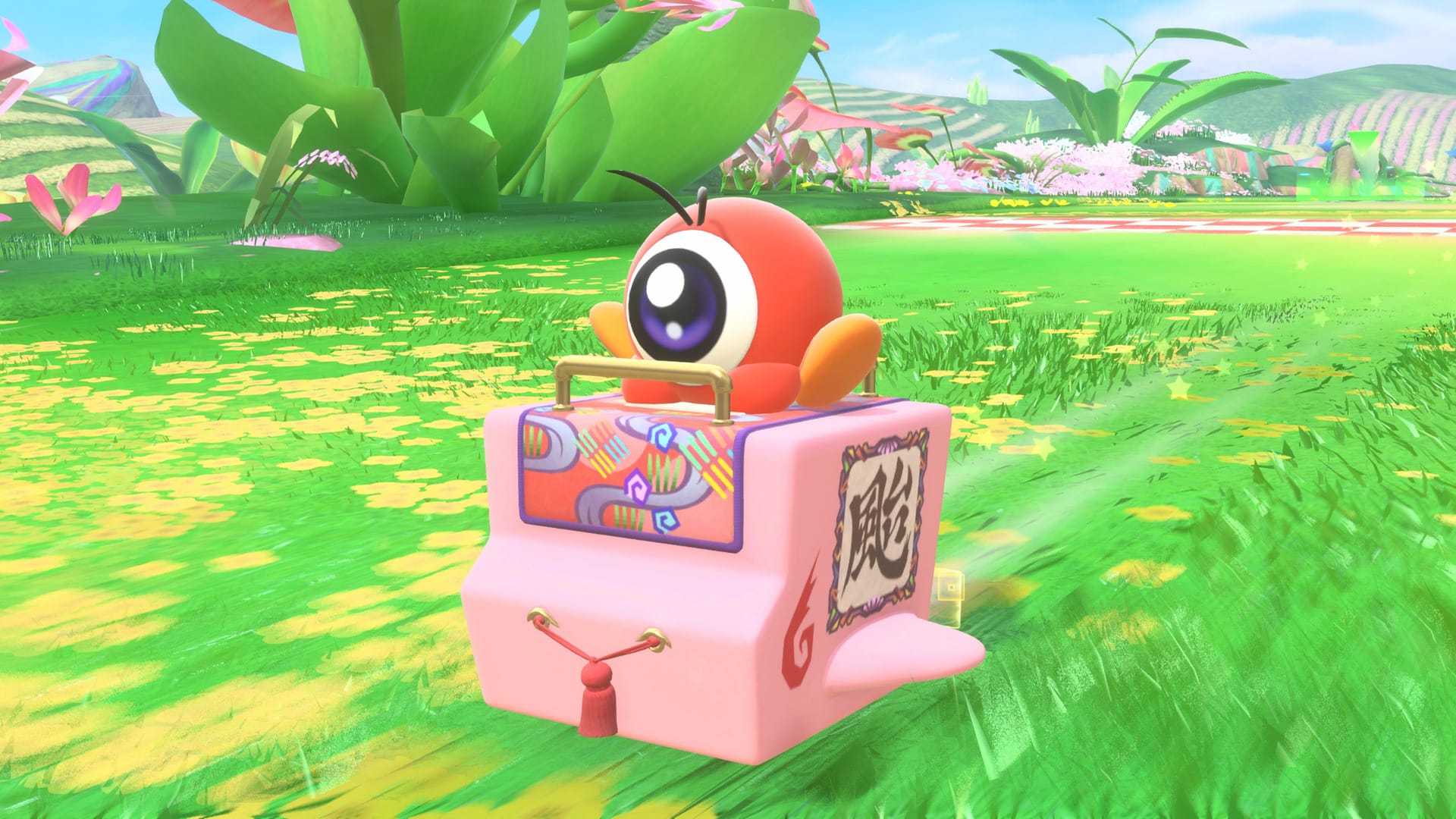
At first blush, it may seem a bit unusual that a game from the traditionally simple Kirby franchise demands such strict attention to mechanical detail, but Kirby himself is the perfect figurehead for this concept. He is defined by his malleability, literally shaping himself to the needs of whatever situation confronts him, and in the Air Ride games, rather than merely changing his powers, he changes his stats and vehicle to suit the situation as well. Thus, as he transforms, the physics of the game also transform; there has never been a more comprehensive realization of the character and what he stands for. As evidenced by the Kirby vs. Rick faceoff, Air Riders’ additional playable characters function as similar vectors for statistical expression based on their own unique properties: King Dedede is bulky, Marx is aerodynamic, and so on. They are further avenues by which to consider Air Riders’ interpretation of the Kirby universe as a set of aestheticized physical principles, and the increased weight of statistical input emphasizes the diversity in the colorful Kirby cast.
This is doubly true of the vehicles, or “stars.” In both games, each star feels radically different from the other, in ways that are intuitively apparent based on their appearance but are mechanically complex beyond the stats augmented by the power-ups. The true purpose of the stars is to provide a route for the player to make changes to their physical properties at the drop of a hat; if they’re on a Wagon Star and have received a hint that one of the courses will be a jumping contest, for instance, they may scramble to make a last-minute switch to a star with higher base Glide. Given the modularity enabled by instant star-switching, the role of the star in the Air Riders physics schema becomes clear: a star allows the player to play in a style of their choosing when paired with the static physical expressions of their character selection, while also giving them an avenue to spontaneously modify that style as necessary if the power-ups they collect (or don’t) during a session necessitate it.
All of this seemingly daunting attention to physical detail and the breakneck pace of City Trial sessions is belied by the simplicity of the control scheme, which has found an admirable match in the diminutive Joy-Con. The GameCube controller was comparatively more complex ergonomically, but Kirby Air Ride only required the control stick and the A button, minimizing the need for dexterity. Much to Sakurai’s chagrin, Air Riders adds Y button functionality for switching vehicles mid-flight, but the game is still played almost entirely with one control stick and one button. This speaks at large to Sakurai and his team’s intimate familiarity with the hardware at hand and the foreknowledge of the game they set out to make. While Air Ride was a step into new territory, Air Riders was developed with the benefit of over 20 years of hindsight. Informed by the technology of the past and the original title, the developers’ vision for the game they were making and the features it was capable of supporting was clearer than ever, allowing them to fully exploit the technological capabilities of the Nintendo Switch 2. Sakurai himself makes note of this in a series of development insight blogs about Air Riders, where he discusses the team’s changes to long-standing design orthodoxy when considering environment, vehicle, and accessibility design. These changes demonstrate the Air Riders team’s awareness of real physicality, as well as the player and the hardware they use, which facilitates adding new complexity to the game’s systems while recognizing that none of it requires more than a simple controller.
You don’t need an intricate control scheme when the game is perpetually urging you forward. You can stop moving, and you can turn around, but by design Air Riders always keeps you hurtling toward your next destination. To return to the physics underpinning the game, one might consider this an applied example of the least action principle, which states that a particle moving from one state to another will always take the trajectory that requires the smallest amount of action. It may seem fatuous to ascribe a rule governing real-world physics to the actions of the avatars in Air Riders, as the players controlling them are capable of error, but it does give us a vital clue as to how ideal play is conducted as a participant in City Trial. More than simply moving from Point A to Point B in the most efficient manner possible, the player is urged to traverse the map in a way that allows them to select and upgrade their vehicles in preparation for the final minigame, ideally so that they move from the “participant” to “victor” state before any other competitor. The player’s ongoing attempts to modify personal physical variables build upon one another, each discrete goal interlocking with and (ideally) facilitating the achievement of the next one, ultimately comprising an aggregate of successes and failures that is pitted against the other competitors’ patchwork vehicles in one final test of skill.
This might sound like a generalized way of describing any competitive game, but City Trial’s triumph is that it provides so many potential ways to build toward a victory state — go fast, grow strong, get thicc, glide infinitely, ravage your opponents until their stats are decimated, assemble a legendary vehicle — while offering multiple clear, easily-quantifiable paths to achieve various builds and making each one feel like a unique physical experience. That it remains so faithful to the core experience that Air Ride pioneered without overcomplicating its mechanics or controls exemplifies Sakurai and his team’s understanding of how to use technology and physics to deepen a system, rather than merely widening it with content or giving the same old game a new coat of AAA paint.
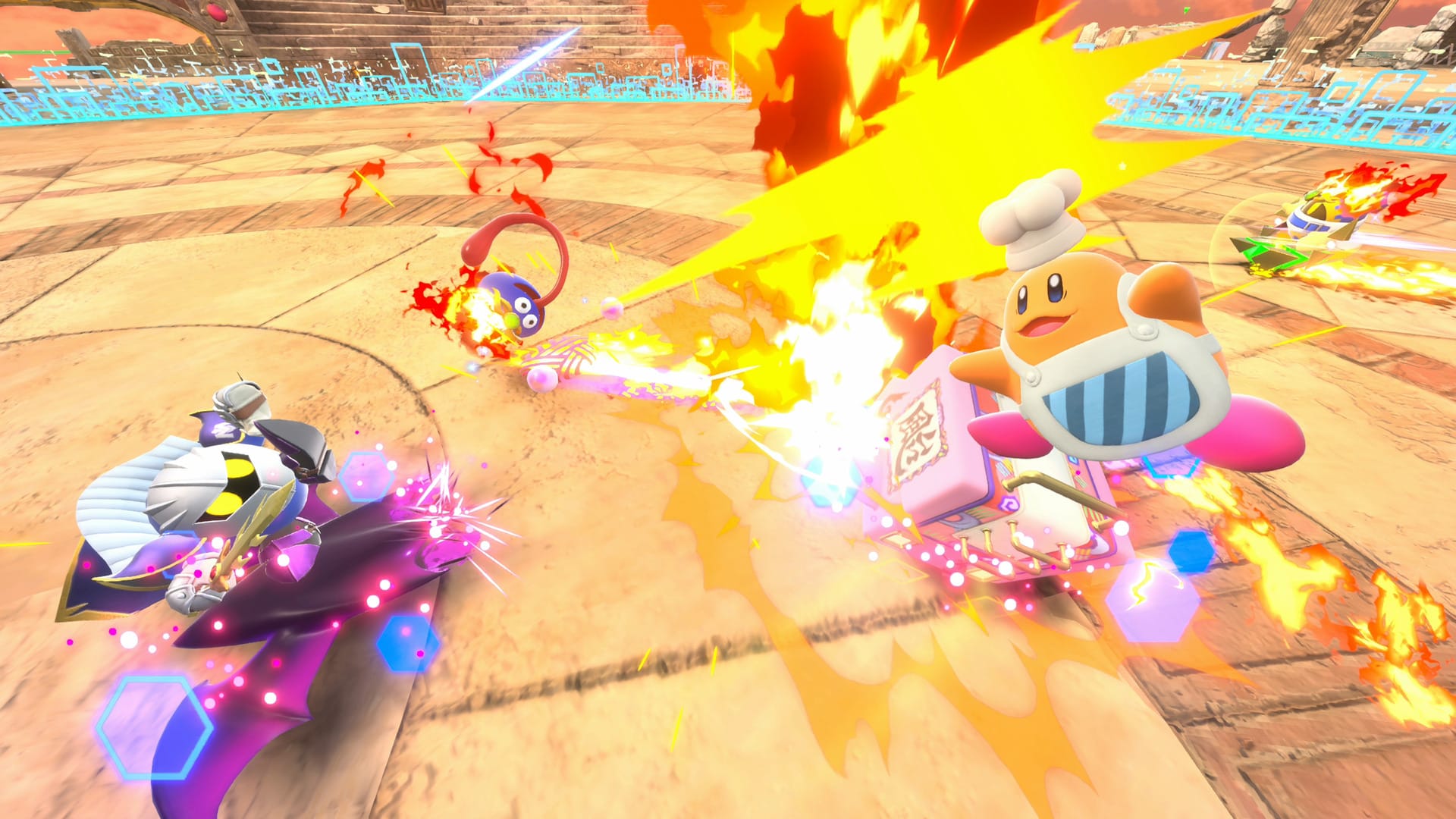
One might wonder, however, what — and who — this deepening ultimately is in service of. Many gamers come to sequels expecting more content and, at least in action-oriented genres like racing, a more refined kinesthetic sensibility. Air Riders meets these expectations by expanding its edges, sharpening them, and then leveraging them into a combative new disposition for the game, at least in the context of City Trial. As Sakurai learned with Super Smash Bros. Melee, when a system deepens, so too does the competitively-minded player’s desire to invest time and effort to master it, and he appears to have tailored Air Riders to reflect this inevitability. The deployment of sophisticated new physics alongside the exponential heightening of the skill ceiling indicate a new willingness on Sakurai’s part to embrace contemporary expectations around online gaming, but those innovations aren’t simply there for the sake of the ladder climbers: they exist to enrich the overall experience, to put super-speedy hamster-smashing joy in the hands of any gamer so inclined.
“Online games are tough. It's easy to get discouraged when you're no match for hardcore players,” Sakurai writes in one of his blogs on Air Riders’ development, acknowledging the game’s casual players while also making room under the umbrella for competitive ones. This comment, and its admission of the anxiety a player may feel toward the new, encapsulates the spirit of Kirby Air Riders, a game that is both of its maximalist time and seeking ways to enrich that maximalism. Revisiting and retooling the fundamental principles that the game was built on, instead of implementing overly complex and exclusionary mechanics for the sake of fitting into popular trends, can create scores of new opportunities to surprise and delight greenhorn and guru alike. Game developers may feel pressured to speed ahead in pursuit of greater and greater heights, but Air Riders proves that forward momentum doesn’t have to compromise the heart of what came before. It can be a way toward a destination that accommodates and fulfills us all.
Thank you to William Hughes for his invaluable research assistance.