Before “cozy games” were a recognized subgenre, there was Legend of the River King, a serene and contemplative Game Boy RPG about fishing. In it, players control a preteen boy who must explore fields, forests, lakes, and streams in search of a rare and storied fish that folk wisdom alleges can cure his ill younger sister. The quest involves catching fish, selling them for funds to buy more and better tackle, fending off hostile wildlife, assisting NPCs, and learning enough about the game world to uncover the legendary fish’s hiding place. With its unhurried gameplay, picturesque environments, and effective minimalist storytelling, Legend of the River King is a forerunner of cozy gaming. I also consider it among the most thoughtful and ecologically conscious games ever made (which inspired me to write the literal book on it).
Yet it’s the game’s selfsame thoughtfulness — its persistent themes of community, interdependence, and the duty of care we owe other living beings –— that makes one of Legend of the River King’s major programming oversights all the more arresting. Namely, it’s possible to softlock the game, achieving a state, without the aid of bugs or other glitches, where you have not lost (because Legend of the River King does not have a “Game Over” routine), but further advancement becomes impossible. Discovering a comparable game state in other titles might make for a fun find, but in Legend of the River King, the softlock instead carries conceptually horrifying implications. It creates a world where your protagonist cannot die, but lingers on the brink of death forever — starving, exhausted, and debilitated. And nobody in the game even acknowledges it’s happening.
I had long been reluctant to explore this dark and well-concealed path in an otherwise comforting experience. It was partially fear; for me, a certain existential discomfort accompanies tugging on the loose threads in the weave of a game’s world and seeing it rip open at the seams, conjuring the same sense of trespass that would accompany widening a tear in a damaged painting. (Lest we forget, Dante reserved a ring of Hell for those who commit violence against art.) But it was also out of an aversion to the particular kind of cruelty that this programming error inflicts. Putting Legend of the River King’s protagonist through the suffering it entails feels wrong. It struck me as comparable to taking apart a live insect. I know in the abstract what befalls a housefly whose wings have been plucked. What profit is there in making that knowledge concrete? Even a digital proxy for human suffering strays too close to the real thing for my conscience.
As of late, however, I determined that conceptualizing the softlock alone was insufficient. What if my hypothesis was wrong? What if you actually couldn’t trap your character? Maybe it would all be fine; maybe the tear in the canvas would prove a mere trompe l’œil. There was enough of a glimmer of hope to merit further investigation. In the interest of fact-finding — and of perhaps banishing the specter haunting one of my favorite games — I had to proceed.
The softlocking method is a straightforward process, albeit one that requires extraordinary incompetence to attain through normal means — or exacting intentionality to pursue for experimental purposes. Here are the steps involved:
- Avoid buying the net. The net is an optional tool that allows you to scavenge for bait in the wild. Once it’s in your possession, you’ll always have a way to bait your hooks.
- Exhaust your existing bait supply. Baits in Legend of the River King are live or perishable items (like insects, frogs, small fish, and dough balls) that are used up once you remove them from your hook, or as soon as a fish bites them. You can therefore run out of them either through indecisively swapping what’s on your hook (which discards the bait currently equipped), or by allowing a preposterous number of fish to escape.
- Have no lures or flies to your name. Unlike baits, lures and flies are inorganic and reusable. Unless a fish absconds with it — which does happen on occasion — having a lure or fly to hand can let you fish indefinitely.
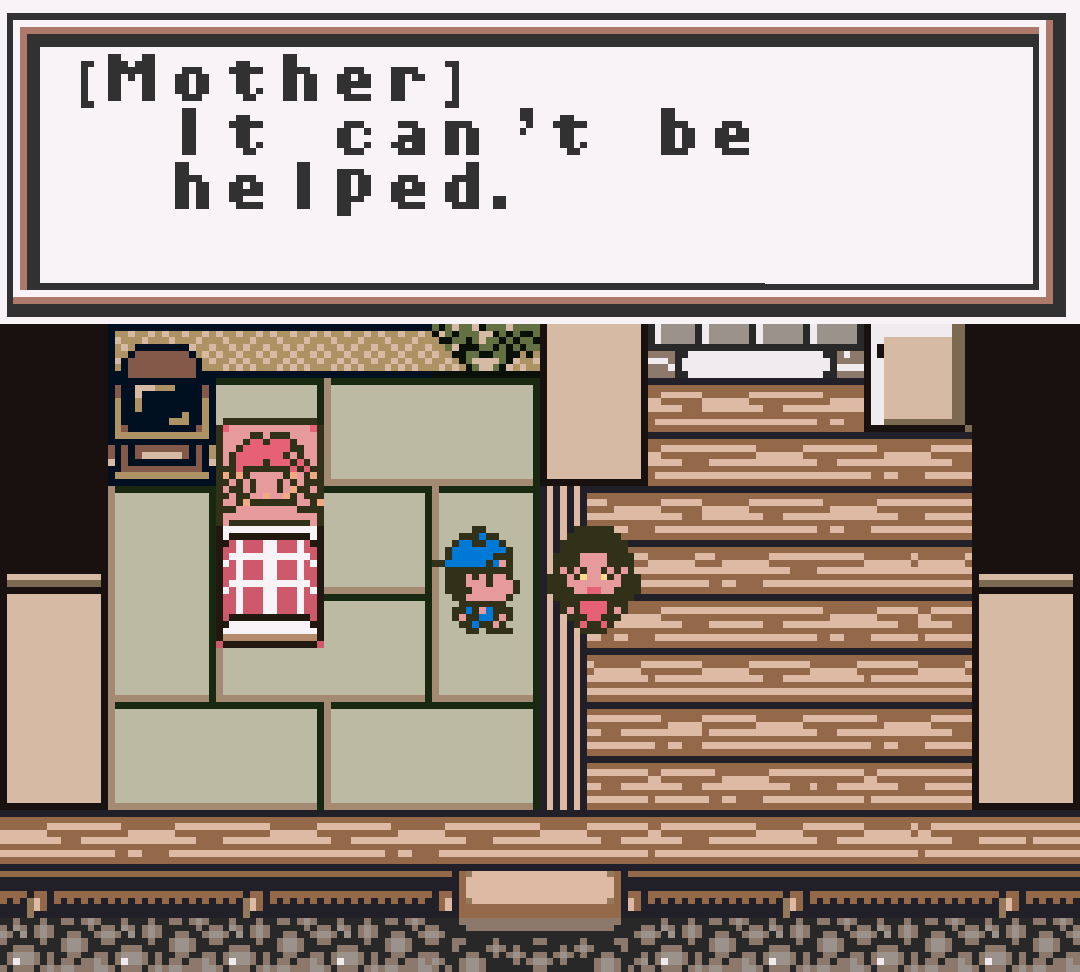
- Strand yourself far from your character’s house. The lone NPC who will give money to your character for free is his own mother: if he approaches her with no money to his name, she’ll give him 20G while sadly muttering, “It can't be helped.” However, you can pin yourself someplace that makes her inaccessible. If you move downriver after you acquire a raft, rest at an inn in another town (which then becomes your respawn point in defeat), and lose all your HP (by beating against the current, say, or by taking a beating from the local wildlife), you won’t have the stamina to row all the way back to her.
- Spend all of your money. Without a net, you can only acquire new bait by paying for it at a tackle shop. If you run out of money, there are no further means available to replenish your fishing supplies. (And, of course, going bankrupt also prevents you from buying a net.)
And that will do it. Since Legend of the River King offers no means of generating income besides selling fish, and since running out of bait precludes the possibility of hooking any fish to sell, a player without bait and money forever remains without the wherewithal to bring in either. It makes for a vicious circle — but one so ludicrously unlikely to occur that the developers never thought to code an exit.
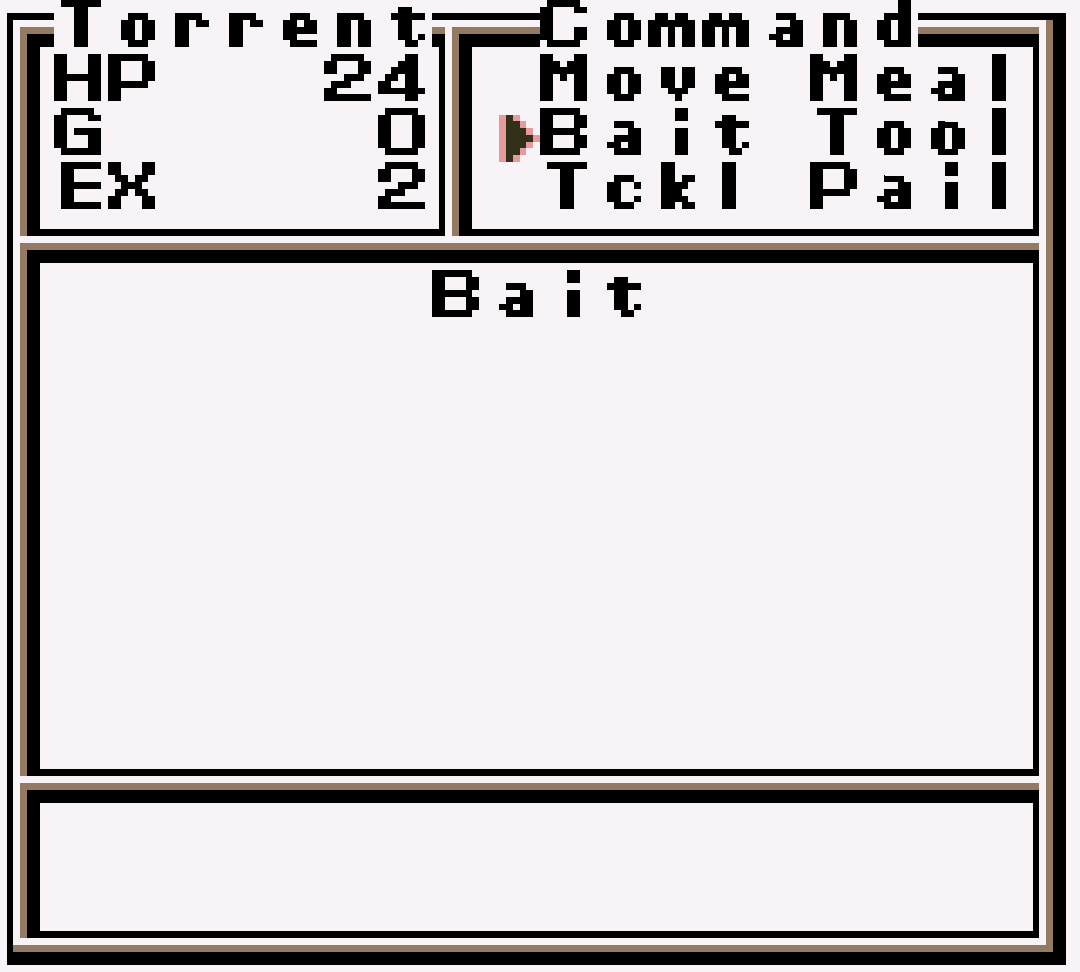
Ending up softlocked was somehow more upsetting than I had predicted. I watched the protagonist — who, let me remind you, appears to be a ten-year-old boy — wander through an unplayable purgatory, with nowhere to go and nowhere he could return. He would never eat again; the local grocer’s oranges and bento-box lunches would always remain beyond his means, and so too would their salubrious, HP-restoring effects. He’d never be able to afford to rest at an inn to recover from injury or illness. Forbidden a safe place to sleep, his strength gradually declined until it capped at the single health point allotted someone who wakes in unfamiliar confines after being attacked by hostile fauna and left for dead. Furthermore, because of Legend of the River King’s peculiar combat mechanics (in which your current HP determines the amount of damage your attacks inflict), the protagonist was unable to fend off even the most minor threats. Every facet of the entire adversarial world crushed him without resistance. Meanwhile, everyone around him acted like nothing was wrong, taking notice of neither his financial straits, his poor physical health, nor the torturous existence in which his circumstances had trapped him. If there exists a way out of this game state, I did not uncover it.
Sure, your protagonist never dies. It’s a cozy game, after all. But given the ceaseless agonies of his unending life, one wonders in this case whether immortality represents a harsher sentence than the alternative.
Such a plight is perhaps the inevitable consequence not only of being locked out of an economy, but an entire world that is predicated on participation in it: watching life go by without you, while those who remain safely within its systems do not deign to pay you any mind. Of course, this is not far removed from how it goes in our own society. When too few people see the cracks in the general welfare, even fewer look to plug them — and fewer still look after the people who slip through.
In this respect, Legend of the River King’s softlock routine furnishes an apt metaphor for how societies fail their most vulnerable, if not an object lesson in what makes societal neglect possible in the first place. What cannot be imagined cannot be addressed. Because the designers never foresaw the most catastrophic edge case of the interplay of their game’s systems, they did not devise a fix for it. Even the most humane and benevolent system architects are vulnerable to such lapses. One therefore wonders how many comparable points of neglect (and how many ensuing disasters) occur among the day-to-day interactions of mammoth social systems — how many times and places where, say, poverty and inaccessibility and discrimination combine with ruinous effects. For a cozy game like Legend of the River King to contain a nightmarish outcome of comparable provenance encourages us to consider whose miseries we might remain blind to in our own comfortable order.
Legend of the River King thus illustrates why it’s imperative that we remain alert to those damaging societal blind spots. It’s already troubling that the pain of its softlocked protagonist should be possible. But we also must remember that, at a great enough scale, all possible outcomes occur. A sufficiently sized player base will stumble upon every one of a game’s failure points; a large enough society all but guarantees that somebody will lie at the intersection of its most noxious tendencies — with devastating results. The perfect storm is not an anomaly, but an inevitability. It therefore behooves us to address its root causes before the worst comes to pass.
Legend of the River King’s softlock scenario may not be a volitional error, to borrow from Joyce’s Ulysses, but it is nonetheless a portal to discovery. For its game-breaking sequence represents a stroke of inadvertent genius: it opens the possibility that “cozy” need not mean “complacent,” and even the most relaxing games may prove instructive. You can certainly treat Legend of the River King as mere escapism, a pocket-sized fishing vacation with which to elude real life for a while. “There but for the grace of God go I,” you may think, looking back at the world you’ve left behind as you ready your line. But we all must return eventually — and Legend of the River King reminds us that our responsibility, when we witness injustice and suffering, is to intervene and say, “Let no one ever go that way.”