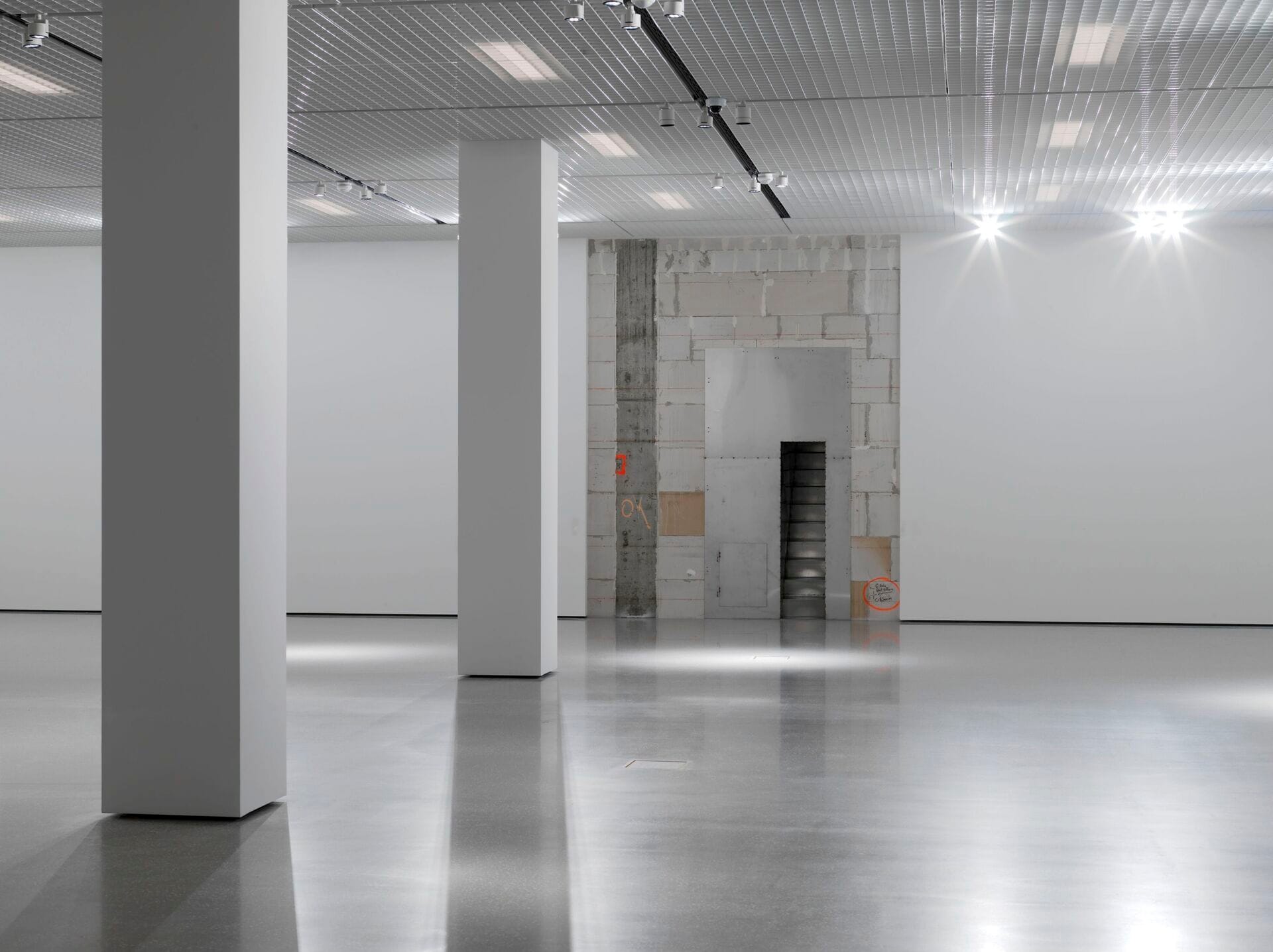
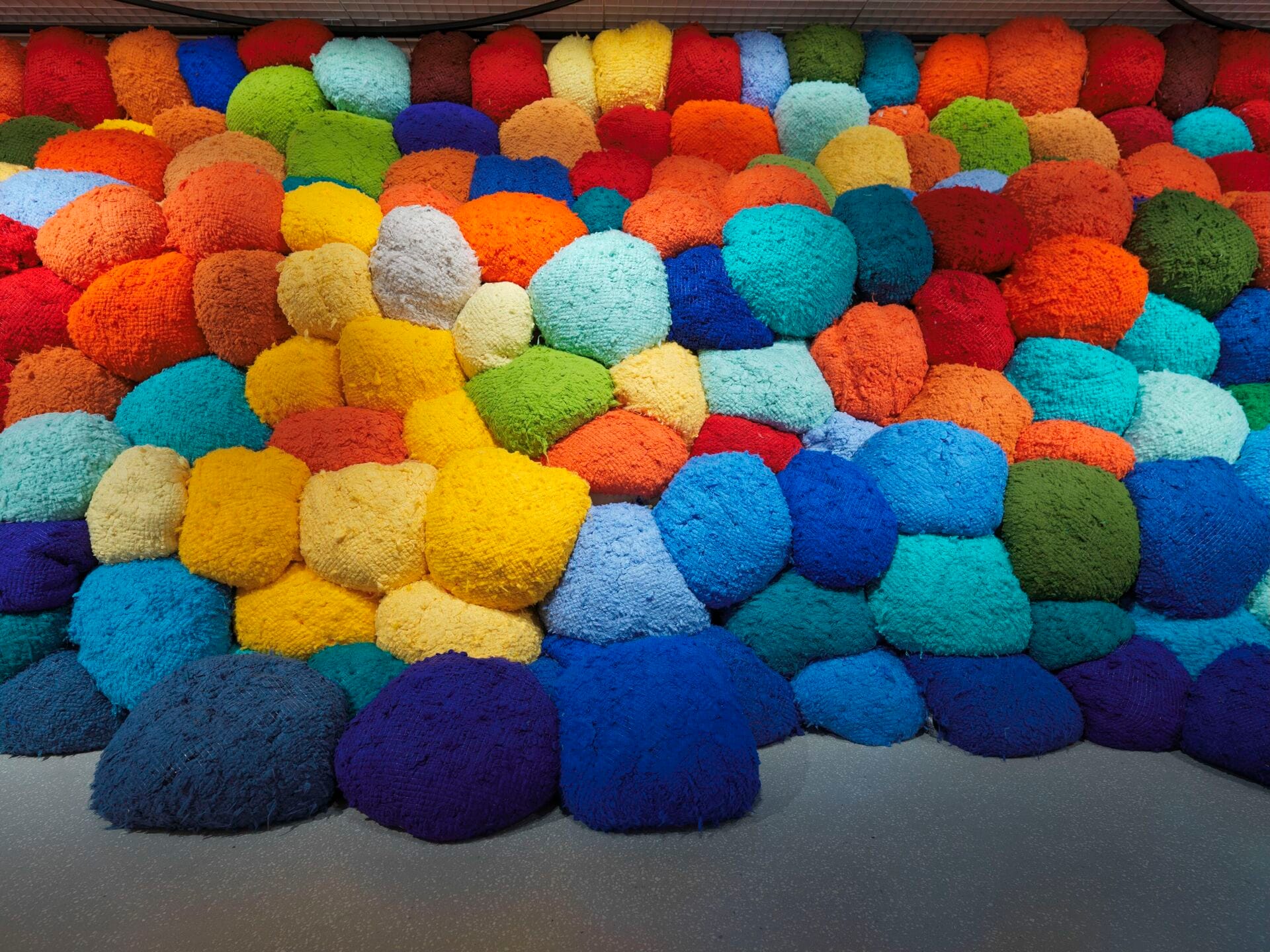
Per Inge Bjørlo’s Inner Space V. The Goal is an installation located in Norway’s National Museum in Oslo. Only one person can experience it at a time, by entering a small door that leads to a set of stairs. It is completely made of stainless steel. When you ascend the stairs, a small corridor leads to another room at the end. In that room, there's probably a heat lamp. I don't know if it's actually a heat lamp or just a lamp, but the ambient temperature is hot. The corridor is very narrow, there's industrial noise that may be actually coming out of hidden speakers or maybe it's just the rustling of my clothes and footsteps on steel in a claustrophobic space, echoing, finding resistance only in my warm breathing, and the lamp is so bright that its yellow light turns red, then orange in my vision. I believe that there are safety warnings outside Inner Space V., but I don't remember — what I remember is that there were additional artworks right in front of it that consisted of giant pom-poms and hay bales and things that looked like safety nets. You couldn't actually interact with the structures, only look at them and imagine how it would feel to get up and down and all around. I felt like I was strolling in an empty children’s park in Brazil. You could almost hear the laughs, music, and the pitter-pattering of people dancing around a pole during the Festa Junina.
It was extremely jarring for me to see these completely different pieces of art right next to each other. Although Inner Space V. was part of a permanent collection, the others were part of a temporary exhibition, which meant that anyone who went there a couple of months before or after I did would have experienced a completely different dynamic, as they would encounter other works upon leaving Inner Space V.
I was ecstatic. I felt it was panic-inducing. Why are things so dissimilar so close to each other? Why am I bombarded with so many different things in such a short time? I think I learned somewhere that “tone” needs to be “consistent” or whatever.
How can I account for that contrast? The pieces were not designed as companions, of course, but seeing them one after the other created a specific impression, an unforgettable one, even, that made both works of art more relevant to my memory and thoughts. By sheer chance, it has created, maybe, a third piece — one that only exists within me.
Here’s the gamble: I could not truly know what to expect before walking up those stairs. I was traveling abroad for the first time. I did not check any pamphlets or websites, nor did I watch any “What to Expect from the National Museum of Oslo”–style YouTube videos. I had to trust the small door on a random wall and understand, through context, that a line of people in front of it, without a bathroom sign to indicate otherwise, meant it was art.
When paying for a museum ticket, even though you may know what exhibitions are on view, you are open to the experience of either seeing what you already know in a different context than before, or to see things that you aren’t expecting.
Why should games be different? Why do so many of us prepare ourselves so much before engaging with one? Perhaps we do not like uncertainty when buying a product, something with a function that it needs to perform — but the function of art is not as clear. Still, the product element leads us to try and gather as much information as possible before even pressing start. We have guides and How Long to Beat dot com, we check leaked achievement lists and sometimes we create Netflix accounts to watch an extended trailer. It all stands as rehearsal to consumption.
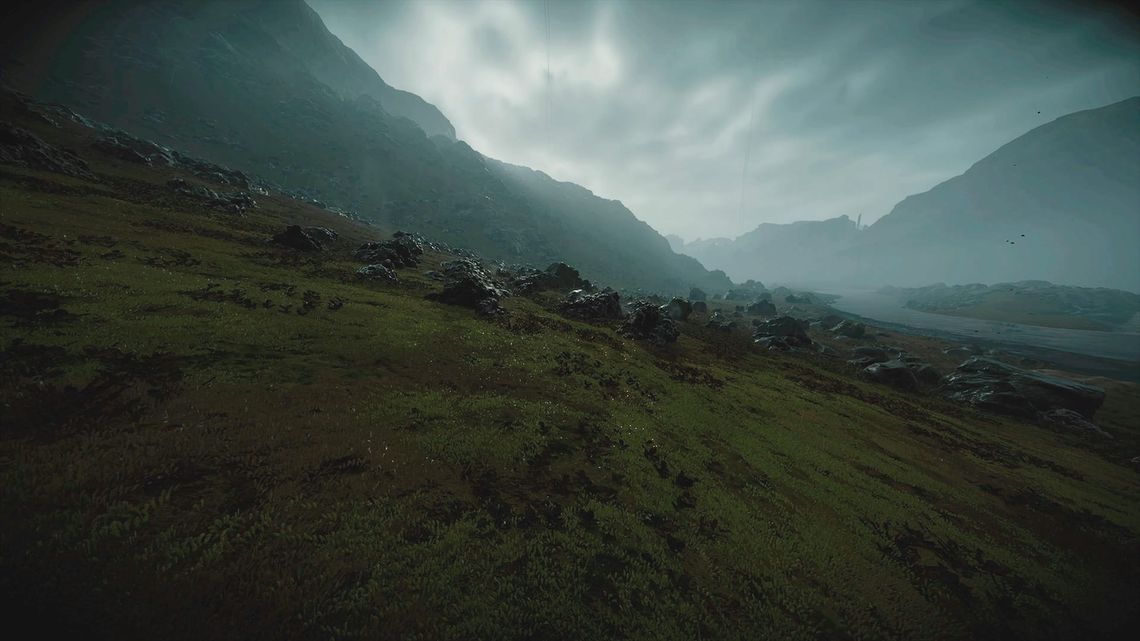
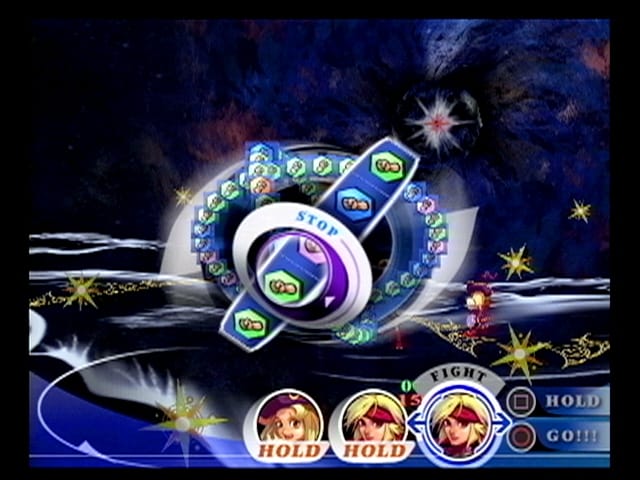
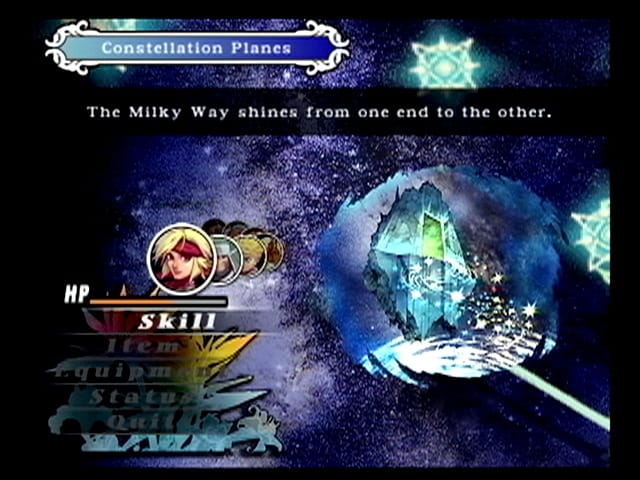
Unlimited Saga — a Playstation 2 game widely regarded as bad, weird, overly complicated, and difficult — aims to recreate the randomness of a real board game. It uses representations of dice, slots, and other elements of chance to create unique experiences for each player. The game map is akin to a board upon which your characters serve as game pieces, moving one space at a time. Maybe, when landing on a space, you’ll receive a message saying that monsters are close. If you get back to the same space later, the monsters may attack. Any space is recontextualized by the spaces around it: monsters may move to closer spaces, treasure may appear or disappear, and treasure chests may open or explode or break. It's a fascinating game that asks you to take navigation itself as an abstract concept. Movement is not taken for granted, and information is not fully conveyed visually. You can map out an entire dungeon, but you won’t know what that dungeon means without moving through it.
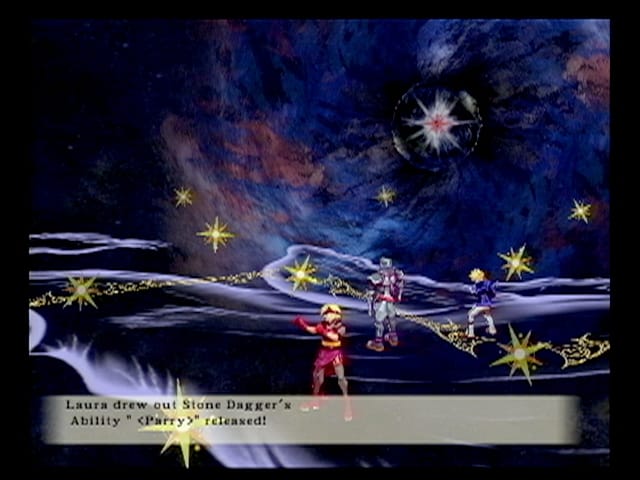
Playing Unlimited Saga felt like learning how to play video games again: an experience unblemished by the usual conventions. That was clearly the reason why it was disliked. Upgrades, menus, the structure of play itself, are all deliberately different. I don’t see it as a deconstruction, but just a construction of something new. The game looking gorgeous helped to pique my interest, but even with that, I remember avoiding playing it for years. I knew that it would be a game I had to dedicate a lot of time to, I knew I would need to study to understand how it works, and I knew that finding motivation to do so wouldn’t be natural: the story, although great, is sparse, and difficulty, even beyond just understanding the game’s mechanics, was high. There’s no momentum pushing you forward other than curiosity, both toward its systems and toward its strange aura.
Nonetheless, as I started slowly chipping away at the game’s core, its language revealed itself to me: each of the eight characters would be easier to understand than the previous ones, no matter the order that I chose to play them. Some had harder challenges within their quests, but I wouldn’t struggle to navigate their spaces anymore; muscle memory would kick in whenever I had to go through a couple of menus to open a chest. There is one cutscene shared by all characters (a festival in a city that they all go through during the story) and without fail, every time I reached it, I thought the same thing: this is the second, fifth or eighth time that I’ve seen this scene, but I am a different person now.However, unlike bicycles: today, if I picked Unlimited Saga up again, I would have difficulty remembering how to read its framework. Its mechanical hermeticism is something you can only understand while it flows around you. As I played, all of the reviews I read and tutorials I watched before proved useless in the face of the game itself: it needed me, in the present, to function. I could not be prepared for it, no matter how much I prepared for it.
Similarly, it is hard for me to properly explain Inner Space V. The installation uses its own empty space as a part of itself — a space that I became subsumed by. While it doesn't give you a set of instructions for how to interact with it, my experience engaging with Bjørlo’s installation reminded me of Fluxus, an art movement that emphasized the element of chance in artistic expression. One element of the art movement was the production of “event scores,” notated pieces of performance art that allowed different people in different places to enact the same works, each performance ephemeral and unreproducible. It doesn't matter how many words I use to describe my traversal of Inner Space V., the conveyance is limited not only by my words, but through my own eyes.
The desire to eliminate uncertainty — wanting to know exactly what a piece of art is before interacting with it — is strange when applied to video games. In Man, Play and Games, Roger Caillois treats uncertainty as one of the conditions for play to exist. He defines four categories of games, one of which is alea — games of chance, activities in which the outcomes cannot be secured by one’s own will. However, beyond this definition, I believe there is something wagered whenever we play a game — how long we will play it for, how we will tackle its challenges, how we’ll understand what it shows us — and all that preparation is an apparatus to try and make that wager unnecessary, or worse, a task that you need to complete in order to participate in the so-called “discourse.”
Maybe Inner Space V. wouldn't be as claustrophobic to someone who has a smaller build, or there wouldn't be as many weird noises if there were no zippers on their clothes brushing against the steel walls. Each individual’s understanding of the piece is modified by very specific and contingent lenses that are not necessarily controllable by the artist. It’s good to keep in mind, when coming into contact with other people’s opinions, that if someone engaged with an artwork while they have the flu, their experience could be blemished. Or maybe giant colorful pom-poms were right outside of the door of their unpleasant experience of sensory overload, providing — perhaps undeservingly — respite.
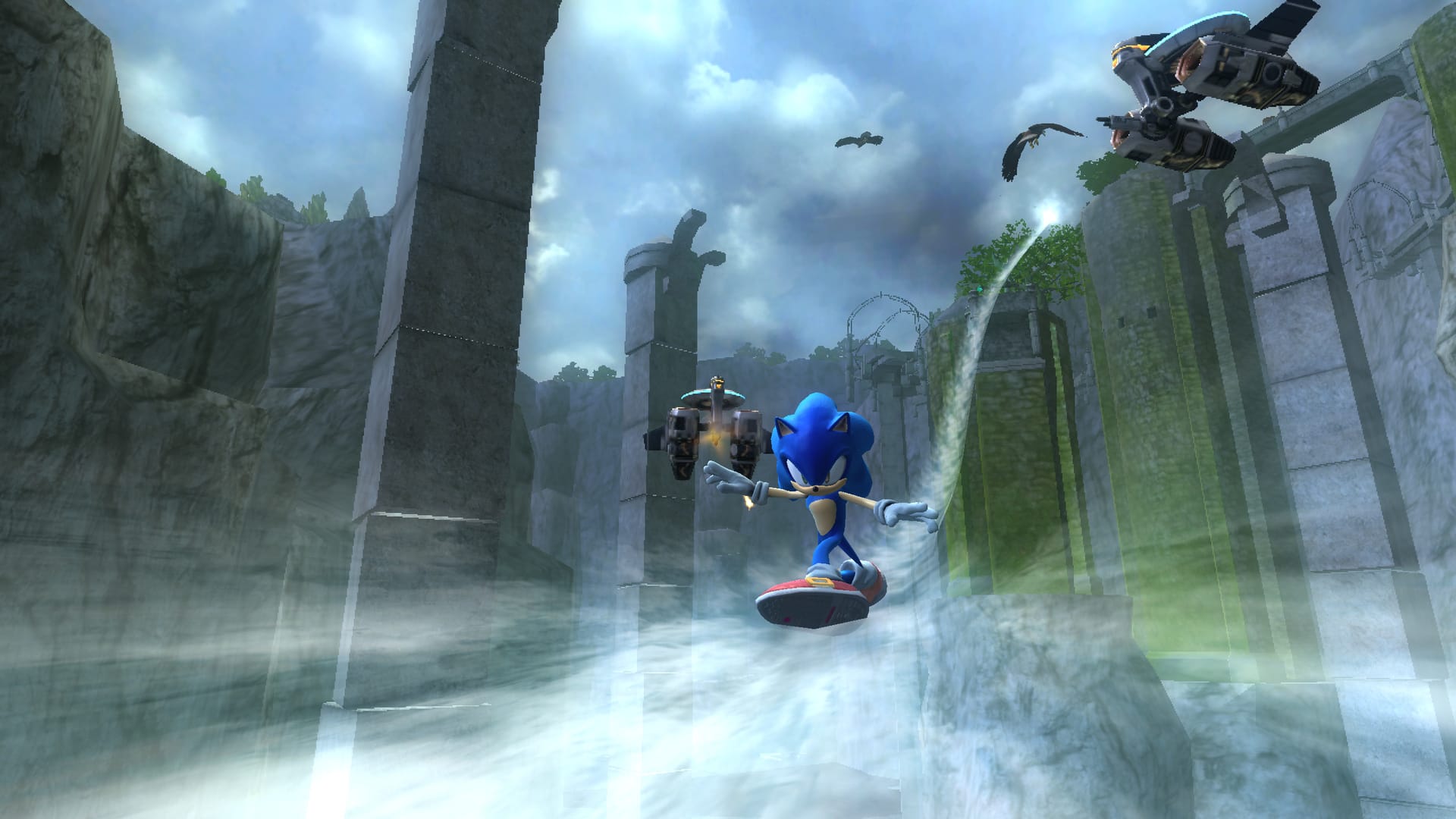
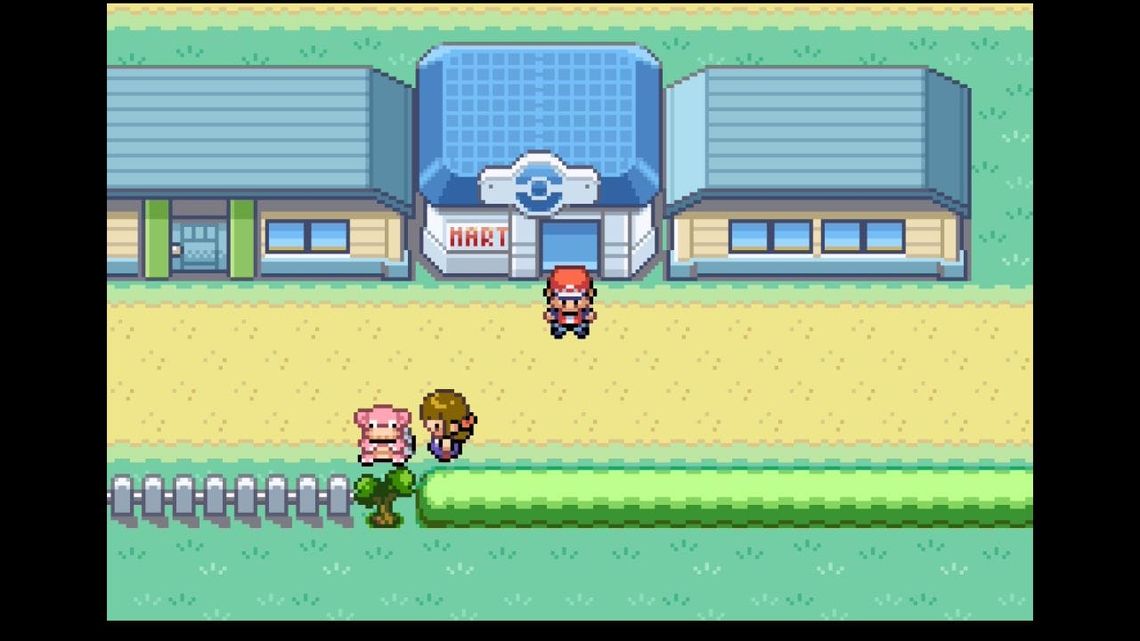
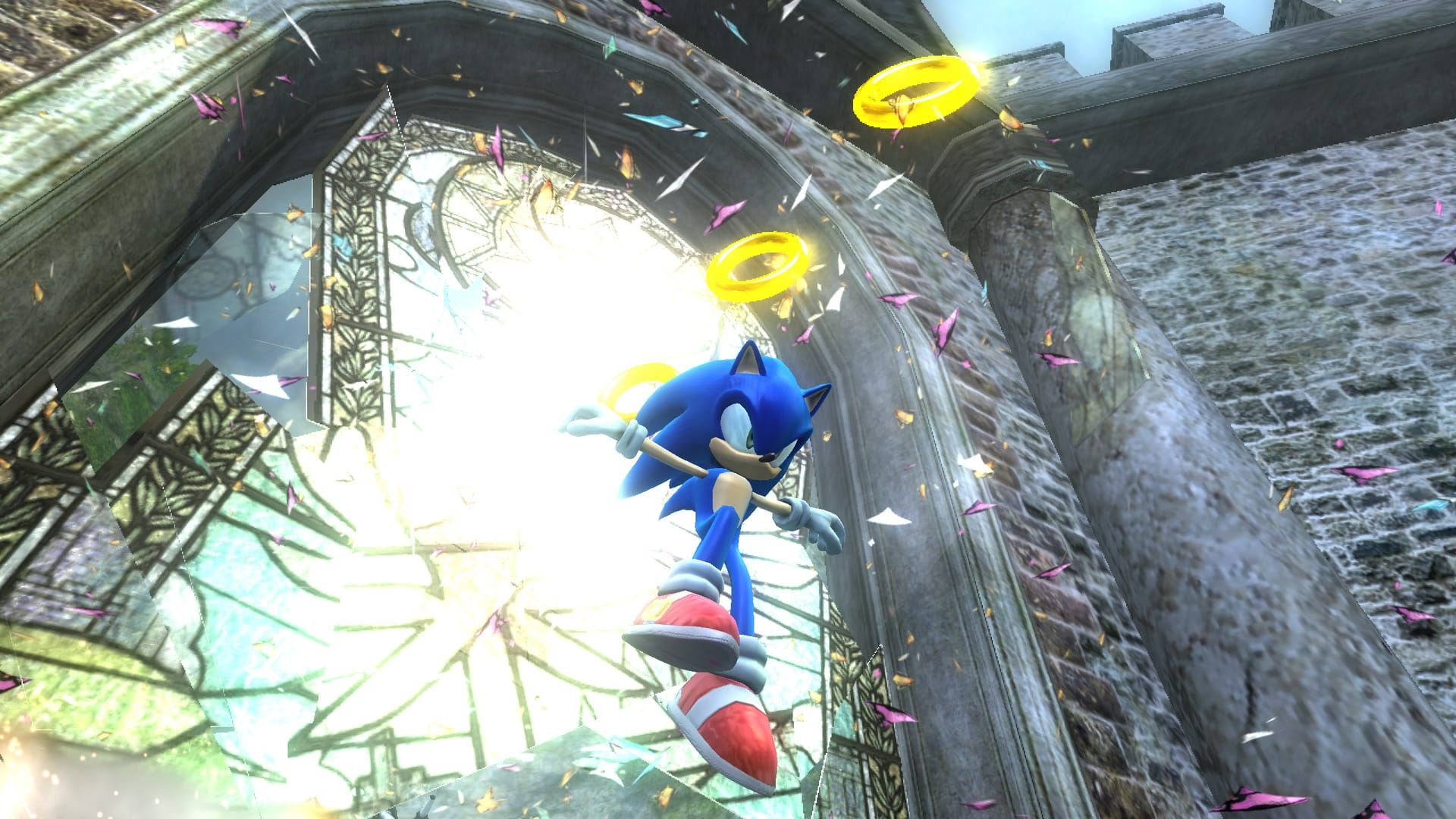
In 2023, I played Sonic the Hedgehog (2006), by that time well aware of the game’s infamy. Believe me: I was there, 13 years old in 2005, browsing Sonic the Hedgehog forums when the first trailers came in. I saw, after, how people reacted to the game versus What It Should Have Been. I was also there, years later, and saw videos on YouTube about how broken it was gather millions of views. It would be futile (and dishonest) to try and play the game “blind,” but I felt compelled to make a conscious effort to experience it as something more than a novelty.
What I ended up finding was a deeply interesting game with Big Ideas and a troubled development cycle which ended up, ironically, feeding its own themes of confusion and brokenness. It said something greater about the obligatory use of IP for recognition (in which familiar faces are placed in contexts in which they do not fit), about the idolatry of technology within the industry, and about commercial deadlines (as the game was famously rushed to sell more during the holiday season). Sonic, as a ‘90s mascot, could not reinvent himself to fit into the Epic, High-Definition, dare I say Prestige game they put him into.
I’m still thinking about Sonic ‘06 now, three years later after playing it, because I approached it in a way that goes beyond “confirming what I saw,” or even “confirming what I believe I’ll think of it.” I wanted to approach a cultural artifact and digest it with my own intestines. All other opinions are already out there, right? They already exist. Wouldn’t it be more interesting if I tried to think of something new?
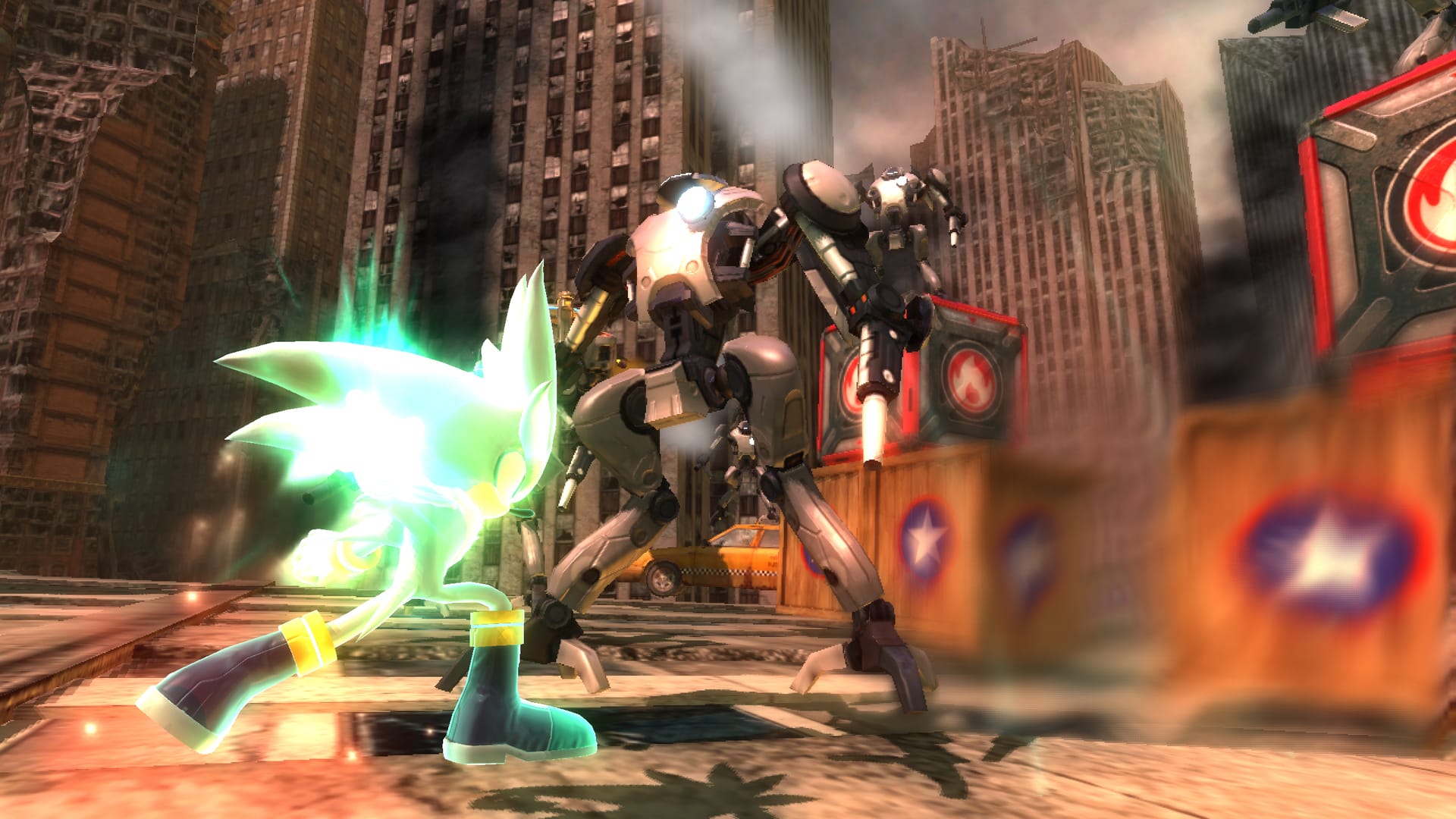
As I also experienced with Unlimited Saga, general critical reception cannot touch the possibilities for nuance that come from engaging with a game directly with no bias. How many great ideas are we leaving on the table because we do not allow ourselves to experience something unprepared?
There is a distance between the audience and a piece of art. That distance arises from what you are, and think, and believe, and want, versus what a piece of art is, and expresses. With games, play occurs within that distance, in the dynamics that manifest between what is being shown and what is understood.
Reviews are commercially important, of course, because they tell people whether they should spend money on a product that has just been released. However, they also prime people with a language by which to understand that product, perpetuating a cycle of SEO-ing the discourse. Instead of dancing around a possible meaning and reading of a text — like a well-thought-out, temporally-insensitive critique can do — a review may produce stability in that reading. It tells people what something is, replacing the possibilities of a piece of art with a description.
While aesthetic testimony itself is not a problem (some of my favorite pieces of writing are critiques or essays about art), if comment sections are to be believed, readers often mistake commentary on art with a review of a product. Critique — as misguided, wrong, or bad faith as it can sometimes be — tries to elevate the understanding of a work by laying out an analysis of it. Reading an article unpacking the way a game’s narrative and mechanics coalesce into making meaning can help you open your mind to better grasp it as a work of art. That newfound comprehension may feel like basking in the heat of a bright lamp in a space that’s opened up after pushing through a narrow hallway: it may be abrasive, but it can also help you see what is around you.
To me, starting a game asks for a similar leap of faith as walking up Inner Space V.’s stairs. However, the commercial apparatus of the games industry is designed to secularize that faith. Your own opinion on a work is always a wager. If you know that you are getting what you want, the uncertainty — a part of the experience that intertwines your real-world aesthetic sensibilities with what your brain understands as “taste” — is gone. Part of the element of play is gone.
Unlimited Saga’s surprises are not narrative or even in the introduction of mechanics: they lie within the player’s movement between spaces. The disappointment of not being able to find any good treasure feeds into the shock of glimmering (a mechanic in which your characters learn new moves in the middle of battle, out of nowhere) at the exact time you needed to win a fight. That can be described, but not felt.
The experience of playing Sonic, through all of its bugs, glitches and melodrama, was one of archaeology. Trying to piece together, through broken code, what was happening in an industry and a development team, and how all of that coalesced in the exploration of characters never meant to speak. Reading about how it fails as a product to be played could never prepare me to see how it soars as architecture to be explored.
Where the conundrum lies is in the understanding that buying a video game is not an effortless action. Time, money, even morals sometimes, each becomes important whenever you decide to engage with a game. As a result, video games are an art form in which criticism routinely comes before acquaintance in order to decide if a purchase will be made. Asking if you should spend $15 to watch a 90 minute movie is very different than asking if you should dish out $70 and 60 hours of your time.
Readers therefore project a weird responsibility onto video game reviews. The games themselves float in a liminal space, forever bouncing between consideration as entertainment products and as works of art. A review crystallizes an impression: this Game is this and that, and its Graphics are high or low fidelity, and it Runs well or poorly, and its Story is good or bad, and its Gameplay is interesting, etc., etc. A game ends up bound to coverage written at the time of its release, closed off from new impressions that could arrive later, unburdened by the need to inform the reader whether the article’s subject is worth giving up currency and time to experience it for themselves.
One product of the aforementioned Fluxus movement was the Fluxkit, an assemblage of objects (balls, cubes, random cutouts) collected together in a case with the intent that individuals can interact with them however they see fit. The point is that anyone can make art with a Fluxkit by interacting and activating its random doohickeys and thingamabobs in a way that was not planned out beforehand.
When critical opinion crystallizes around a game, it becomes akin to a Fluxkit taken out of the hands of those who would use it and placed in a museum. As art historian Cabelle Ahn explains, “once exhibited within museum-mausoleums, Fluxkits are withdrawn from their original functions and remain inactivated. In these cases, they can be read as the archive and the relic of an unfulfilled work — replete with untransferable potential energy.” Confining the Fluxkits within the defined context of an art exhibition renders them inert, making you a gazer, not a participant.
The interactivity of games — the possibility of approaching them in different ways — makes the comparison to Fluxkits easy enough. You can recognize all the parts that make up a Fluxkit, but the pieces are just a means to an end: the hope that the art that you make cannot be expressed by anyone other than yourself. Even though a game is still constrained by its mechanics, cutscenes, graphics, or whatever, you will control your inputs and come out with something uniquely yours. Likewise, a game played (or avoided) based on a reviewer’s opinion can render the experience inert — “by the books,” safe.
To engage with art is to embrace the possibility of surprise, and with that, to enjoy ending up as happy and satisfied as empty and upset when it ends. Not being prepared for every possible outcome allows an individual to understand a work of art as only they could. Sonic clipping through the ground and dying can be funny in a YouTube video, and frustrating when you only have one life and need to go through multiple different loading screens to get to the same point again. But can it be meaningful? I personally can decide that Sonic clipping through the ground is art, and I don’t want to give up that power.
You cannot encounter art without mediation — your own life, beliefs, experiences. Every time you install a game, or enter a movie theater, or pass through the turnstiles of a museum, you are gambling your time, and even your emotions; you may exit the experience feeling ecstatic or disappointed. Perhaps you’ll see exactly what you want, but maybe (just maybe) you’ll experience something so outside of your expectations that your perception will be changed, and you’ll realize that you didn’t want what you thought you wanted after all. This can only happen if you keep yourself open to every possibility. The wager is an intrinsic part of play.
The installations I saw outside of Inner Space V.caused a clash that created a third piece within myself, a big bang of artistic resonance. Looking back, I can see that my mind created something different than what was actually on display: the pieces I saw were a combination of this, this, and this. I filled in the spaces with the possibility of jumping into the hay and performing the Dança do Pau de Fitas around a pole. Anything outside of Inner Space V. felt like a relief. Ironically, that only happened because of the isolation I experienced before going to the museum.
Inner Space V.’s English guide instructs you to leave your phone outside and enter the installation completely alone in order to “find useful insights.” This is something I now try to do with every work of art — game or otherwise — that I engage with. For both Sonic ‘06 and Unlimited Saga, I was only able to gather so much meaning from the games because of circumstances that I had no control of, embracing them, for all their perceived faults, as something rare, exclusive, unreproducible.
I turned them into fulfilled work.