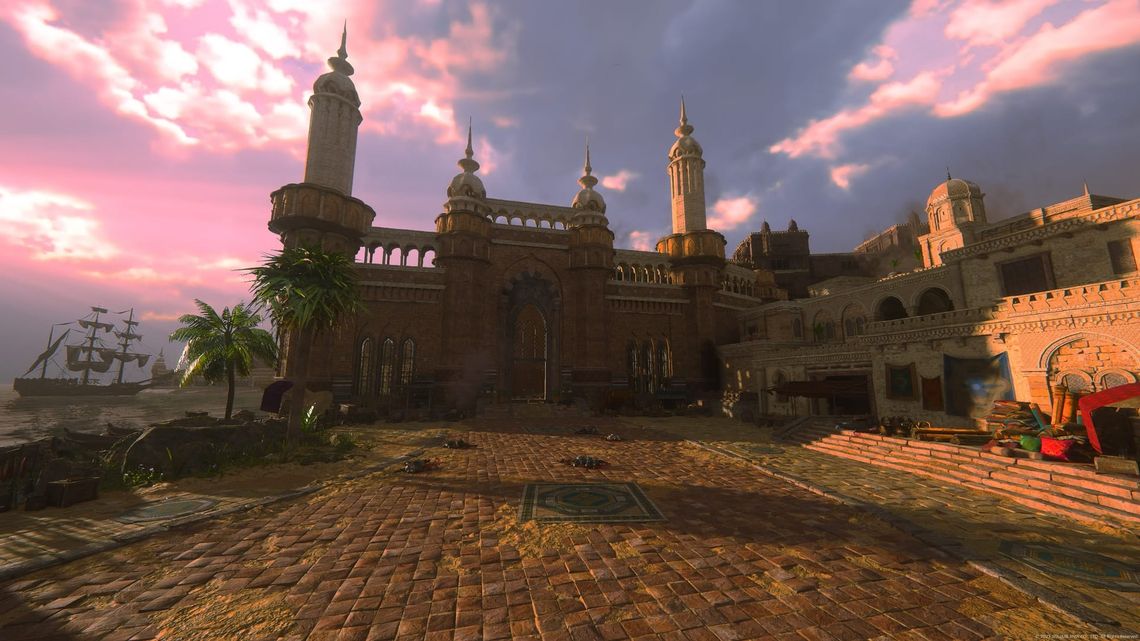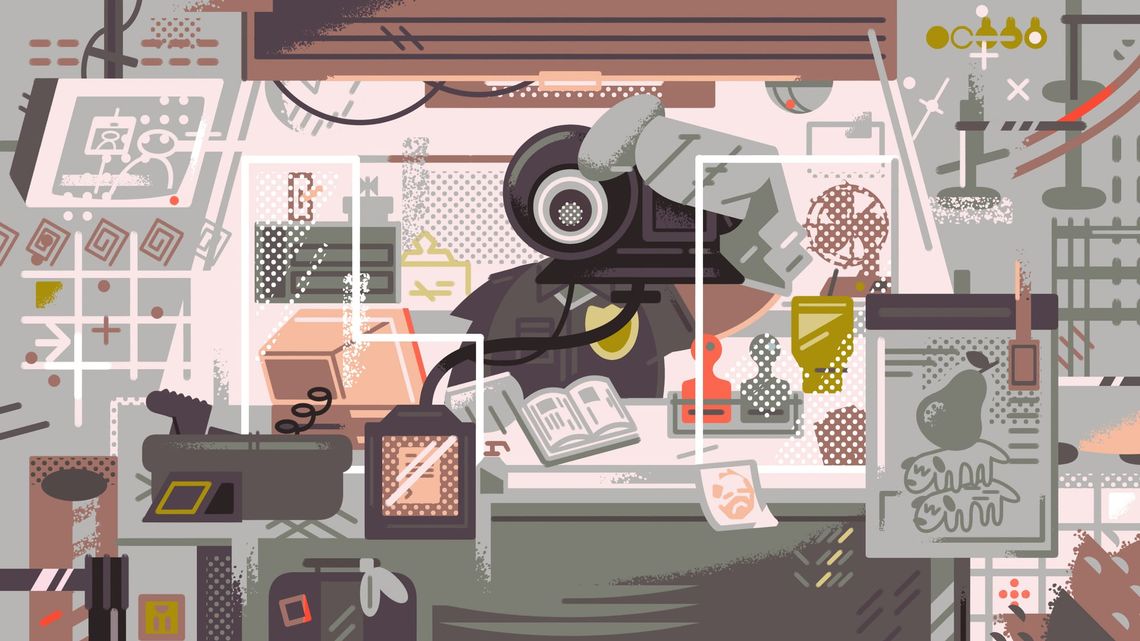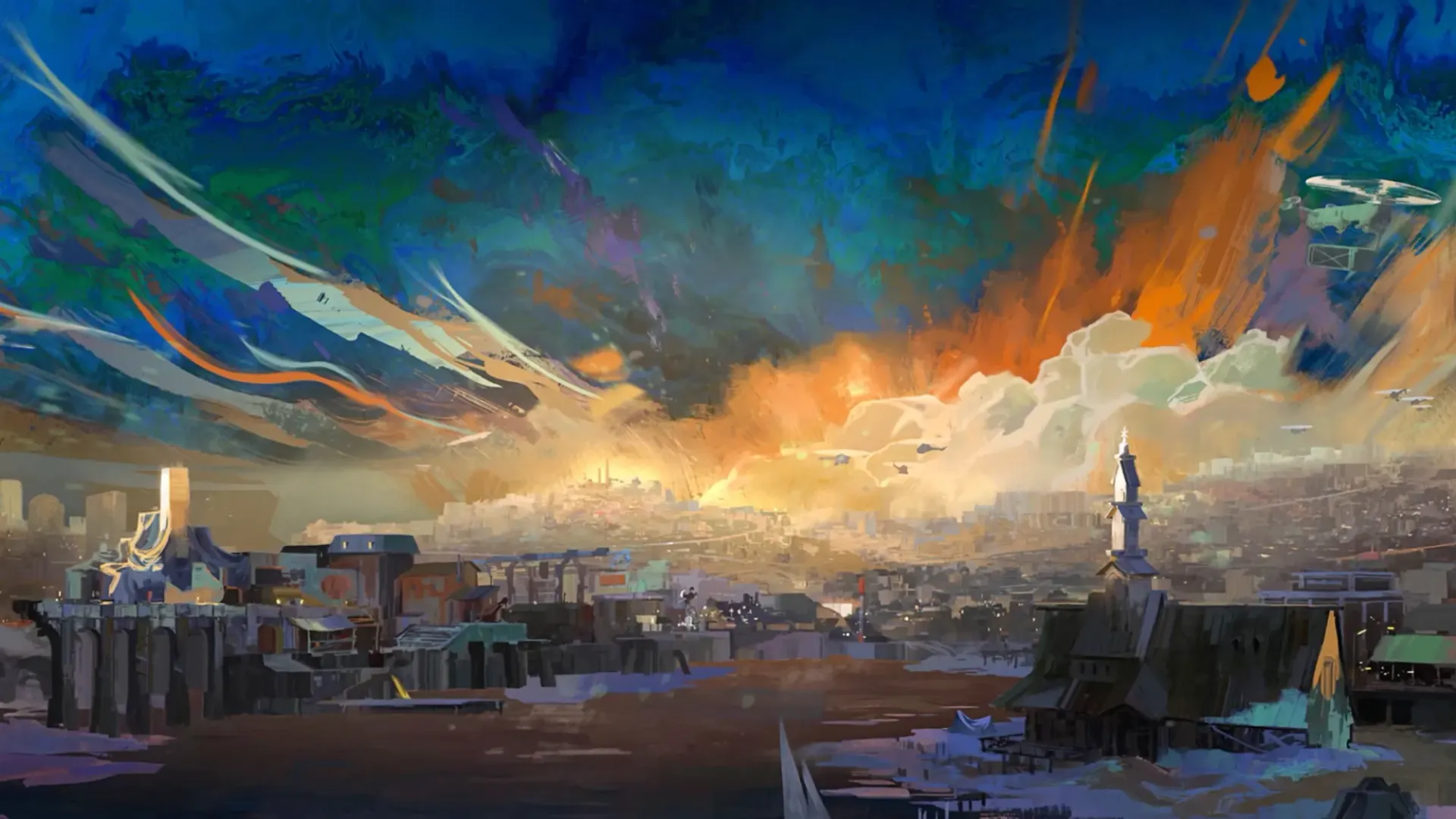
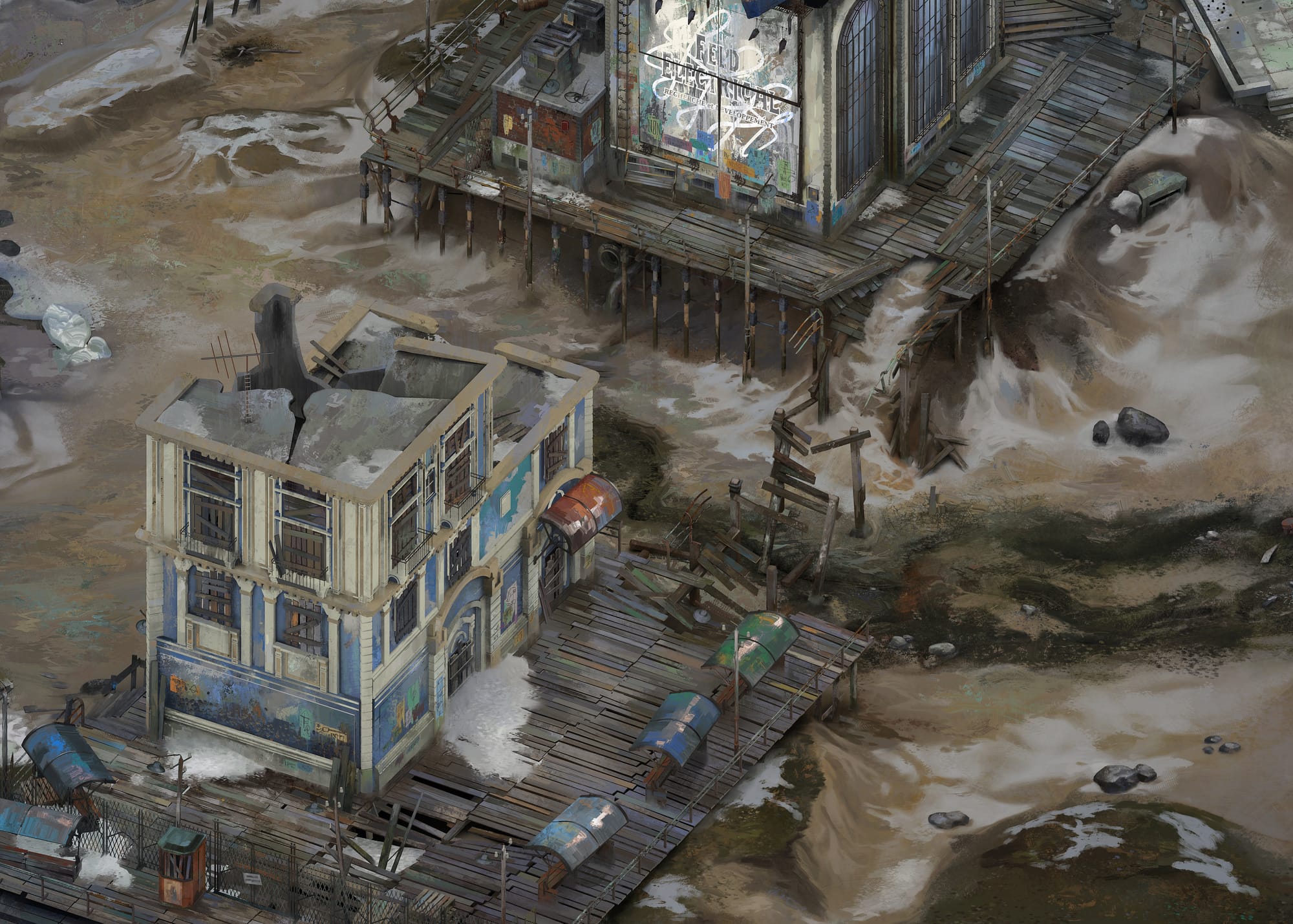
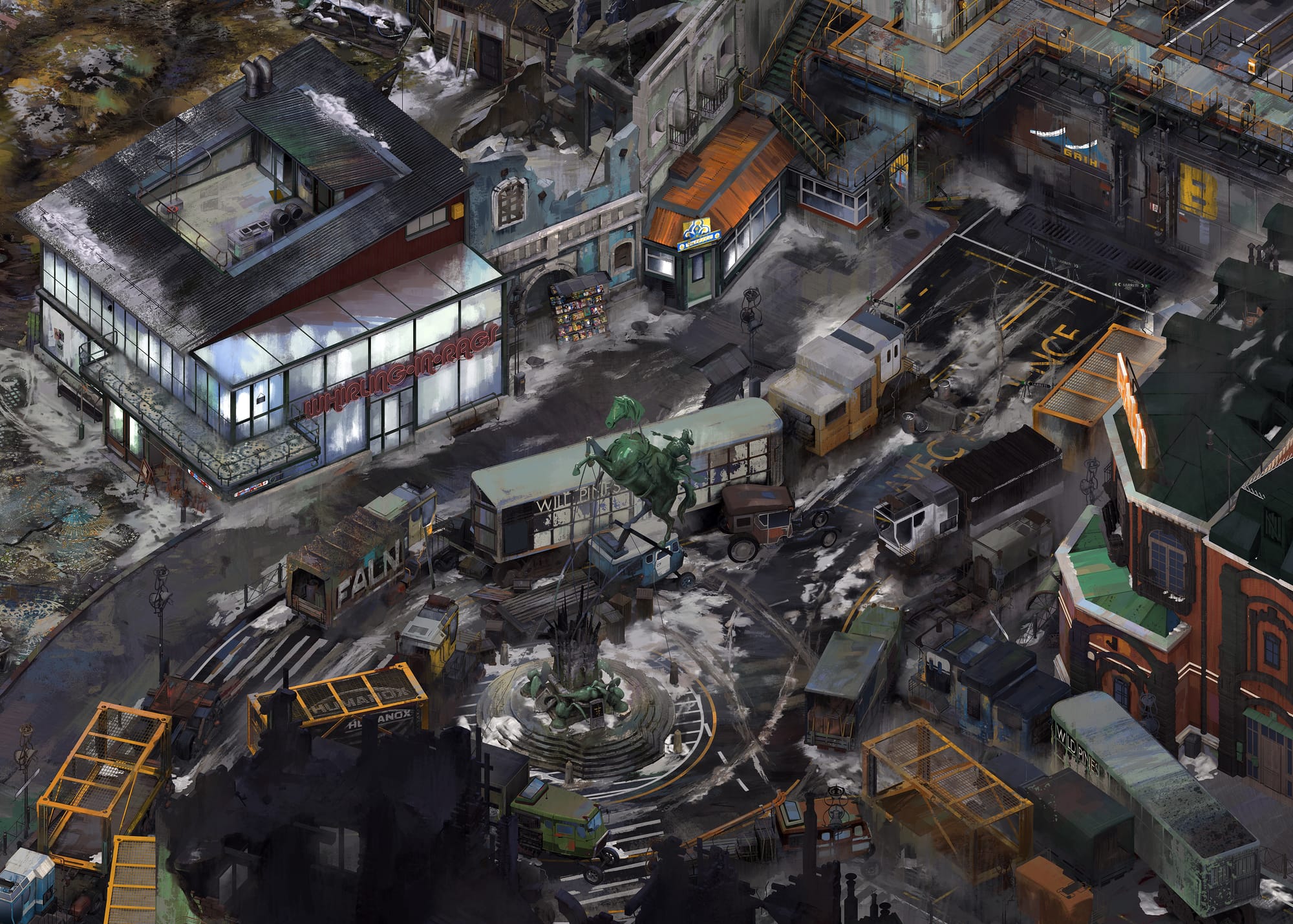
When Harry first steps out of the Whirling-in-Rags onto the Rue de Saint-Ghislaine in Martinaise, a cornet rings out, reverberating off of the cobblestones and incomplete murals calling the masses to revolution. Martinaise is an impoverished borough of Revachol, itself once a great city of the world. Now it is subjugated by the Coalition of Nations, under the auspices of the transnational Moralist International. The song that plays is titled “Instrument of Surrender,” referring to the so named treaty of unconditional surrender that the MoralIntern forced Revachol to sign. The “instrument” in question is both musical and diplomatic; the Instrument heralded the end of the Revacholian Commune forty-some years prior, while a song by the same name now soundtracks its dismal aftermath. But Disco Elysium is more than a sad game, and “Instrument of Surrender” is more than a sad song. In each, the undercurrents of optimism are the key message.
While Disco Elysium is most often noted and quoted for the sad-funniness of its setting and dialogue, it's the possibility for hope which provides the plot with its momentum; melancholia without hope is just wallowing, which is where we find Harry but not where we leave him. It is this heady combination which gives me great empathy for Harry. His world is mine, his struggles are mine, his disappointments are mine. His triumphs, too, are mine. Disco Elysium’s soundtrack stirs within me a unique emotional reaction: an appreciation for all the things of my life in spite of its disappointments. Two tracks in particular are key to unlocking the emotional beats of Harry’s story, and especially move me: “Instrument of Surrender” and “Detective Arriving on the Scene.”
“Instrument of Surrender” is one of the most evocative songs on the Disco Elysium soundtrack. It emotionally and sonically grounds the rest of the soundtrack with the melodies and motifs it introduces. It also has a storied history within Sea Power’s discography. It is an echo of an echo: elements of “Cleaning Out the Rooms” from the band’s 2010 EP Zeus (and the album Valhalla Dancehall the following year) were incorporated into “Red Rock Riviera” in 2012 as part of the soundtrack for the documentary From the Sea to the Land Beyond, then reworked again for Disco Elysium in collaboration with Robert Kurvitz, who approached Sea Power about scoring the game with a number of tracks already in mind.
“Instrument of Surrender” seems like it should be a straightforward dirge for the Revacholian revolution, but its staying power derives from being more than a sad song. It is more spare than its higher-energy forebears but remains in a major key, which is associated with a more optimistic feel. The viola motif which leads “Cleaning Out the Rooms” enters at 2:00[1] and takes center stage for a minute before giving way to a more upbeat cornet sequence than the opening melody. While the viola lends “Cleaning Out the Rooms” its forlornness, in “Instrument for Surrender” it seems more wistful in contrast to the lonesome cornet. It comes to possess the energy of possibility, reinforced by the song’s rising energy from 3:45 onward.
The surrender in the song title is also Harry’s, for when it first plays he is at his lowest point. The Instrument handed Revachol over to a centrist invader whose moralist equivocating has left it in stasis, while Harry is similarly paralyzed. Yet it plays when he steps onto Martinaise’s streets for the first time, dazed but roused nevertheless, with potential opening up before him. The rendition in the game itself is quite different from the official soundtrack — longer and more ambient, with the positivity of the OST version’s back half woven in more ethereally. It is a music cue that I have found to be personally stupefying: it stopped me in my tracks during multiple failed attempts to play through Disco Elysium, overwhelming me with emotion and halting my progress.
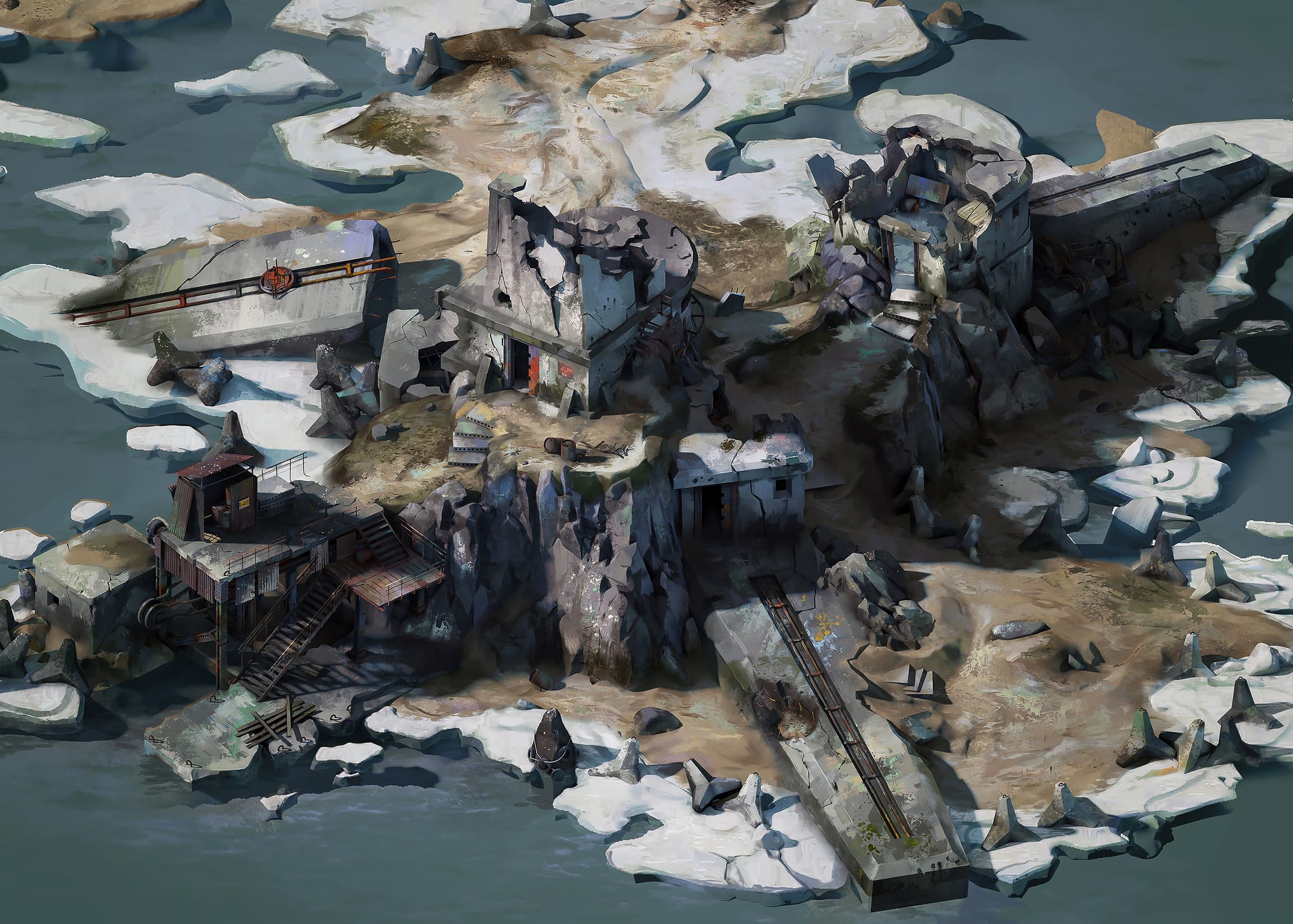
Like the music, much of the world of Disco Elysium redirects to Harry’s interiority. Occupied Revachol is as much an externalization of Harry’s inland empire of self as it is the world which acts upon him. Yet, while Harry reclaims some ability to self-actualize over the course of his story, Revachol is a static backdrop. If Harry internalizes the Kingdom of Conscience thought, he’s greeted with one of the game’s most excoriating quotes, which reads in part:
Centrism isn't change -- not even incremental change. It is control. Over yourself and the world. Exercise it. Look up at the sky, at the dark shapes of Coalition airships hanging there. Ask yourself: is there something sinister in moralism? And then answer: no. God is in his heaven. Everything is normal on Earth.
Adopting the other political alignments — communism, ultraliberalism, and fascism — produces tongue-in-cheek quotes which are satirical in their glibness. “You can’t make an omelette without breaking a few million eggs!” declares your inner mind upon internalizing communist ideology, neatly summarizing the justifications for real purges and famines. On the other hand, the Kingdom of Conscience quote’s self-seriousness conveys an even deeper level of frustration with centrism’s preference to maintain the status quo[2]. The MoralIntern’s authority over Harry is suffused throughout the story; occupier of his homeland, employer by proxy. The Revachol Citizen’s Militia from which he derives purpose exists only by the MoralIntern’s good graces. True to form, none of this can be changed throughout the plot. It serves as the basis for the melancholia of Revachol as a setting, a once-great city laid low, eulogized by songs like “Instrument of Surrender.” By finally doing his damn job, Harry becomes dynamic against the world’s stasis, and against his own. Disco Elysium does not yearn for the dictatorship of the proletariat. Yet, there is a sense of loss for a fictional world which predates the bombed-out one players are greeted with — both the exterior world and Harry’s interior world. Because the storytelling is intensely focused on the latter, it naturally produces space for the player’s introspection into their own interior lives. It was this invitation to consider what felt stuck or missing in my own life that provoked a powerful emotional reaction within me.
If "Instrument of Surrender" is about a moment of complete collapse, “Detective Arriving on the Scene” is its mirrored twin. It more resolutely delivers the optimism which previously was only tentative. It plays at the same location, the Rue de Saint-Ghislaine, but in the evening. The player is therefore likely to hear it for the first time at the end of their first day piloting Harry around. Among the many embarrassments of that first day, they also will have made some small progress that feels like the beginning of lifting a titanic weight, and the song’s interpretation of motifs introduced by “Instrument of Surrender” reflects this. It features the same viola melody, again at 2:00, but the cornet is triumphant. The track title comes from one of the final conversations in the game: Harry’s encounter with the Insulindian Phasmid, a manifestation of hope and wonder, during the culminating moment of his own redemption. Recontextualizing the melodies of “Instrument of Surrender” offers an early glimmer of something more nuanced than uninterrupted melancholy. When I first heard “Detective Arriving on the Scene,” it meant I had broken through my previous stagnancy. It provided the propulsion necessary to eventually reach the Phasmid myself. This personal triumph would have meant less if not for the struggle which preceded it.
As these two songs are more than their initial melancholy, Disco Elysium is more than a sad game. When it was released, it felt like something novel in a world where the machinery of culture no longer itself creates culture, but follows, adapts, and reuses social media trends. This gave Disco Elysium the sharp edge necessary to wedge itself in the collective psyche such that we seem to be always returning to it, searching for meaning. “Capital has the ability to subsume all critiques into itself,” observes Joyce Messier, one of the narrative’s representations of the MoralIntern. “Even those who would critique capital end up reinforcing it instead.” There is an inherent irony that Kim’s bomber jacket, a symbol of a fictional revolution, is now productized in the real world. We admire what shines briefly on its own before being assimilated. Culture, like a coral reef, is composed of skeletons that hint at a different way of being. The subsequent dramatic departure of key figures from ZA/UM only adds to Disco Elysium’s mystique as the singular product of that era of the studio. Fraught though it was, ZA/UM momentarily stood against the static perpetual recycling of culture and produced something new and interesting enough that it is now emulated by other games hoping to capture some of its magic. It was a small rebellion, the way Harry dared to change and become better in an unchanging world.
There is a certain painful familiarity in recognizing all the flaws and missed opportunities of our world in a fictional one, but with that recognition comes catharsis. It’s not quite nostalgia, but the German word sehnsucht comes close: imagining an ideal life in an imperfect world. It took me five years to roll Disco Elysium’s end credits after many attempts, and only thanks to my wife co-playing with me. The game enraptured me, but the feeling of playing was that of having my own faults and insecurities dug out from my guts and shown to me. When my friends joked that Disco Elysium was so uniquely me-coded that there was no way I couldn’t have played it, they touched on a truth so true it was paralytic. Like Revachol, like Harry, like “Instrument of Surrender,” I became stuck, unable to traverse the Rue de Saint-Ghislaine and move the plot forward. The experience of playing alongside another person was like swimming where before I had sunk. Adapting to my wife’s approach to play diverted my inclination to spin out in the face of the game’s grandiosity. Mikee Goodman’s Ancient Reptilian Brain had us crying tears of laughter by the time Harry was re-entering consciousness, and together we guided his hungover body through the Whirling-in-Rags, out the door, and beyond.
I’ve completed Disco Elysium once, and as impactful as it was I have no desire to play through it again. However, I now listen to its soundtrack regularly. When I listen to Disco Elysium’s music, I am prodding a psychic bruise experimentally, to see what memories fall out from that liminal space that banishes sleep at 3 a.m. Times and places that cannot be revisited, alternate paths that cannot be walked. Loading a minivan with film cameras and driving into the snowy Michigan night to photograph stars and gun stores. Throwing a book across my room in frustration while a concerned friend checked on me, as I knew I was going to fail all my classes and move home while everyone else started their post-college lives in Chicago. Planning a move to Europe that was doomed to be waylaid by the pandemic. Happenstance medical tests which uncovered a life-changing diagnosis. I cope by losing myself in media and while Disco Elysium wasn’t one of those anaesthetics, when I look into its world and hear its music I can see my face beneath the surface of brackish water lapping against Revacholian docks, fighting to stay afloat. The surrender in “Instrument of Surrender” is also mine. I also feel the hope that allows me to persevere.
This admittedly embarrasses me. I am embarrassed that I look upon these times with a masochistic self-indulgence. I am embarrassed that, fifteen years after being transformed by Kieron Gillen’s “The New Games Journalism,” I still default to the prism of myself as the lens for critically analyzing a game, as if there should be an as-yet unobtained way of thinking unique to me. I am embarrassed by the visceral swell of my own emotions, but cannot help that the music of Disco Elysium has wedged itself into a spot in my brain that feels built to house it. In “The New Games Journalism, Same As The Old Games Journalism,” Gita Jackson reflects on games as “emotional experiences that radiate outward into the rest of my life.” (They also mention their “inherent dislike of personal essays about Disco Elysium” which I think is very funny and very fair.) Through its music, I return to my own emotional experience of Disco Elysium again and again, seeking comfort in the familiarity of Harry’s pain — and in turn my own. There is an existential pain in knowing we are fated to live an imperfect existence, and that there will be mistakes that cannot be undone. It is this impossibility that we long for in sehnsucht. Disco Elysium will let you quickload and reroll until you pass every check, but all of Harry’s worst mistakes have already been committed by the time you meet him.
Sehnsucht or not, I would not trade this life for anything, mistakes and all, because now I have a child that has crystallized this life’s meaning. Some mornings I put on a Sea Power song for us — sometimes “Instrument of Surrender,” sometimes something else — and let a deep appreciation for an imperfect life, lived nevertheless, surge over me.
You press play and let the music wash over you. A mental surfactant, it gently abrades and carries away the rougher edges of your present consciousness. You watch your daughter twist and spin along with the opening tones. You already miss this moment in anticipation of its passing, and all the future moments in anticipation of their arrival. What thoughts and feelings will she have when she is as old as you are now? What will capture her, the way this song does to you? You leave the song behind as you step outside together, now alone but for birdsong. Look up at the blue sky. It is already hot in this city, too hot to sustain a Revacholian drizzle. This is a land of thunderstorms, sudden and torrential. Her tiny hand holds tight to yours. She needs you (for now). You can keep her on this earth. Be vigilant. You love her. She makes everything worth it.
Timestamps throughout will correspond to the official Disco Elysium soundtrack release. ↩︎
I cannot help but see how Estonia’s place in the post-Soviet regime has influenced Disco Elysium’s perspective. It has the advantage of distance from Soviet hegemony which it does not have from the largest centrist influence on Estonian self-determination, the European Union. ↩︎