This article contains spoilers for Final Fantasy XVI.
In the lead up to Final Fantasy XVI’s release back in 2023, producer Naoki Yoshida said the following about the game’s perceived lack of ethnic diversity in an interview with IGN:
Ultimately, we felt that while incorporating ethnic diversity into Valisthea was important, an over-incorporation into this single corner of a much larger world could end up causing a violation of those narrative boundaries we originally set for ourselves. The story we are telling is fantasy, yes, but it is also rooted in reality.
This quote hung over the game like a curse in the months before it released. It’s been talked about to death, caused a small boycott movement, and the phrase "rooted in reality" is still a sore spot for many fans, myself included. A large part of this outrage emerged because it brought attention to race in a way that Final Fantasy never had before. While there have been a large number of iconic (as well as less memorable) POC in the franchise including Barrett, Sazh, Kiros, and Leo, race has never been a driving force behind those characters’ stories.
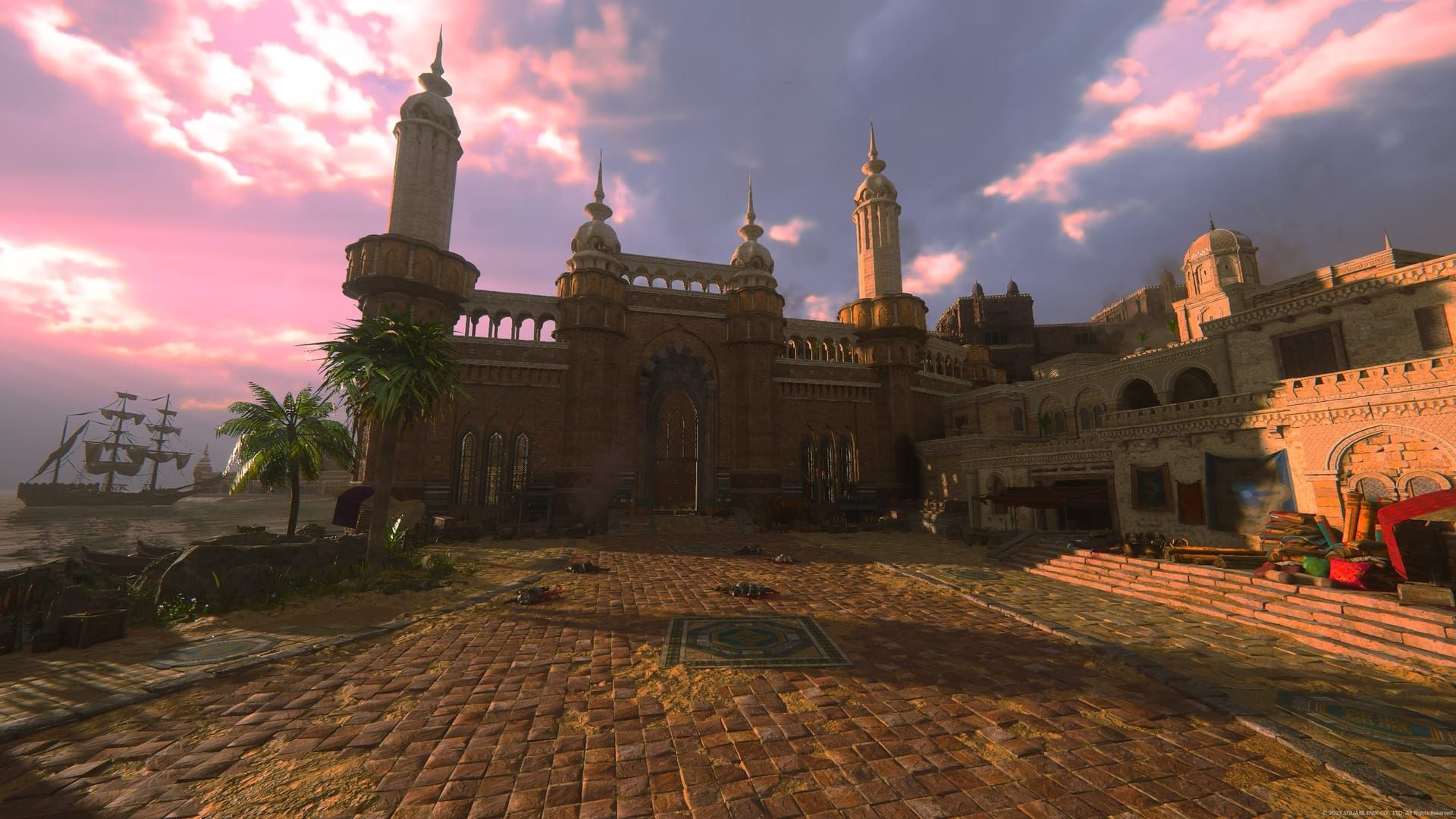
Despite the conversation around race in Final Fantasy XVI and the anger towards Yoshida’s comments, once the game did release, very little (but not nothing) was said about its Middle East and North African (referred to as MENA from here onwards)-inspired nation of Dhalmekia. Admittedly, in the infamous interview Dhalmekia isn’t part of the conversation around diversity, nor is it even mentioned at all, which is understandable since the article was published seven months prior to the game’s release. However, Dhalmekia’s appearance in the final game is notable in the context of Yoshida’s 2022 quote. It possesses a striking Arabic aesthetic that lifts architectural elements like domes and patterns from medieval mosques such as the Sultan Hassan Mosque in Cairo and the Mosque-Cathedral of Cordoba, but the country itself lacks a cultural backbone, standing in contrast to other countries of Final Fantasy XVI’s setting of Valisthea, which have cultural identities rooted in connection to the history of medieval Europe, like Sanbreque. This leaves Dhalmekia’s people in stasis — with no customs, no rituals, and no way to set themselves apart from anyone else besides their skin color — a cultural void that is further emphasized by its contrast with Final Fantasy XII’s Dalmasca and the Motes of Water civilization introduced in Final Fantasy XVI’s Rising Tides DLC.
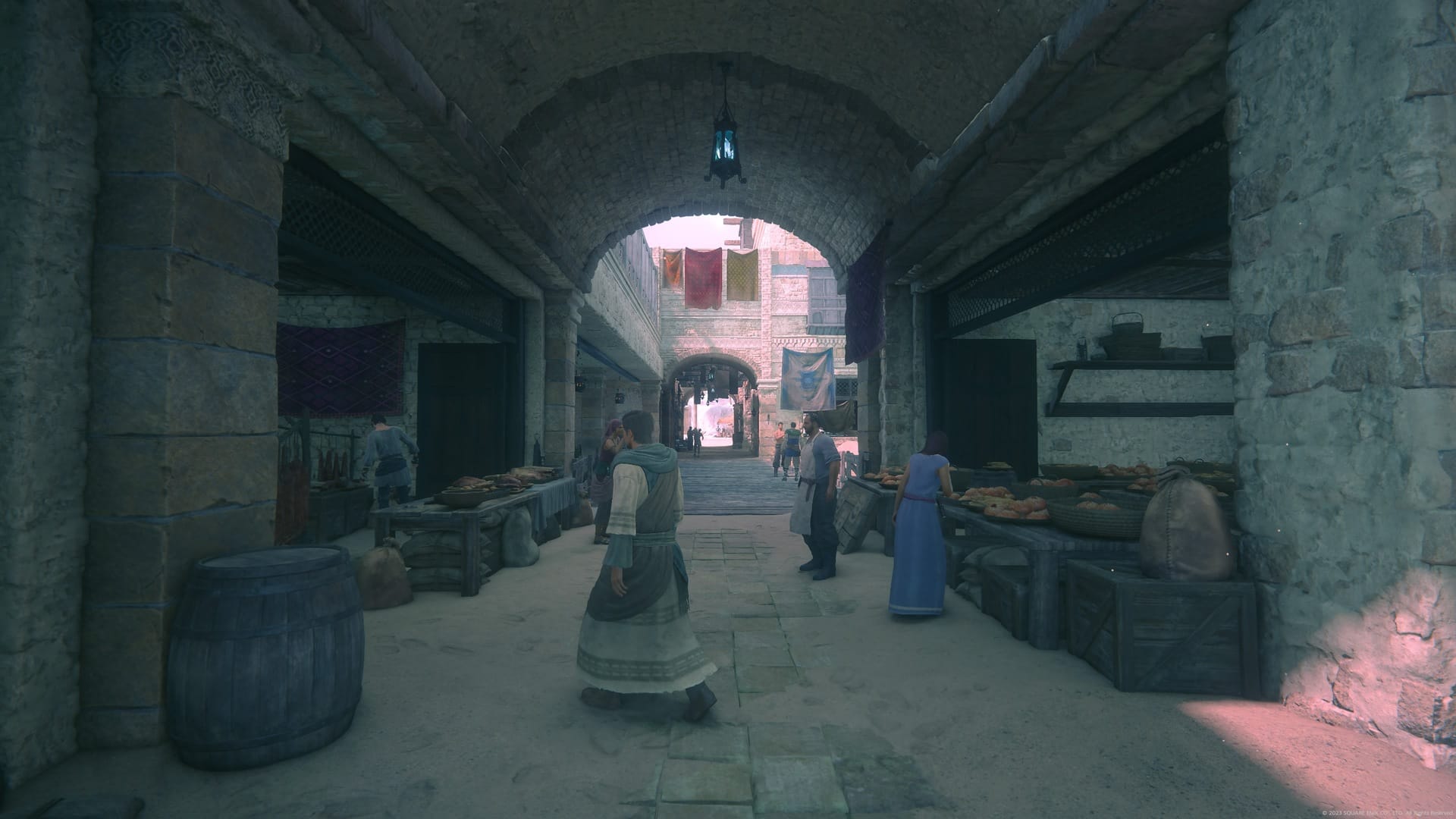
The problem is that Dhalmekia — the only non-white nation in the base game — is all surface, no substance. It is a desert nation of craftspeople whose wealth comes from trading artisan goods across Valisthea. Much in the tradition of fantasy games, each of its towns has its own specialty goods or services: Tabor has its tanneries, Dravozd features an entire questline about its smithing, and Dalimil’s main attraction is its hot springs, which are surrounded by shops, including a carpet shop, a shisha stall, stores that sells herbs and spices, a brass ornament shop, and a bakery. For the latter, the variety tells a visual story about how the town has grown due to the captive audience of travelers enjoying the hot springs and a populace who make the most of the opportunities they get. While various objects and accoutrements on display add visual flavor, this flavor never extends to the people that occupy the country.
The shallowness of Dhalmekia’s cultural makeup is also reflected in its characters’ costuming and voices. There are some male non-player characters who wear turbans, as well as female NPCs who cover their hair as if they’re wearing a hijab. Upon further inspection, the turbans aren’t accurate to real MENA styles and the women are just wearing hoods. Furthermore, people are generally overdressed for the desert. They wear western waistcoats, sleeveless shirts as underlayers, togas, and heavy robes that don’t function in a desert environment like the airy galabeyas or thawbs of real MENA countries. Dhalmekian residents also have inconsistent accents, which stands out in contrast to an example like protagonist Clive’s home country of Rosaria, where he and his family speak in a more refined “Queen’s English” that stands in contrast to the more rural English accents used by characters from the lower classes. While other nations feature vocabulary or nomenclature drawn from languages like Welsh in the Iron Kingdom, Norse in Waloed, and French in Sanbreque, there isn’t a single Arabic word spoken or used as a name in Dhalmekia. Instead, the country uses names with Slavic, Germanic and English inspirations like Dravozd, Hugo and Blackthorne respectively, which highlights the lack of cultural cohesion further.
There is one way that Dhalmekia does reference Islamic customs and history: it’s the only nation that doesn’t have a monarchy or a state religion, and uniquely allows religious freedom. In his book The Silk Roads, Peter Frankopan states that “cohabitation of the faiths was an important hallmark of Islamic expansion — and an important part of its success” (2016, 87). Islam was able to flourish because Muslim leaders found common ground with the other Abrahamic faiths and used it as a basis for mutual respect and cooperation both politically and economically before and during the Middle Ages. Where Final Fantasy XVI diverges from real-world history is that despite the region’s religious freedom, there is no in-world equivalent to Islam or any religion at all in Dhalmekia, nor are there any religious people from other nations represented. The aesthetics of Islam are taken and turned into a cultureless facsimile, as nothing is used to fill the gap the absence of religious belief leaves in the nation’s cultural makeup.
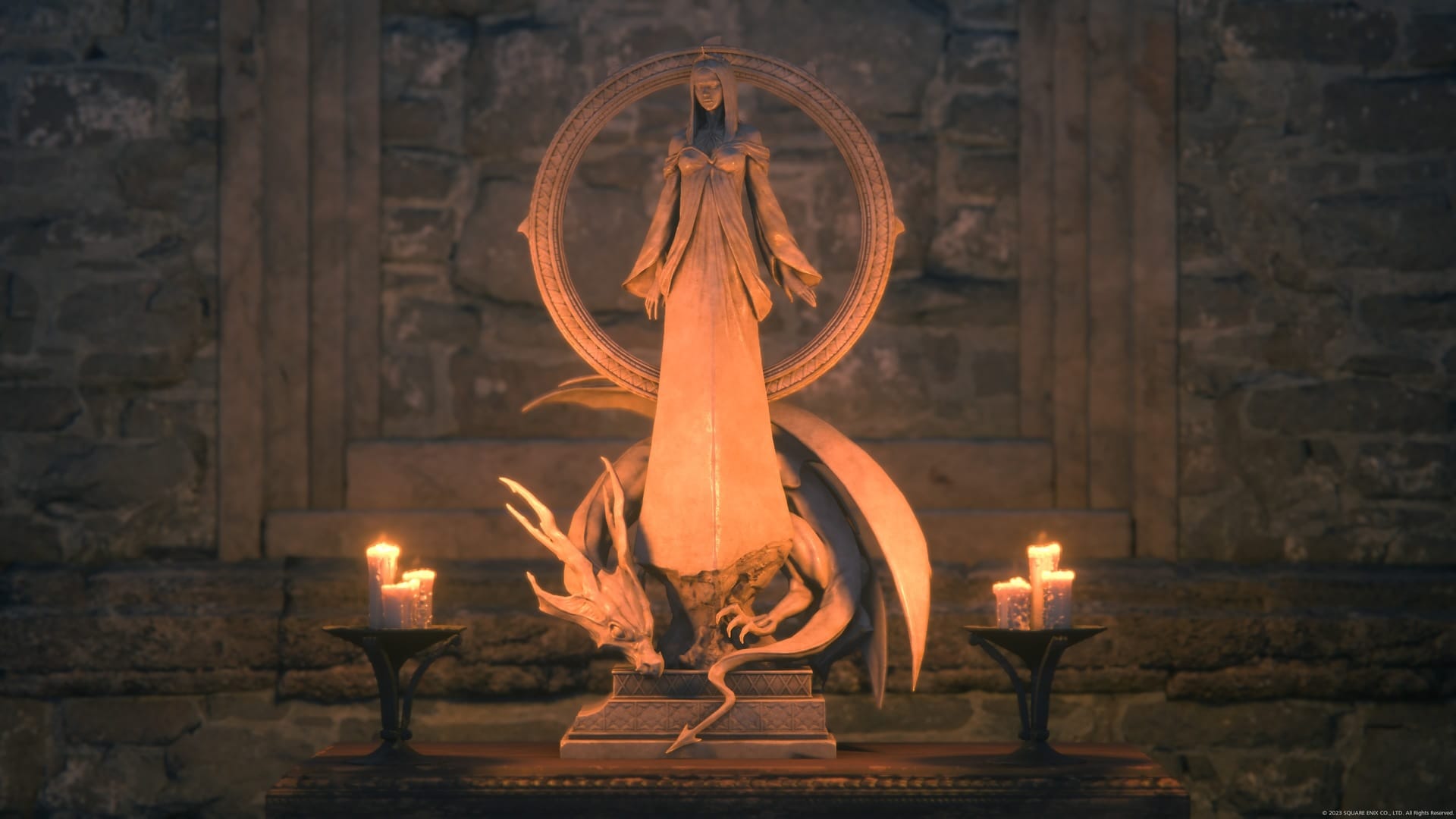
The shallowness of Dhalmekia’s worldbuilding has an obvious foil in France-inspired Sanbreque, which takes a Christian-coded aesthetic, ties it to its imperial expansionism, and makes it a core part of the empire’s identity. The nation’s French inspiration is reflected in the names of its people — Dion, Philippe, and Olivier, for instance — and the name of the country’s citizens is rendered as “Sanbrequois,” which has a parallel in terms like Quebecois and Bruxellois. The empire is a theocracy, run by an emperor whose decisions are informed by a council of high priests and diviners who read the stars for guidance on future courses of action. Everything Sanbreque does is in the name of the goddess Greagor and its infrastructure reflects that. Greagorism’s main motif is the dragon, a creature seen as the servant of the eponymous goddess and the closest thing in the world to divinity. This is a reflection of how the many native dragon species in the empire’s heartland that are encounterable in the overworld have been baked into its culture. The Sanbrequois Eikon is Bahamut, a massive dragon, and the highest ranked knights are dragoons whose armor and fighting style are inspired by “Greagorian scripture” and whose “status as knights of the sacred dragon affords them … higher standing in the eyes of the people” according to the in-game lore bible. The core of Sanbreque’s Mothercrystal — a mountain-sized crystalline deposit mined for smaller crystals that give people the ability to use magic — is guarded by a dragon and encased in a church that features gargoyles styled after dragons. The national flower of Sabreque is the Wyvern Tail, which is part of the emperor’s costume and worn close to his chest. The flower is also used across Valisthea to embed a poison in the brands of enslaved Bearers so they can’t be removed. Sanbreque’s cultural identity is tied to the crystals and the Bearer slave trade through its religion, thereby normalizing it in the eyes of the people. Still, Greagorism isn’t portrayed entirely negatively. Some characters like Quentin in Lostwing are Greagorists, but use their beliefs to fight for Bearers’ freedom. Sanbreque stands in contrast to Dhalmekia due to the cohesion inherent in its worldbuilding. Small visual details intertwine with the story and add up to create a greater whole, whereas Dhalmekia’s art, architecture, objects, and costuming of its people feel slapdash by comparison, and have no grounding in cultural touchstones like religion.
The cultural void of Dhalmekia goes further, branching into a lack of meaningful content. Most side quests in the region involve Clive going out of his way to ensure that the craftspeople get the materials they need or finding the causes of disrupted trade routes, then devising a way to fix them. The vast majority of these quests play out very generically, with a pat on the back and a reward for completion, but result in no real change for the characters or new discoveries about the world for the player. On the other hand, Sanbreque’s quests not only build the image of the empire, but also show the player how the world works in practice. Structurally, they’re the same fetch quests as the ones in Dhalmekia, but they involve Clive more directly. The quest “Playthings” sees Clive looking for “Chloe” — an individual a little girl talks about as though she were a pet, but turns out to be a Bearer who has been neglected and worked to death. The girl then reveals she is one of many Chloes, and will be quickly replaced. All the while, Clive’s own brand provokes the disgust of the Sanbrequois people he talks to, giving the player a taste of a Bearer’s perspective.
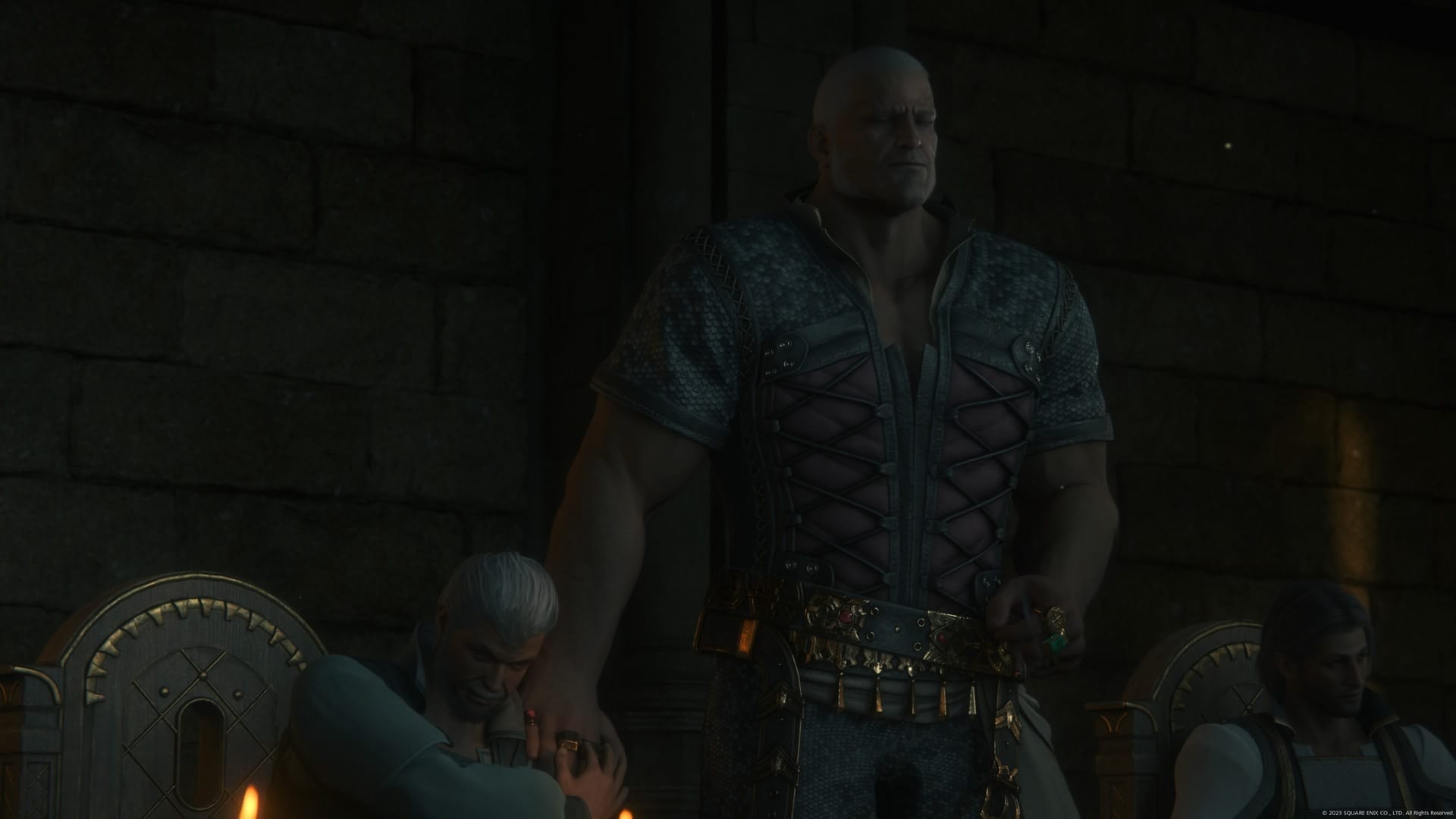
Furthermore, Dhalmekia’s position as a bastion for religious freedom and politics likewise untethered from religion could be grounds for a country that functions differently to the others in Valisthea, but the political narrative associated with the nation is hamstrung by the superficial characterization of the country’s Dominant Hugo Kupka. As Dhalmekia’s Dominant, he stands as a synecdoche for the country as a whole. Localization lead Michael-Christopher Koji Fox detailed this writing approach in a 2022 interview published on the official Playstation blog:
Dominants are living, breathing human beings, how they are employed by their respective nations becomes a fairly accurate reflection of how those nations treat their own populace. A nation that treats its Dominant like a pawn, most likely also sees its people as pawns, to be sacrificed in order to save the more important pieces. A nation that fears its Dominant is one that is likely to lash out against all magic users (Dominants and Bearers), whereas a nation that reveres its Dominant is more likely to view its people as equals.
Unfortunately, this philosophy doesn’t hold when applied to Dhalmekia. Like other Dominants in the game, Hugo possesses immense power tied to the region’s Eikon — Titan, the Warden of Earth — which he wields recklessly. In fairness, the game’s introduction of Hugo is surprisingly effective. The country is run by a parliament of five heads of smaller city states, but Hugo, who is referred to as a “permanent economic advisor,” cripples their ability to govern. After the parliament’s negotiations for reinforcements from Waloed for military assistance go nowhere, he acts out, pushing one of Dhalmekia’s leaders down, ending the conversation early and leaving to use Titan to take matters into his own hands. In the course of a couple of minutes you understand the inefficiency of the country’s leadership and how Hugo exploits it to make the leaders look worse, thereby increasing his own influence on them and the country at large.
This promising character introduction does not amount to anything, as Hugo’s characterization in the rest of the game notably lacks depth and his actions don’t have consequences for the Dhalmekian people. Hugo is presented as overconfident, short-fused and selfish, but as his story plays out, you find that there isn’t a lot behind those emotions. After his introduction, Clive kills Hugo’s lover, sending him into a revenge-fueled frenzy with deadly consequences. As the plot unfolds, Hugo eventually devolves into a big, dumb, moustache-twirling brute who kidnaps Jill (a party member and Clive’s love interest) and performs the medieval equivalent of tying a damsel in distress to train tracks by staging an elaborate execution for her on a big chopping block. Hugo’s devolution from a cunning manipulator to a monster of the week is thus emblematic of his, and by extension Dhalmekia’s, lack of an ideological counterpoint to Clive.
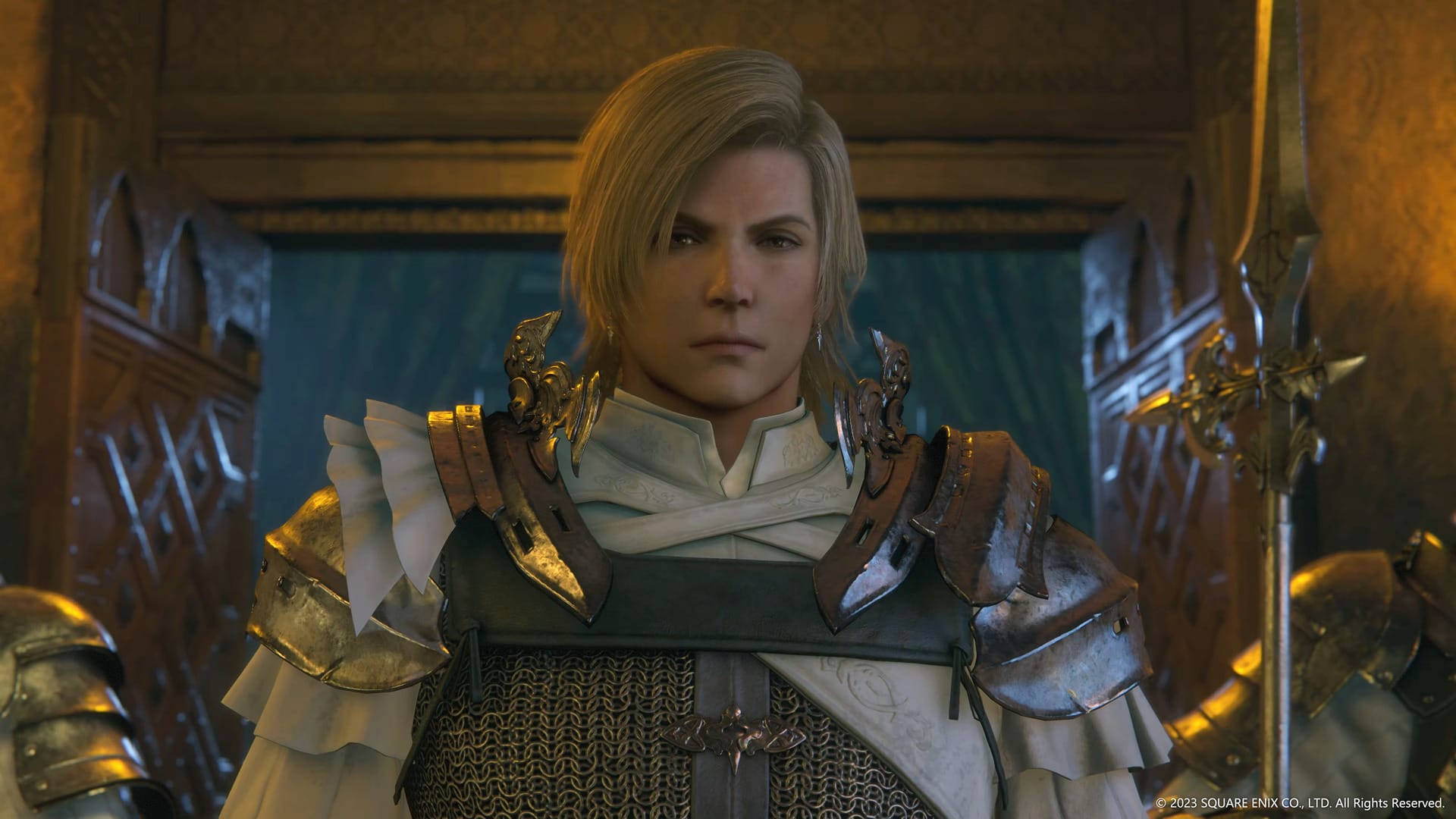
Hugo’s lack of depth further stands out in comparison to Sanbreque’s much more developed Dominant Dion Lesage. The two sides of Sanbreque collide within the mind of prince Dion. He is loved and trusted by the people of the empire for his leadership of the dragoons, his honor and his empathy. However, much like Sanbreque’s Bearers, he is seen as a tool by the ruling class who is to be used to maintain his country’s rotten foundations. Ultimately, the tension between the expectations of his family and those of the people breaks him, he loses control of Bahamut and the empire is undone by the dragon that once upheld its tyranny. Dion’s rampage as Bahamut is both tragically preventable, yet arguably cathartic. Throughout the game, you watch him hold in his frustration toward his family until he can’t anymore and tears it all down. Even after he regains his senses, he takes accountability for his actions and strives to redeem himself. On the other hand, Hugo rampages as Titan from the very beginning, so his lowest point doesn’t feel different from his highest. Nothing new is revealed about the character with his later appearances and his death feels meaningless for both Dhalmekia and the world at large.
What makes Dhalmekia’s shortcomings all the more frustrating is that there have been examples of MENA-inspired nations done right in other games in the Final Fantasy series. The first MENA-coded nation in the franchise to have a bit more meat on its bones is Final Fantasy XII’s Dalmasca, in which a large portion of that game takes place. While most Dalmascans, including most of the party, are white (or at least white-passing), the game goes to great lengths to show how Dalmascan culture is suppressed by imperialism in its opening hours. Rabanastre is a big, bustling, and rich metropolis with the same Islamic inspirations for its art and architecture as Dhalmekia’s cities, but it merges its inspirations with fantastical technology to make it feel both familiar and otherworldly. The beginning of the game makes it clear that Dalamascans are second-class citizens in their own country due to their imperial occupiers. This manifests in a variety of ways: Western-inspired imperial heraldry covers Dalmascan architecture, old shops are given light-up signs and streets have big, black street lamps that stick out against the sandstone like sore thumbs. The most prominent and noticeable effect of the empire is how soldiers block off areas to stop the passage of commoners during the state visit by imperial consul (and eventual main antagonist) Vayne.
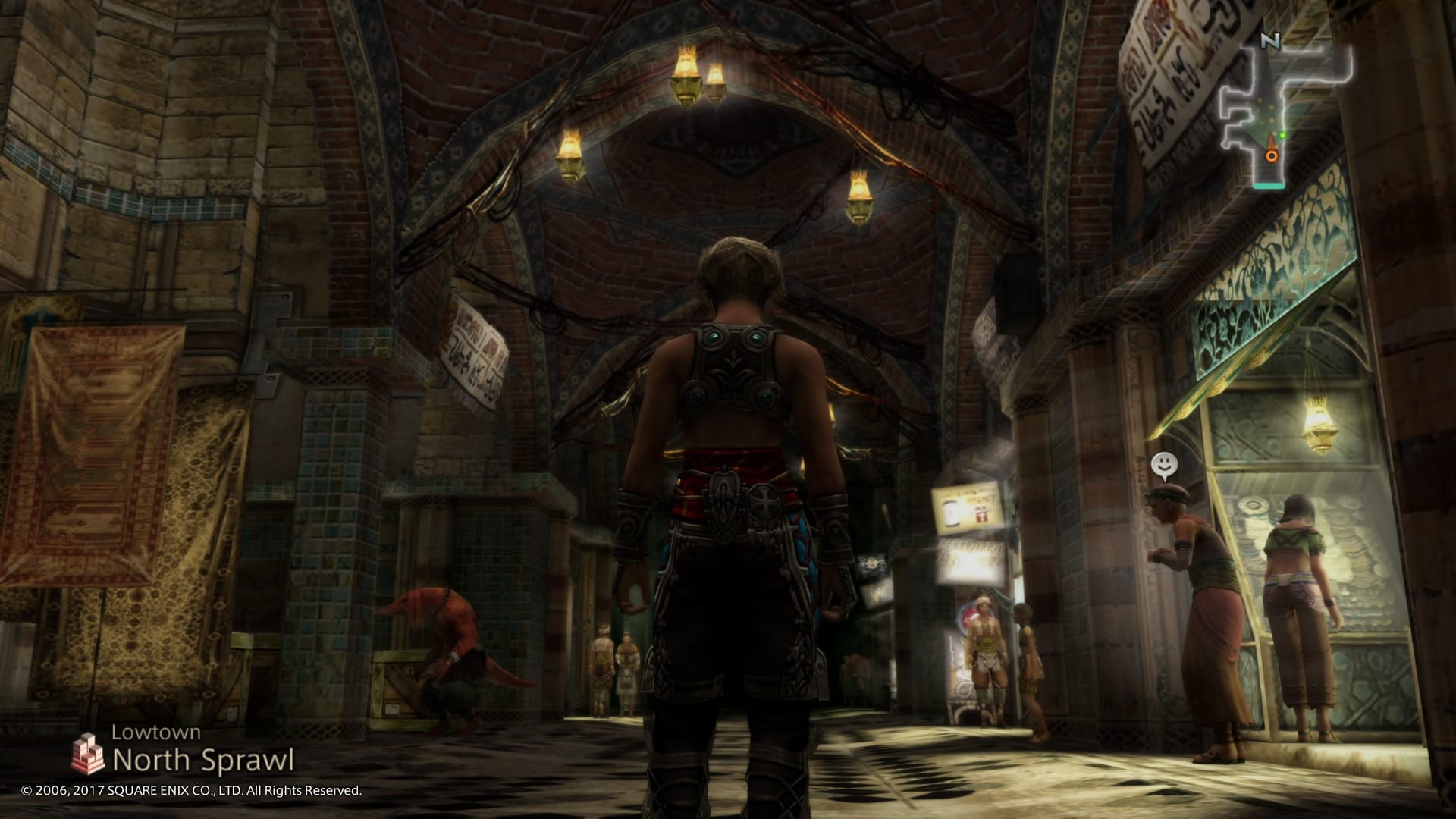
The most locked off area is Lowtown, an undercity where the poorest and coincidentally darker-skinned Dalmascans live. Once the state visit ends, you’re given access to Lowtown and you finally get to see the “real” Dalmasca. Everyone seems to know each other, shops are bespoke and sell what people actually need (as opposed to weapons and armor for the player), old ventilation systems are clearly maintained by the people, and the signage is hand-painted. There’s even a little kebab shop. It’s not an unfamiliar setting, but the diversity of residents and the fantastical design of Lowtown as a place that revolves around the city’s waterways makes it feel like a distinct location in another world. Like Dhalmekia, the country doesn’t feature any Arabic text or an in-universe equivalent, but because the game goes to such lengths to distinguish Dalmasca as a place with its own way of life (and on a broader note, because the world of Ivalice is so well-realized), it doesn’t need to. It places the people first, and takes aspects of real MENA community culture to create something new.
Additionally, Final Fantasy XVI itself features a nation with non-white inhabitants that takes the more involved approach to worldbuilding in the vein of Dalmasca — just not in the base game. Nearly a year after Final Fantasy XVI’s release, the Rising Tide DLC introduced the Motes of Water, a nation of darker-skinned people with a history and culture tied to the Eikon Leviathan and a nomadic way of life forced upon them by their oppression at the empire’s hands. The time you spend in Mysidia, the Motes’ home, almost feels like an apology for Dhalmekia and the claims made in Yoshida’s 2022 interview. The people are more fully formed and they have customs and rituals that Clive actively takes part in. The Rising Tide also takes Leviathan’s Hebrew roots and molds a Jewish-inspired culture around it. This can be seen in the Motes’ exile from the Valisthean heartland, their subjugation, and even their names, such as Shula (derived from Shulamith).
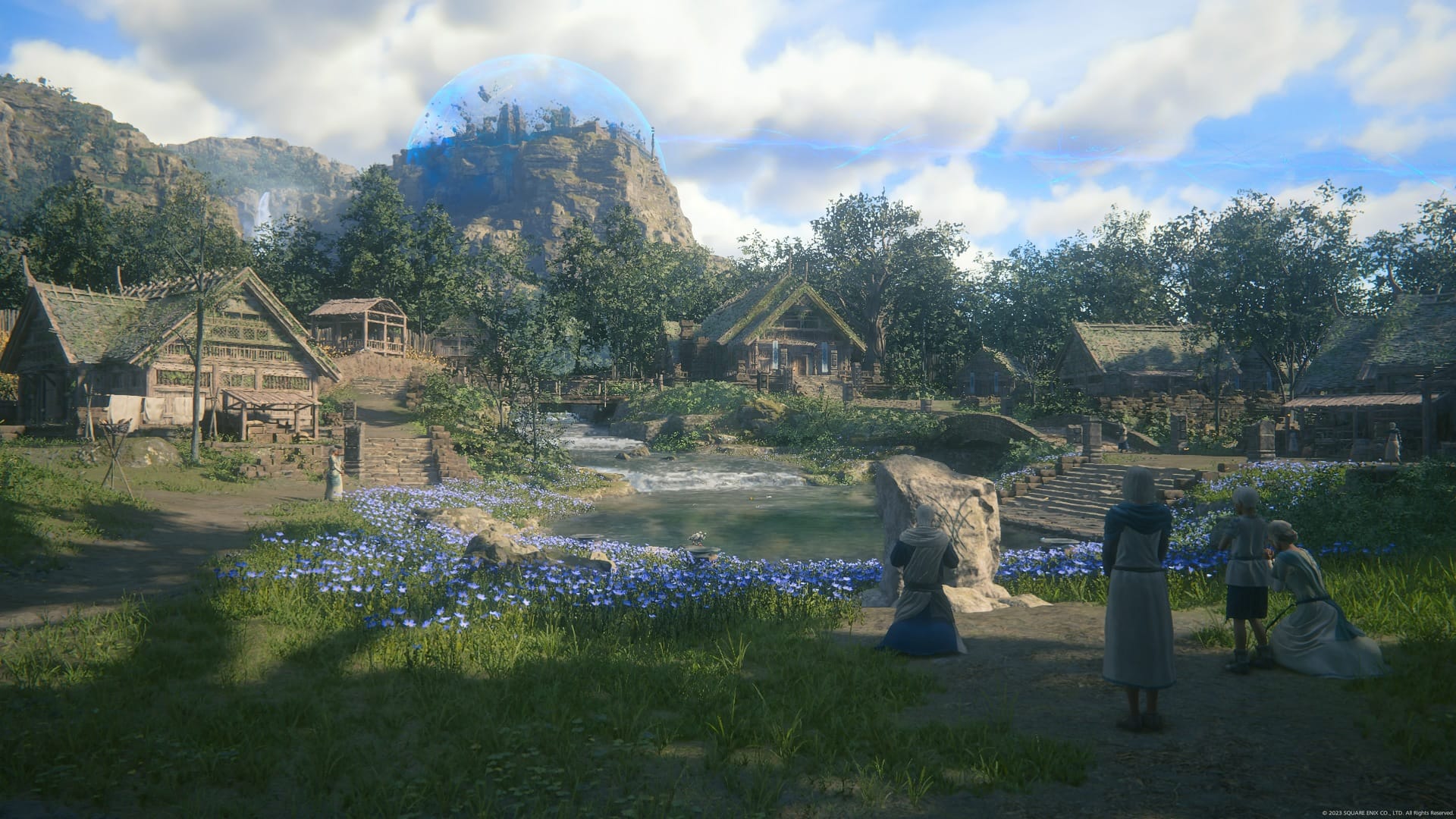
The adaptation of Christian and Jewish aesthetics, mythology, and history into Valisthea makes the Islamic cultural void in Dhalmekia all the more glaring. If the Dhalmekians were afforded the space to have a culture like the Motes of Water, Valisthea would have felt much more like a living, breathing world where each nation has a defined role in the political ecosystem. The Motes are part of additional content that is unimportant to the main story, but their inclusion subverts expectations because their culture doesn’t exist to uphold Valisthea’s status quo. This makes the world feel more diverse not only racially, but ideologically. Dhalmekia on the other hand falls flat due to its lack of consideration for the MENA cultures and history it draws from. Dhalmekia could have easily taken inspiration from the Mamluks, whom Frankopan describes as “largely descendants of slaves … traded through the ports of the Crimea and the Caucasus to serve in the Egyptian military” and eventually came to rule Egypt during the Middle Ages (The Silk Roads, 2016, 168). A country ruled by formerly enslaved Bearers or their descendants that still benefits from the oppressive systems of the rest of Valisthea could have been a way to add more perspectives to the world and more depth to the nation’s characters.
Instead, Dhalmekia’s people have no flavor, its Dominant has no depth, and it can’t find its place in Valisthea because it has been recast to function more as a familiar-but-indistinct action set piece to break the monotony of European-inspired landscapes than a fully-formed nation rooted in the same reality as the others. Final Fantasy XII’s Dalmasca laid the foundation for a MENA-inspired country that could build its own culture by intertwining aesthetic inspirations with environmental design and NPC interactions. Using those foundations, it shows how imperialism suppresses community through gameplay restrictions. Not only does Dhalmekia fail to build on these foundations, but it also fails to match the depth of its neighbors. Sanbreque’s theocratic imperialism is a pillar of Valisthea’s systems of oppression, but Dhalmekia is merely a proponent of those systems rather than a participant. Now that Mysidia has removed Dhalmekia’s status as the game’s only non-white nation and provided Valisthea with a culture that broadens Final Fantasy XVI’s world, Dhalmekia has nothing left to distinguish itself but its mishmashed architecture, its unsmoked shishas, and its vast, empty desert.